Durango in La Plata County, Colorado — The American Mountains (Southwest)
The American Dream
Photographed by Cosmos Mariner, July 14, 2025
1. The American Dream Marker
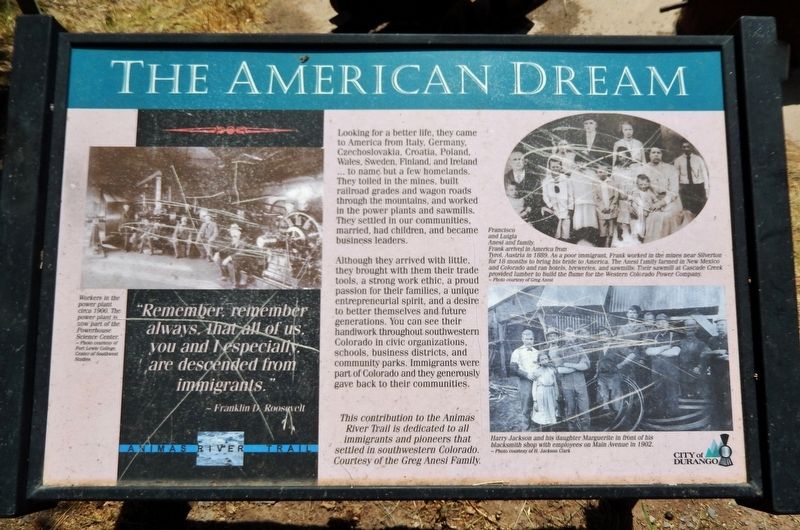
“Remember, remember always, that all of us, you and I especially, are descended from immigrants.”
—Franklin D. Roosevelt
Looking for a better life, they came to America from Italy, Germany, Czechoslovakia, Croatia, Poland, Wales, Sweden, Finland and Ireland — to name but a few homelands. They toiled in the mines. built railroad grades and wagon roads through the mountains, and worked in the power plants and sawmills. They settled in our communities, married, had children, and became business leaders.
Although they arrived with little, they brought with them their trade tools, a strong work ethic, a proud passion for their families, a unique entrepreneurial spirit, and a desire to better themselves and future generations. You can see their handiwork throughout southwestern Colorado in civic organizations, schools, business districts, and community parks. Immigrants were part of Colorado and they generously gave back to their communities.
[photo captions]
• Workers in the power plant circa 1900. The power plant is now part of the Powerhouse Science Center.
• Francisco and Luigia Anesi and family. Frank arrived in America
this page online
• Harry Jackson and his daughter Marguerite in front of his blacksmith shop with employees on Main Avenue in 1902.
This contribution to the Animas River Trail is dedicated to all immigrants and pioneers that settled in southwestern Colorado. Courtesy of the Greg Anesi Family.
Erected by City of Durango.
Topics. This historical marker is listed in these topic lists: Immigration • Industry & Commerce • Settlements & Settlers.
Location. 37° 16.648′ N, 107° 52.985′ W. Marker is in Durango, Colorado, in La Plata County. It can be reached from Roosa Avenue 0.1 miles north of Avenida Del Sol, on the right when traveling north. The marker is beside the Animas River Trail, near Schneider Skate Park. Touch for map. Marker is at or near this postal
Photographed by Cosmos Mariner, July 14, 2025
2. The American Dream Marker
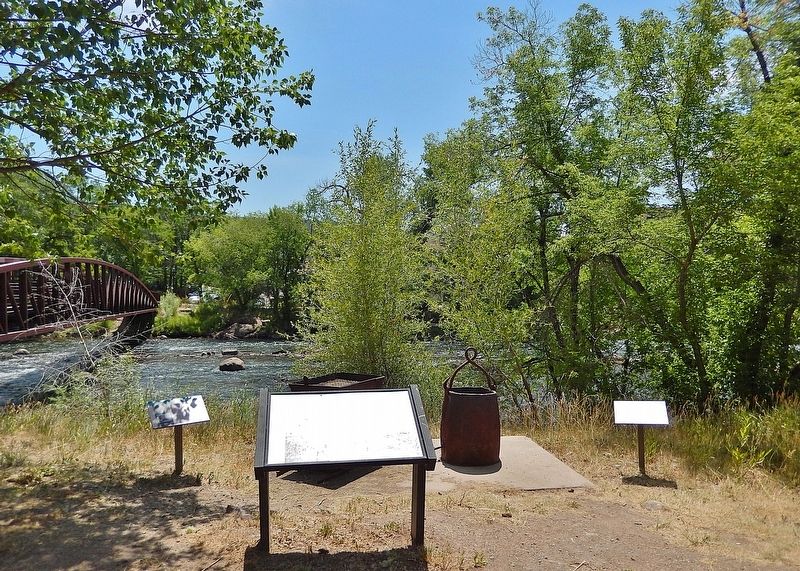
Looking east from the Animas River Trail, the Animas River is in the background.

Regionally, this marker is in the American Mountain West and at the Four Corners. Globally, it is in North America, the Rocky Mountains, the Western Hemisphere, the Western World, and the Anglosphere. Historically, it finds itself in what was once the territory of the Ancestral Puebloans.
Other nearby markers. At least 8 other markers are within walking distance of this marker: Swivel End-dump Car (here, next to this marker); Shaft “Can” Skip (here, next to this marker); The “Fancy” Ladies (about 300 feet away, measured in a direct line); La Plata County Vietnam Veteran Memorial (about 400 feet away); Stuart Allen Roosa (about 600 feet away); Electric Revolution (approx. 0.2 miles away); A Pleasant Summer Afternoon, circa 1885 (approx. 0.2 miles away); Early Durango circa 1889 (approx. ¼ mile away). Touch for a list and map of all markers in Durango.
Also see . . . City of Durango History (City of Durango).
Excerpt: The Denver and Rio Grande Railroad Company formed Durango along the banks of the Animas River in September 1880 to serve the San Juan mining district. Lots of silver (and later, even more of gold) was being discovered in the mountains ever since gold fever struck in 1872 and resulted in the settlement of mining towns like Silverton, 50 miles north.(Submitted on January 12, 2026, by Cosmos Mariner of Cape Canaveral, Florida.)
Within a year of its founding in 1880, Durango had a population of 2,400 and really began to grow. People arrived from many countries to work in the smelters and mines and on the railroad. By the turn of the century, Durango had become a vacation destination, with the creation of the San Juan National Forest in 1905 and Mesa Verde National Park in 1906. The population of the city of Durango doubled to 4,686 by 1910.
Credits. This page was last revised on February 18, 2026. It was originally submitted on January 9, 2026, by Cosmos Mariner of Cape Canaveral, Florida. This page has been viewed 185 times since then. Photos: 1, 2. submitted on January 12, 2026, by Cosmos Mariner of Cape Canaveral, Florida.
