
What Cheer in Keokuk County, Iowa — The American Midwest (Upper Plains)
What Cheer Freedom Rock Veterans Memorial
Honoring Keokuk County Veterans
| — | Ray “Bubba” Sorensen II | — |
Photographed by Cosmos Mariner, September 19, 2025
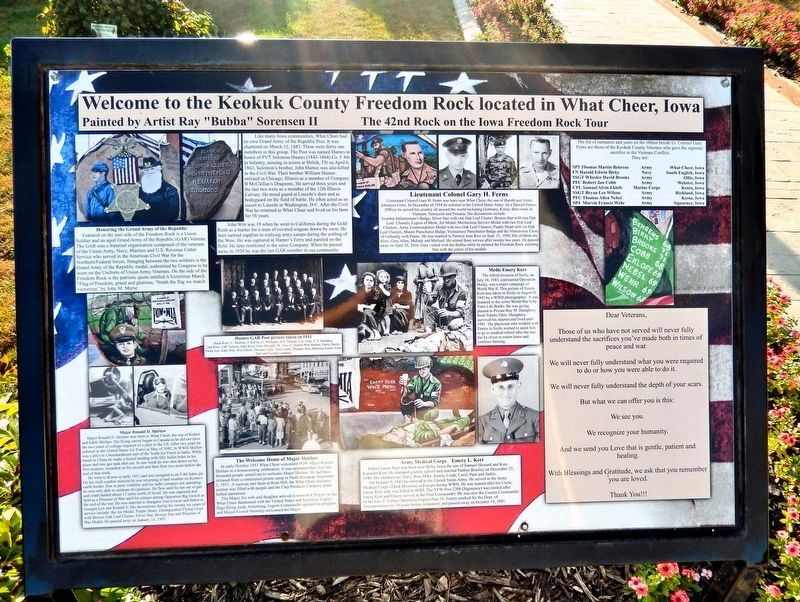
1. What Cheer Freedom Rock Marker (south/left panel)
Painted by Artist Ray “Bubba” Sorensen II
The 42nd Rock on the Iowa Freedom Rock Tour
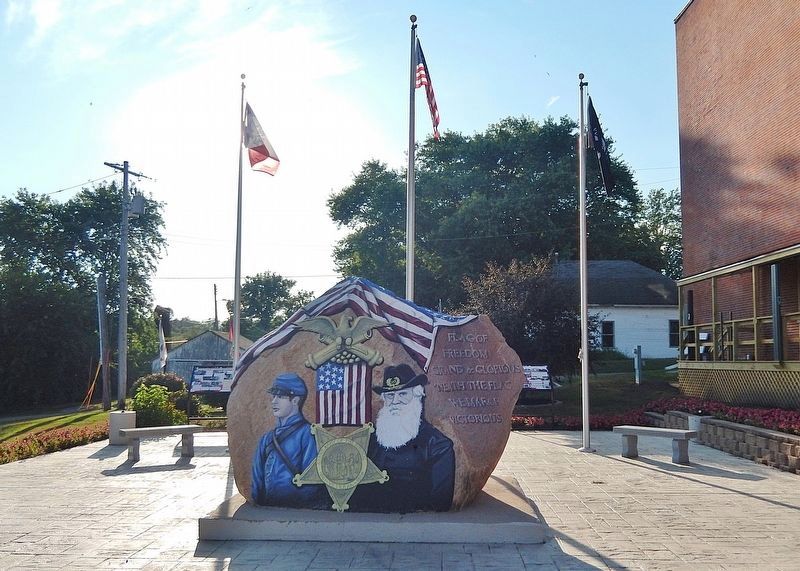
Honoring the Grand Army of the Republic
Featured on the east side of the Freedom Rock is a Union Soldier and an aged Grand Army of the Republic (GAR) Veteran. The GAR was a fraternal organization composed of the veterans of the Union Army, Navy, Marines and U.S. Revenue Cutter Service who served in the American Civil War for the Northern/Federal forces. Hanging between the two soldiers is the Grand Army of the Republic medal, authorized by Congress to be worn on the Uniform of Union Army Veterans. On the side of the Freedom Rock is the patriotic quote entitled A Victorious March. “Flag of Freedom, grand and glorious, `Neath the flag we march victorious” by John M. Morse.
Like many Iowa communities, What Cheer had its own Grand Army of the Republic Post. It was chartered on March 12, 1883. There were thirty one members in this group. The Post was named Humes in honor of PVT Solomon Humes (1843-1864) Co. F 8th IA Infantry, missing in action at Shiloh, TN on April 6, 1862.
this page online
John Will was 19 when he went to California during the Gold Rush as a hunter for a train of covered wagons drawn by oxen. He later carried supplies to outlying army camps during the settling of the West. He was captured at Harper's Ferry and paroled on the field. He later reenlisted in the same Company. When he passed away in 1934 he was the last GAR member in our community.
Major Ronald D. Shirlaw
Major Ronald D. Shirlaw was born in What Cheer, the son of Robert and Edith Shirlaw. His flying career began in Canada as he did not have the two years of college required of a pilot in the US. After two years he enlisted in the United States Air Force in May of 1942. In WWII Shirlaw

Photographed by Cosmos Mariner, September 19, 2025
2. What Cheer Freedom Rock Marker (north/right panel)
The Welcome Home of Major Shirlaw In early October 1953
What Cheer welcomed POW Major

Photographed by Cosmos Mariner, September 19, 2025
3. What Cheer Freedom Rock (east side)
Honoring the Grand Army of the Republic
Lieutenant Colonel Gary H. Ferns
Lieutenant Colonel Gary H. Ferns was born near What Cheer, the son of Harold and Verna Johannes Ferns. In December of 1954 he enlisted in the United States Army. As a Special Forces Officer be served his country all around the world including Germany, Korea, three tours in Vietnam, Venezuela and Panama. His decorations include: Combat Infantryman's Badge, Silver Star with one Oak Leaf Cluster, Bronze Star with two Oak Leaf Clusters, Legion of Merit, Air Medal, Meritorious Service Medal with two Oak Leaf Clusters,

Photographed by Cosmos Mariner, September 19, 2025
4. What Cheer Freedom Rock (northeast)
A Victorious March. “Flag of Freedom, grand and glorious, `Neath the flag we march victorious” by John M. Morse.
Medic Emery Kerr
The Allied invasion of Sicily, on July 10, 1943, codenamed Operation Husky, was a major campaign of World War II. This picture of Emery Kerr was taken in Sicily on August 9, 1943 by a WWII photographer. It was featured in the series World War II by Time Life Books. He was giving plasma to Private Roy W. Humphrey from Toledo, Ohio. Humphrey survived his injuries and lived until 1981. The physician who worked with Emery in Sicily wanted to assist him to go to medical school after the war, but he chose to return home and continue farming.
Army Medical Corps Emery L. Kerr
Emery Lacey Kerr was born near Delta, Iowa the son of Samuel

Photographed by Cosmos Mariner, September 19, 2025
5. What Cheer Freedom Rock (west side)
In honor of P.O.W. Ronald Shirlaw and all of the POW☆MIA
———
Lt. Colonel Gary Ferns and Keokuk County Veterans who gave the supreme sacrifice in the Vietnam Conflict.
———
WWII Medic Emery L. Kerr
———
Lt. Colonel Gary Ferns and Keokuk County Veterans who gave the supreme sacrifice in the Vietnam Conflict.
———
WWII Medic Emery L. Kerr
On January 9, 1943, he enlisted in the United States Army. He served in the Army Medical Corps (Third Division) in Europe during WWII. He was named after his Uncle, Lacey Kerr, who was killed in WWI. The VFW Post 2308 (Sigourney) was named after Lacey Kerr and Emery served as the Post Commander. He was also the County Commander of the Leo. F. Farmer American Legion Post 19. Emery worked for the Dept. of Transportation for 28 years before retirement and passed away on October 19, 1981.
The list of surnames and years on the ribbon beside Lt. Colonel Gary Ferns are those of the Keokuk County Veterans who gave the supreme sacrifice in the Vietnam Conflict. They are:
SP5 Thomas Martin Behrens Army What Cheer, Iowa
FN Harold Edwin Birky Navy South English, Iowa
SSGT Wheeler David Brooks Army Ollie, Iowa
PFC Robert Jan Cobb Army Webster, Iowa
CPL Samuel Alvin Eklofe Marine Corps Keota, Iowa
SSGT Bryan Lee Wilson Army Richland, Iowa
PFC Thomas Allen Nebel

Photographed by Cosmos Mariner, September 19, 2025
6. What Cheer Freedom Rock (southwest)
SP4 Marvin Francis Wehr Army Sigourney, Iowa
Dear Veterans,
Those of us who have not served will never fully understand the sacrifices you've made both in times of peace and war. We will never fully understand what you were required to do or how you were able to do it. We will never fully understand the depth of your scars. But what we can offer you is this: We see you. We recognize your humanity. And we send you Love that is gentle, patient and healing.
With Blessings and Gratitude, we ask that you remember you are loved.
Thank You!!!
The Freedom Rock® & Freedom Rock Tour
The Freedom Rock (established in 1999) is a large (approx. 60+ ton) boulder located in Menlo Iowa, in Adair County, that rock is repainted every year with a different Thank You for our nations Veterans to honor their service to our country. The artist, Ray “Bubba” Sorensen II, was inspired by the movie Saving Private Ryan, as well as, wanting to give Veterans a unique recognition on Memorial Day.
Sorensen had the idea of spreading the message of The Freedom Rock to other small communities across Iowa. The idea in part came from the 99 county tours

Photographed by Cosmos Mariner, September 19, 2025
7. What Cheer Freedom Rock Artist
The rock used for the Keokuk County Freedom Rock was donated by Lyle Molyneux and Sons and came from a farm 2 miles northwest of What Cheer.
In front of the rock lays 2 bays for Veteran bricks each bay holds 324 bricks for a total of 648 bricks. There are also 85 project support bricks that lay north of the sidewalk going west to the parking area.
Welcome to What Cheer, Iowa established in 1865
Near where What Cheer is now located there was a slab shanty on the north bank of the Coal Creek. This was the home of Peter Britton, a bachelor, Englishman by birth, a coal miner by trade and the first settler of Petersburg. It was he who plotted the fourteen acres and named it Petersburg. When a post office was established, an official name had to be chosen for it. Britton was set on Petersburg but since there were several other towns already with that name the post
Photographed by Cosmos Mariner, September 19, 2025
8. What Cheer Freedom Rock Veterans Memorial Plaza
(east side)
(east side)
When mining opportunities declined, as well as the population of What Cheer, townsmen had the idea that there could be some value to the clay found in the coal mines. On June 16, 1912, the What Cheer Clay Products opened for business and provided employment until the early 1960's. Johnnie Nelson, clay artist, came from Red Wing, Minnesota to test the clay when the pottery opened. In 1916 Johnnie and his family purchased
Photographed by Cosmos Mariner, September 19, 2025
9. What Cheer Freedom Rock Veterans Memorial Plaza (west side)
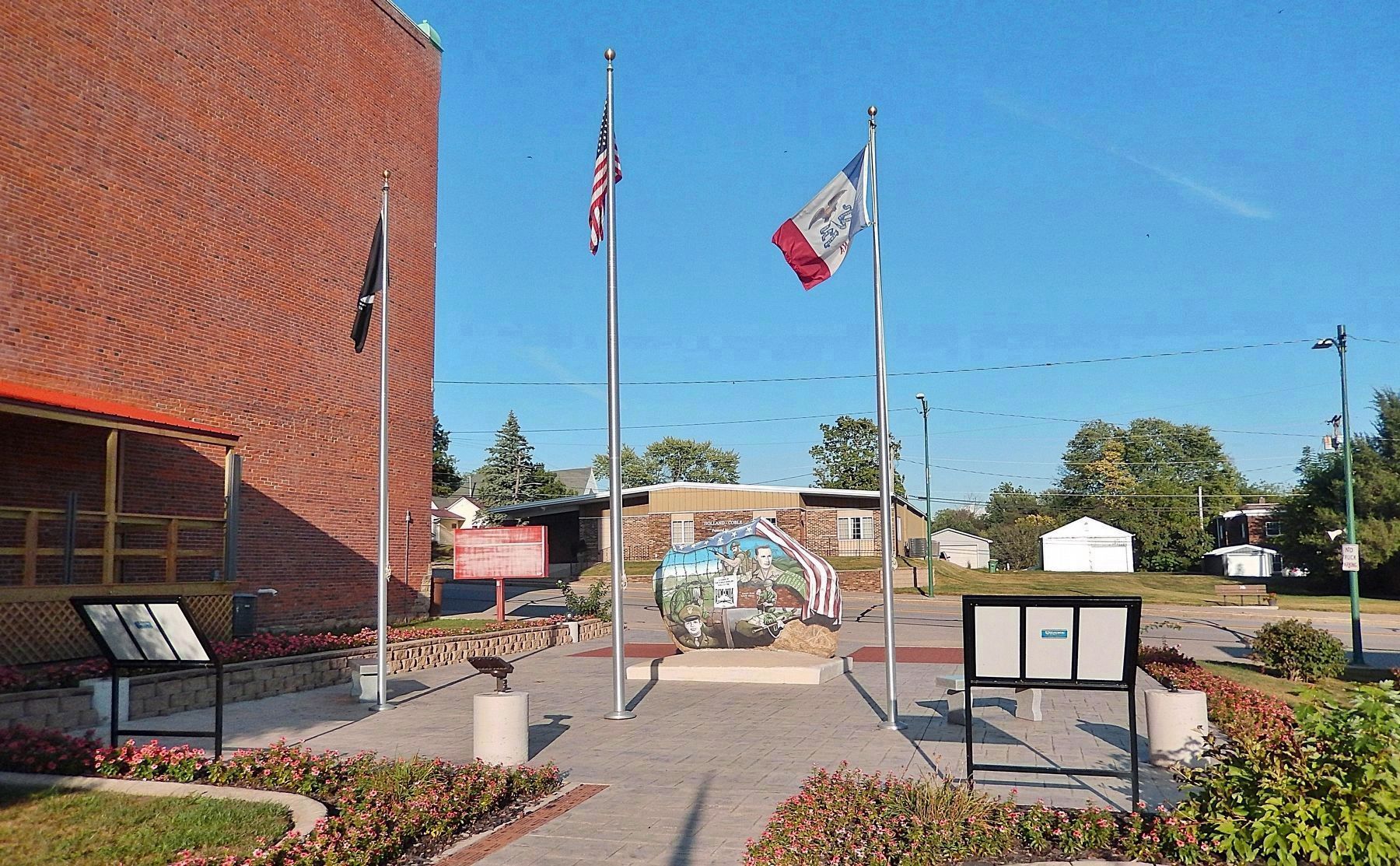
The back side of the interpretive panels describing this Freedom Rock and the town of What Cheer are seen here in the left [north] and right [south] foreground.
What Cheer, Iowa American Legion Post #533 Lash-Jordon-Behrens
The What Cheer American Legion Post began on February 1, 1922 as Ray Lash Post #533. It was named after the first What Cheer young man to die in service in WW I. The name was changed after Wesley Jordon was listed as missing in action at Pearl Harbor in WWII and again after the loss of Thomas Behrens in Vietnam. The What Cheer Post later joined with the James Murphy Post #319 (Keswick, Iowa) American Legion.
Cleveland Ray Lash, 25 was the first What Cheer man to lose his life in WWI in 1918. He had been ill at a Military Camp in New Orleans. His parents as well as military personnel escorted his body back to What Cheer. Five hundred people were at the Depot to meet the train's arrival. They formed a line and escorted the body to his home. At 11 o'clock the body was taken to the What Cheer Opera House where it lie in state for public viewing. The services were held in the Opera House to a standing room only crowd. The funeral procession was composed of the Grand Army, Sons of Veterans and the G.A.R. Circle who marched from the City Hall to the Opera House. Six members of the Red Cross sat on the stage. He is buried at Highland Cemetery. His parents were Wm. S. and Louisa Watts Lash and he was a brother to Ruth Lash.
Wesley Vernie Jordon, 23 was listed as missing in action in January 1942, following the bombing of Pearl Harbor on December 7, 1941. Wesley was born in Deep River and graduated from Gibson High School in 1936. In May of 1938 he and his friend, Chester Shacklett joined the United States Navy. They, along with the Armstrong Brothers; Thomas, Vincent and Terry were serving aboard the USS Oklahoma. The ship was on Battleship row on the morning of the surprise attack. In the first ten minutes of the battle eight torpedoes hit the Oklahoma, with a ninth striking as it sunk. The crew of the Oklahoma did everything they could to fight back. Fourteen marines and 415 sailors gave their lives. His parents were Wm Ferris and Ola Braden Jordon and had a sister, Doris. Wesley was married to Leta Tish on July 14, 1940.
Thomas Martin Behrens, 25 was first What Cheer life lost in the Vietnam Conflict. He was killed on October 31, 1968. He had been serving as a squad leader in the 1st Platoon D Co. 4th Battalion 3rd Inf. 11th Brigade Americal Division U.S. Army. Tom's military rank was promoted to Sergeant just a few days before his death. His unit had been participating in a combat sweep operation near the village of An Binh Trai, in Quang Ngai Province in the Republic of South Vietnam. Tom was on patrol when he was mortally wounded after a concealed enemy explosive device was detonated. Services for Tom were held in What Cheer on November 14, 1968. Tom's parents were Kenneth and Eleanor Fyfe Behrens and his siblings are Mary and Dan. He is buried at Highland Cemetery near What Cheer.
What Cheer Opera House
The building to the north of the Keokuk County Freedom Rock is the historic What Cheer Opera House. It was rebuilt and restored in 1893 by the Masonic Lodge after a fire in 1890. It was a showplace for many acts throughout the years, such as the Crow Sisters and the Scotch Band, directed by James Dalziel. In 1906 John Phillip Sousa played there. With trains running through town it was a popular spot for traveling entertainers. In preparation for What Cheer's Centennial in 1965 a community group was organized to stop the demolition of this building and revitalize the historic Opera House. In 1973 it was listed on the National Register of Historic Places. The ground upon which the Keokuk County Freedom Rock sits was donated by the What Cheer Opera House.
[photo captions]
• Humes GAR Post picture taken in 1911
Back Row: C. Mohme, J. Kelvie, G. Williams, W.F. Moode, L.S. Cory, C.Y. Danahue — 2nd Row: J.M. Nelson, John Ross, John Dansdill, W. Urie, O. Seaton Wm Humes, Harry Darlin — Front row: John Witt, Wm Elliott, Thomas Lally, Nels Lamb, Thomas Arie, Harrison Lamb, John Hall and George Leathers.
• Sketches that Bubba had drawn that were sent to the Rock Committee to approve.
• Ray “Bubba” Sorensen II, with the Keokuk County Freedom Rock. Painted March 2016.
• What Cheer parade celebrating the end of World War I.
Erected 2016.
Topics and series. This historical marker and memorial is listed in these topic lists: War, Korean • War, US Civil • War, Vietnam • War, World II. In addition, it is included in the Freedom Rock Memorials, the Military Order of the Purple Heart, the The Grand Army of the Republic, and the Valor in Aerial Operations series lists.
Location. 41° 24.076′ N, 92° 21.296′ W. Marker is in What Cheer, Iowa, in Keokuk County. It is on South Barnes Street (State Highway 21) just south of Briney Street, on the right when traveling south. Touch for map. Marker is at or near this postal address: 108 South Barnes Street, What Cheer IA 50268, United States of America. Touch for directions.

Regionally, this marker and memorial is in Eastern Iowa. It is also in the American Midwest and in the Corn Belt. Globally, it is in North America, the Western Hemisphere, the Western World, and the Anglosphere. Historically, it finds itself in what was once the territory of the Mississippian Culture and also the Louisiana Purchase.
Other nearby markers. At least 8 other markers are within 16 miles of this marker, measured as the crow flies: Opera House (within shouting distance of this marker); Veterans Memorial (approx. 9.1 miles away); Birthplace of Boys and Girls Rural Clubs (approx. 9.1 miles away); Civil War Memorial (approx. 9.1 miles away); Court of Keokuk County and Keokuk County Court House (approx. 9.1 miles away); Poweshiek County Freedom Rock (approx. 15.4 miles away); WTC Steel (approx. 15.4 miles away); The Bill of Rights (approx. 15½ miles away).
More about this marker. This marker comprises two interpretive panels along with the Freedom Rock in the memorial plaza.
Credits. This page was last revised on January 10, 2026. It was originally submitted on January 9, 2026, by Cosmos Mariner of Cape Canaveral, Florida. This page has been viewed 100 times since then. Photos: 1, 2, 3, 4, 5, 6, 7, 8, 9. submitted on January 10, 2026, by Cosmos Mariner of Cape Canaveral, Florida.
