Durango in La Plata County, Colorado — The American Mountains (Southwest)
Vanishing Homeland

Photographed by Cosmos Mariner, July 16, 2025
1. Vanishing Homeland Marker
“Either they (the Utes) or we must go, and we are not going… the Western Empire is an inexorable fact. He who gets in the way of it will be crushed.”
—The Denver Times, 1879
(This reflected the prevailing attitudes toward the Utes by Euro-American settlers.)
When Spanish explorers ventured into what is now northern New Mexico and southern Colorado in the 1600s, they encountered Ute Indians. The Utes were organized into small family bands that migrated seasonally between the mountains and the deserts and foothills, in search of game and wild plants. By the late 17th century, the Utes acquired horses from the Spanish, which increased their mobility and enabled them to protect themselves against other Indian tribes.
With the discovery of gold in the San Juan Mountains in the 1860s, prospectors knowingly trespassed on Ute land to stake mining claims. As more settlers arrived, the Utes lost most of their traditional homeland in a series of agreements and treaties with the U.S. Government.
Erected by Colorado Historical Society and City of Durango.
Topics. This historical marker is listed in these topic lists: Exploration
this page online
Location. 37° 15.64′ N, 107° 52.683′ W. Marker is in Durango, Colorado, in La Plata County. It can be reached from Santa Rita Drive just west of South Camino Del Rio (U.S. 160/550). The marker is near the interpretive kiosk at the southeast corner of the parking lot in Santa Rita Park. Touch for map. Marker is at or near this postal address: 111 South Camino Del Rio, Durango CO 81301, United States of America. Touch for directions.

Regionally, this marker is in the American Mountain West and at the Four Corners. Globally, it is in North America, the Rocky Mountains, the Western Hemisphere, the Western World, and the Anglosphere. Historically, it finds itself in what was once the territory of the Ancestral Puebloans.
Other nearby markers. At least 8 other markers are within walking distance of this marker: Santa Rita (here, next to this marker); Welcome to the San Juan Skyway (here, next to this marker); Santa Rosa Community, circa 1948 (within shouting distance of this marker); Durango's Smelter (within shouting

Colorado Historical Society
2. Marker detail: Traditional teepees and wickiups used by the nomadic Utes
Also see . . . Treaties and Agreements with the Utes (Southern Ute Indian Tribe).
Excerpt: On December 30, 1849, a peace treaty was signed between the United States and the Utes at Abiquiu, New Mexico. The treaty forced the Utes to officially recognize the sovereignty of the United States and established boundaries between the U.S. and the Ute nation.(Submitted on January 14, 2026, by Cosmos Mariner of Cape Canaveral, Florida.)
In 1863 another treaty was signed at Conejos terminating all Ute claims to mineral rights and lands in the San Luis Valley that had been settled by Europeans.
The Brunot Treaty was ratified by the United States in 1874 and is most often remembered by Utes as the agreement when their land was fraudulently taken away. The Utes were led to believe that they would be signing an agreement that would allow mining to occur on the lands located only in the San Juan Mountain area,the site of valuable gold and silver ore. However, they ended up forcibly relinquishing the lands to the U.S. government.Courtesy Fort Lewis College, Center of Southwest Studies3. Marker detail: Traditional Ute DanceToday, the Southern Ute Tribal Office is in Ignacio, and the Ute Mountain Ute Tribal Office is in Towaoc.
In 1895 the Hunter Act was passed opening up the Ute strip to homesteading and sale to non-Indians.


Animas Museum, La Plata County Historical Society
4. Marker detail: Ute Encampment

Photographed by Cosmos Mariner, July 16, 2025
5. Vanishing Homeland Marker
Looking northwest across the Santa Rita Park parking lot.
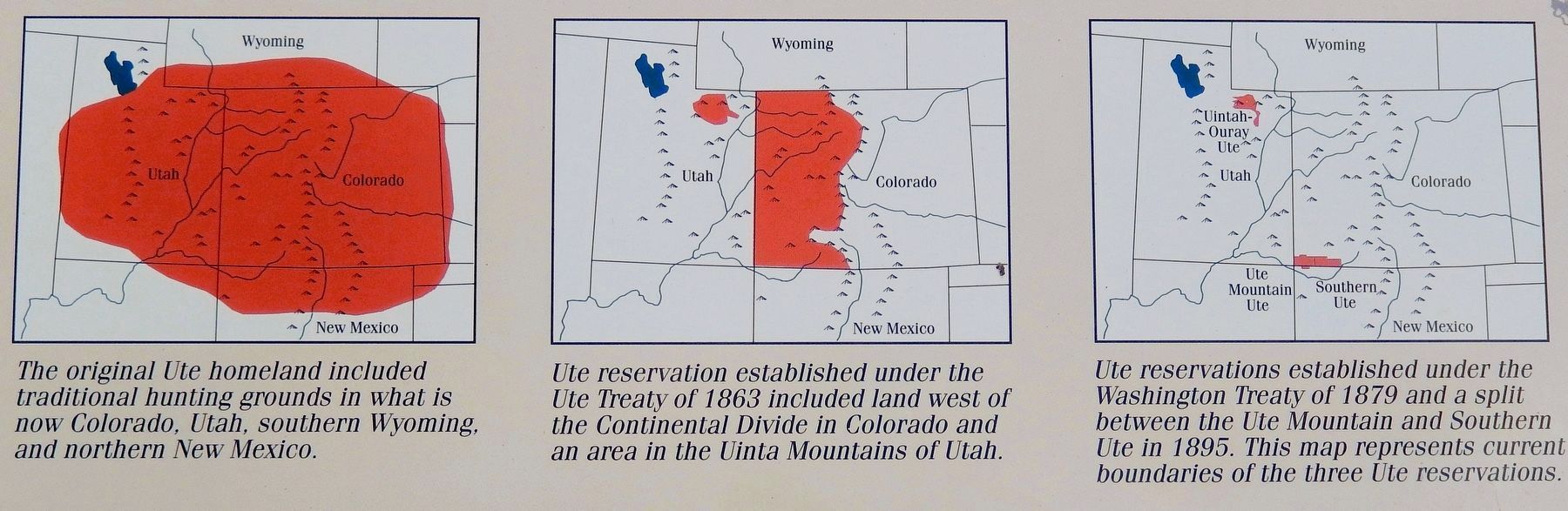
6. Marker detail: Vanishing Ute Homeland Maps
The original Ute homeland included traditional hunting grounds in what is now Colorado, Utah, southern Wyoming, and northern New Mexico.
Ute reservation established under the Ute Treaty of 1863 included land west of the Continental Divide in Colorado and an area in the Uinta Mountains of Utah.
Ute reservations established under the Washington Treaty of 1879 and a split between the Ute Mountain and Southern Ute in 1895. This map represents current boundaries of the three Ute reservations.
Credits. This page was last revised on January 14, 2026. It was originally submitted on January 14, 2026, by Cosmos Mariner of Cape Canaveral, Florida. This page has been viewed 86 times since then. Photos: 1, 2, 3, 4, 5, 6. submitted on January 14, 2026, by Cosmos Mariner of Cape Canaveral, Florida.
