Lake City in Hinsdale County, Colorado — The American Mountains (Southwest)
Site of Founder's Cabin — August, 1874
Photographed by Cosmos Mariner, July 21, 2025
1. Site of Founder's Cabin — August, 1874 Marker
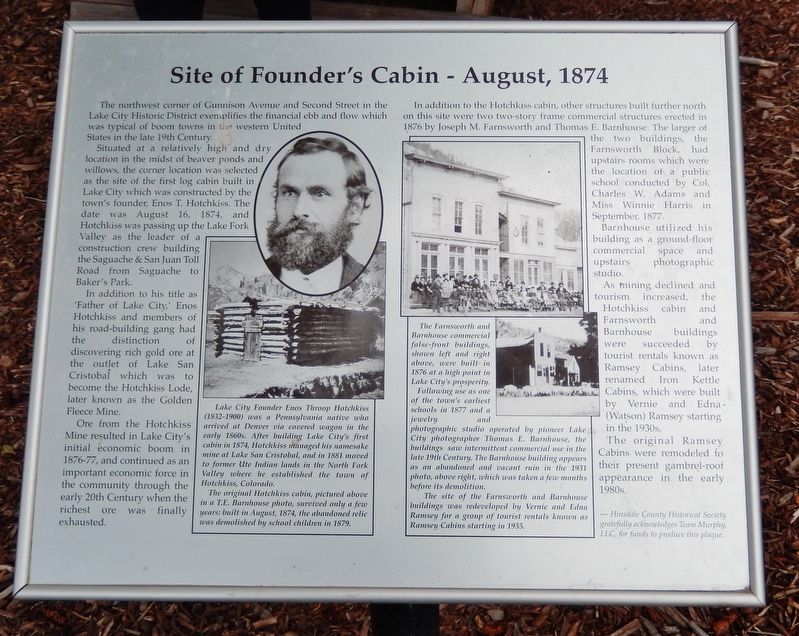
The northwest corner of Gunnison Avenue and Second Street in the Lake City Historic District exemplifies the financial ebb and flow which was typical of boom towns in the western United States in the late 19th Century.
Situated at a relatively high and dry location in the midst of beaver ponds and willows, the corner location was selected as the site of the first log cabin built in Lake City which was constructed by the town's founder, Enos T. Hotchkiss. The date was August 16, 1874, and Hotchkiss was passing up the Lake Fork Valley as the leader of a construction crew building the Saguache & San Juan Toll Road from Saguache to Baker's Park.
In addition to his title as 'Father of Lake City,' Enos Hotchkiss and members of his road-building gang had the distinction of discovering rich gold ore at the outlet of Lake San Cristobal which was to become the Hotchkiss Lode, later known as the Golden Fleece Mine.
Ore from the Hotchkiss Mine resulted in Lake City’s initial economic boom in 1876-77, and continued as an important economic force in the community through the early 20th Century when the richest ore was finally exhausted.
this page online
In addition to the Hotchkiss cabin, other structures built further north on this site were two two-story frame commercial structures erected in 1876 by Joseph M. Farnsworth and Thomas E. Barnhouse. The larger of the two buildings, the Farnsworth Block, had upstairs rooms which were the location of a public school conducted by Col. Charles W. Adams and Miss Winnie Harris in September, 1877.
Barnhouse utilized his building as a ground-floor commercial space and upstairs photographic studio.
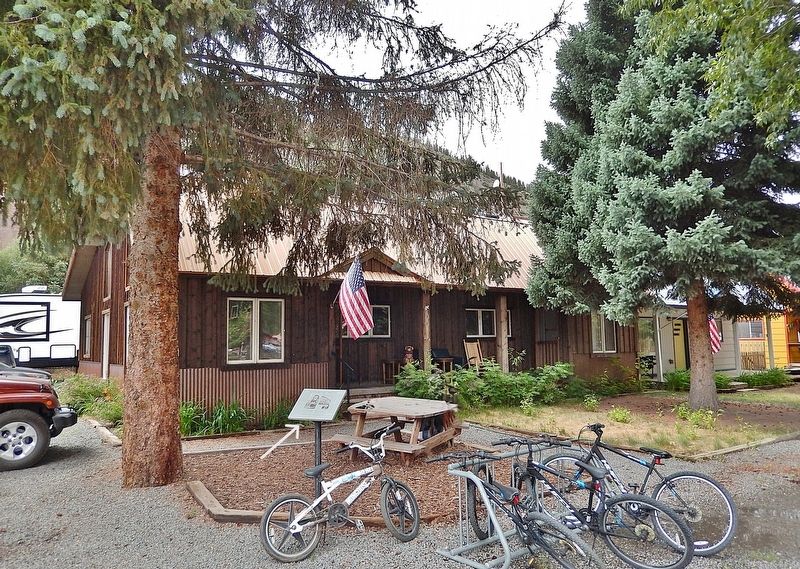
As mining declined and tourism increased, the Hotchkiss cabin and Farnsworth and Barnhouse buildings were succeeded by tourist rentals known as Ramsey Cabins, later renamed Iron Kettle Cabins, which were built by Vernie and Edna (Watson) Ramsey starting in the 1930s.
The original Ramsey Cabins were remodeled to their present gambrel-roof appearance in the early 1980s.
[photo captions]
[left] Lake City Founder Enos Throop Hotchkiss (1832-1900) was a Pennsylvania native who arrived at Denver via covered wagon in the early 1860s. After building Lake City's first cabin in 1874, Hotchkiss Managed his namesake mine at Lake San Cristobal, and in 1881 moved
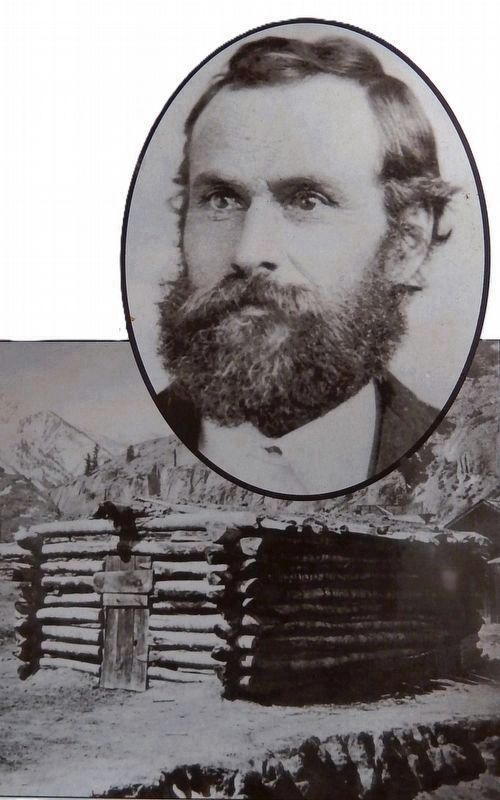
2. Marker detail: Lake City Founder Enos Throop Hotchkiss
Below is the original Hotchkiss cabin, built in August 1874.
The original Hotchkiss cabin, pictured above in a T.E. Barnhouse photo, survived only a few years: built in August, 1874, the abandoned relic was demolished by school children in 1879.
[right] The Farnsworth and Barnhouse commercial false-front buildings, shown left and right above, were built in 1876 at a high point in Lake City's prosperity.
Following use as one of the town's earliest schools in 1877 and a jewelry and photographic studio operated by pioneer Lake City photographer Thomas E. Barnhouse, the buildings saw intermittent commercial use in the late 19th Century. The Barnhouse building appears as an abandoned and vacant ruin in the 1931 photo, above right, which was taken a few months before its demolition.
The site of the Farnsworth and Barnhouse buildings was redeveloped by Vernie and Edna Ramsey for a group of tourist rentals known as Ramsey Cabins starting in 1935.
Hinsdale County Historical Society gratefully acknowledges Team Murphy, L.L.C, for funds to produce this plaque.
Erected by Hinsdale County Historical
Photographed by Cosmos Mariner, July 21, 2025
3. Site of Founder's Cabin Marker
The marker is near the northwest corner of the intersection, overlooking the property at this location today.
Topics. This historical marker is listed in these topic lists: Industry & Commerce • Roads & Vehicles • Settlements & Settlers. A significant historical date for this entry is August 16, 1874.
Location. 38° 1.652′ N, 107° 19.004′ W. Marker is in Lake City, Colorado, in Hinsdale County. It is at the intersection of Gunnison Avenue (State Highway 149) and 2nd Street (County Road 20), on the right when traveling south on Gunnison Avenue. The marker is near the northwest corner of the intersection. Touch for map. Marker is at or near this postal address: 201 Gunnison Avenue, Lake City CO 81235, United States of America. Touch for directions.

Regionally, this marker is in the Colorado High Rockies. It is also in the American Mountain West. Globally, it is in North America, the Rocky Mountains, the Western Hemisphere, the Western World, and the Anglosphere. Historically, it finds itself in what was once the Ancestral Puebloan.
Other nearby markers. At least 8 other markers are within walking distance of this marker: Jail Cells for Women & the Insane (within shouting distance of this marker); Architectural Contrasts — 1877, 1947 (within shouting distance of this marker); Curtis Planer (within shouting distance of this marker); Bachelor Cabins, Carson (within shouting distance of this marker); The Colorado-Yule Marble Company (within shouting distance of this marker); Colonel Channing Franklin Meek (about 300 feet away, measured in a direct line); Slag Cart (about 300 feet away); Finley Block — Built 1877 (about 300 feet away). Touch for a list and map of all markers in Lake City.
Also see . . .
1. Lake City, Colorado (Western Mining History).
Excerpt: Valuable ore was first identified in the Lake City area in 1871, but at the time the area belonged to the Ute Indians so the discoveries were not exploited at the time. The Utes ceded the land to the United States in 1874, opening the area to new exploration.(Submitted on January 20, 2026, by Cosmos Mariner of Cape Canaveral, Florida.)
Shortly after the Utes ceded the land, Enos Hotchkiss, “The father of Lake City”, located rich gold and silver ore at what would become the Hotchkiss Mine, and later the Golden Fleece Mine. In 1874 Hotchkiss built the first log cabin at the site that would become Lake City.
By Spring of 1875 Lake City had thirteen cabins. In June of that year Lake City’s first newspaper, the Silver World, was published. That same year saw the opening of the first sawmill, the arrival of the first stagecoach, and the establishment of a post office.
2. Lakeshore & the Golden Fleece Mine (Legends of America).
Excerpt: The Golden Fleece Mine was three miles wide and nine miles long in the Lake Mining District, stretching from south of Lake City past Lake San Cristobal. The district was also called the Lake City District and the Lake Fork District. Silver and lead were the chief metals produced, but considerable gold and some copper and zinc were also mined.(Submitted on January 20, 2026, by Cosmos Mariner of Cape Canaveral, Florida.)
As development and production increased, Lake City became a center of activity, and smelters and concentrating works were built. Although rapid progress was made in the late 1870s, the area lacked railroad transportation and was generally inaccessible. This situation brought on a decline in activity in the late 1880s, alleviated in 1889 by the construction of a rail branch to Lake City. Soon after the railroad arrived, very rich ore was found at the Golden Fleece Mine, with a single railroad car of ore yielding $50,000.
By 1904, the major ore deposits had been exhausted, and most mines were closed. By then, the Golden Fleece Mine had produced $1,400,000 in silver and gold ore. It also shut down that year but operated intermittently until 1919.
Credits. This page was last revised on January 20, 2026. It was originally submitted on January 17, 2026, by Cosmos Mariner of Cape Canaveral, Florida. This page has been viewed 38 times since then. Photos: 1, 2, 3. submitted on January 20, 2026, by Cosmos Mariner of Cape Canaveral, Florida.
