Lake City in Hinsdale County, Colorado — The American Mountains (Southwest)
Lake City's First Post Office
Photographed by Cosmos Mariner, July 21, 2025
1. Lake City's First Post Office Marker
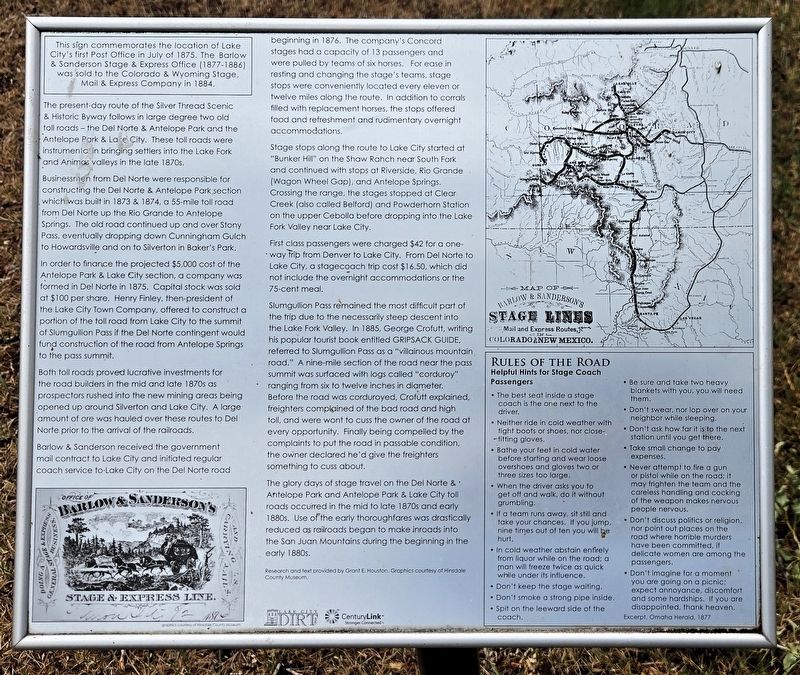
This sign commemorates the location of Lake City's first Post Office in July of 1875. The Barlow & Sanderson Stage & Express Office (1877-1886) was sold to the Colorado & Wyoming Stage, Mail & Express Company in 1884.
The present-day route of the Silver Thread Scenic & Historic Byway follows in large degree two old toll roads — the Del Norte & Antelope Park and the Antelope Park & Lake City. These toll roads were instrumental in bringing settlers into the Lake Fork and Animas valleys in the late 1870s.
Businessmen from Del Norte were responsible for constructing the Del Norte & Antelope Park section which was built in 1873 & 1874, a 55-mile toll road from Del Norte up the Rio Grande to Antelope Springs. The old road continued up and over Stony Pass, eventually dropping down Cunningham Gulch to Howardsville and on to Silverton in Baker's Park.
In order to finance the projected $5,000 cost of the Antelope Park & Lake City section, a company was formed in Del Norte in 1875. Capital stock was sold at $100 per share. Henry Finley, then-president of the Lake City Town Company, offered to construct a portion of the toll road from
this page online
Both toll roads proved lucrative investments for the road builders in the mid and late 1870s as prospectors rushed into the new mining areas being opened up around Silverton and Lake City. A large amount of ore was hauled over these routes to Del Norte prior to the arrival of the railroads.
Barlow & Sanderson received the government mail contract to Lake City and initiated regular coach service to Lake City on the Del Norte road beginning in 1876. The company's Concord stages had a capacity of 13 passengers and were pulled by teams of six horses. For ease in resting and changing the stage's teams, stage stops were conveniently located every eleven or twelve miles along the route. In addition to corrals filled with replacement horses, the stops offered food and refreshment and rudimentary overnight accommodations.
Stage stops along the route to Lake City started at “Bunker Hill” on the Shaw Ranch near South Fork and continued with stops at Riverside, Rio Grande (Wagon Wheel Gap), and Antelope
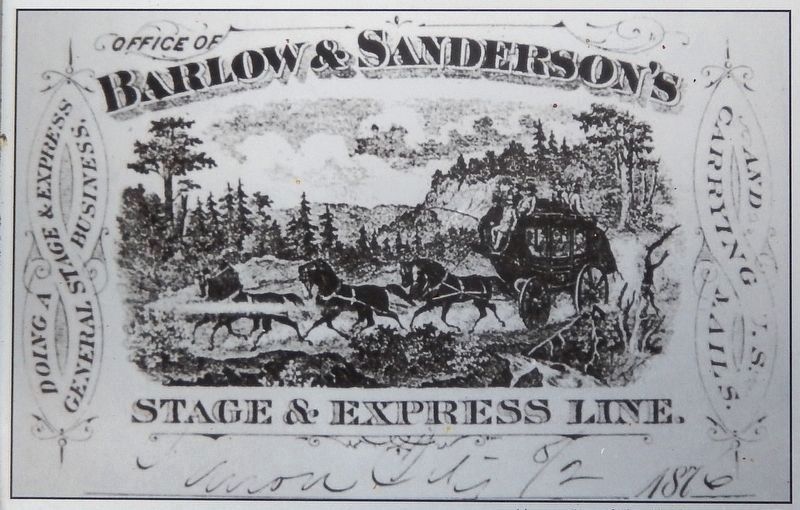
Courtesy Hinsdale County Museum
2. Marker detail: Barlow & Sanderson's Stage Line
First class passengers were charged $42 for a one-way trip from Denver to Lake City. From Del Norte to Lake City, a stagecoach trip cost $16.50, which did not include the overnight accommodations or the 75-cent meal.
Slumgullion Pass remained the most difficult part of the trip due to the necessarily steep descent into the Lake Fork Valley. In 1885, George Crofutt, writing his popular tourist book entitled GRIPSACK GUIDE, referred to Slumgullion Pass as a “villainous mountain road.” A nine-mile section of the road near the pass summit was surfaced with logs called “corduroy” ranging from six to twelve inches in diameter. Before the road was corduroyed Crofutt explained, freighters complained of the bad road and high toll, and were wont to cuss the owner of the road at every opportunity. Finally being compelled by the complaints to put the road in passable condition, the owner declared he'd give the freighters something to cuss about.
The glory days

Courtesy Hinsdale County Museum
3. Marker detail: Map of Barlow & Sanderson’s Stage Lines
Mail and Express Routes in Colorado & New Mexico.
Rules of the Road
Helpful Hints for Stage Coach Passengers
• The best seat inside a stage coach is the one next to the driver.Research and text provided by Grant E. Houston. Graphics courtesy of Hinsdale County Museum.
• Neither ride in cold weather with tight boots or shoes, nor close-fitting gloves.
• Bathe your feet in cold water before starting and wear loose overshoes and gloves two or three sizes too large.
• When the driver asks you to get off and walk, do it without grumbling.
• If a team runs away, sit still and take your chances. If you jump, nine times out of ten you will be hurt.
• In cold weather abstain entirely from liquor while on the road; a man will freeze twice as quick while under its influence.
• Don't keep the stage waiting.
• Don't smoke a strong pipe inside.
• Spit on the leeward side of the coach.
• Be sure and take two heavy blankets with you, you will need them.
• Don't swear, nor lop over on your neighbor whilesleeping.Photographed by Cosmos Mariner, July 21, 20254. Lake City's First Post Office MarkerThe marker is in the lot at the northeast corner of the intersection. The lot appears to be a de facto community park.
• Don't ask how far it is to the next station until you get there.
• Take small change to pay expenses.
• Never attempt to fire a gun or pistol while on the road; it may frighten the team and the careless handling and cocking of the weapon makes nervous people nervous.
• Don't discuss politics or religion, nor point out places on the road where horrible murders have been committed, if delicate women are among the passengers.
• Don't imagine for a moment you are going on a picnic; expect annoyance, discomfort and some hardships. If you are disappointed, thank heaven.
—Excerpt, Omaha Herald, 1877
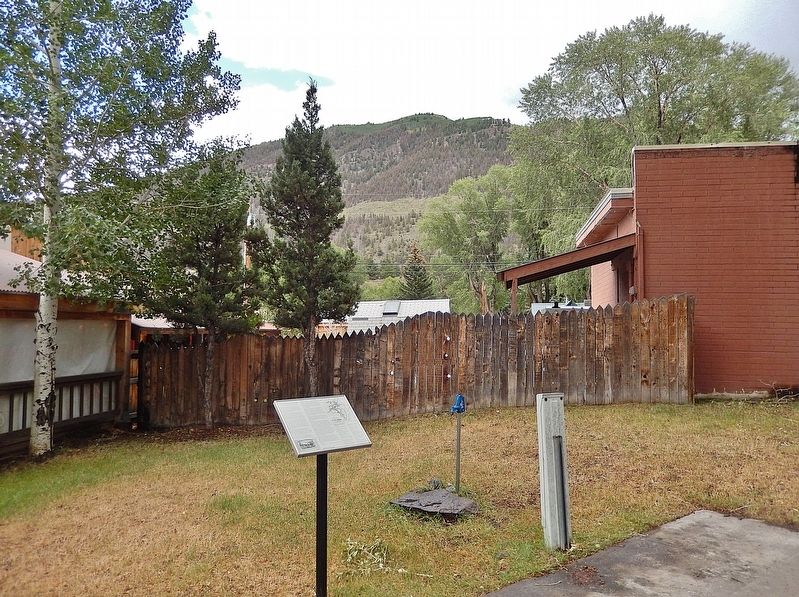
Erected by Lake City Downtown Improvement & Revitalization Team, Inc.
Topics and series. This historical marker is listed in these topic lists: Industry & Commerce • Roads & Vehicles • Settlements & Settlers. In addition, it is included in the Postal Mail and Philately series list. A significant historical month for this entry is July 1875.
Location. 38° 1.726′ N, 107° 18.94′ W. Marker is in Lake City, Colorado, in Hinsdale County. It is on Gunnison Avenue (State Highway 149) just north of 3rd Street, on the right when traveling north. The marker is near the northeast corner of the intersection. Touch for map. Marker is at or near this postal address: 310 Gunnison Avenue, Lake City CO 81235, United States of America. Touch for directions.

Regionally, this marker is in the Colorado High Rockies. It is also in the American Mountain West. Globally, it is in North America, the Rocky Mountains, the Western Hemisphere, the Western World, and the Anglosphere.
Other nearby markers. At least 8 other markers are within walking distance of this marker: Susan B. Anthony in Lake City (a few steps from this marker); Alfred (Alferd) Packer's Trial Takes Place at Courthouse in 1883 (within shouting distance of this marker); Votes for Women (within shouting distance of this marker); Susan B. Anthony Speaks at Courthouse on September 20, 1877 (about 300 feet away, measured in a direct line); G & M Cabins — 1936, 1947 (about 300 feet away); Architectural Contrasts — 1877, 1947 (about 400 feet away); Hough Block — Built 1880-82 (about 400 feet away); Lake City Historic Loop (about 400 feet away). Touch for a list and map of all markers in Lake City.
Credits. This page was last revised on January 21, 2026. It was originally submitted on January 17, 2026, by Cosmos Mariner of Cape Canaveral, Florida. This page has been viewed 46 times since then. Photos: 1. submitted on January 20, 2026, by Cosmos Mariner of Cape Canaveral, Florida. 2, 3, 4. submitted on January 21, 2026, by Cosmos Mariner of Cape Canaveral, Florida.
