Lake City in Hinsdale County, Colorado — The American Mountains (Southwest)
Alfred (Alferd) Packer's Trial Takes Place at Courthouse in 1883
Photographed by Cosmos Mariner, July 21, 2025
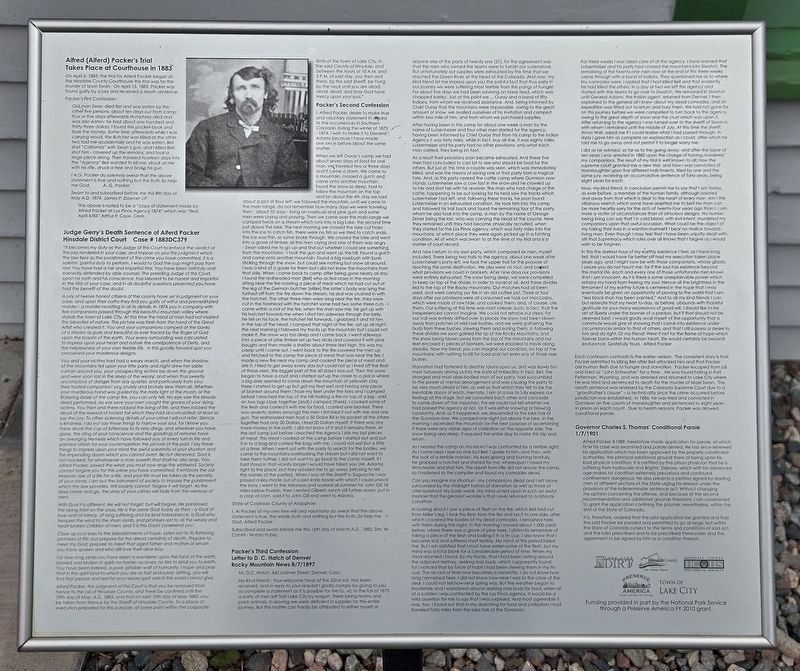
1. Alfred Packer's Trial Marker
On April 6, 1883, the trial for Alferd Packer began at the Hinsdale County Courthouse. This trial was for the murder of Israel Swan. On April 13, 1883, Packer was found guilty by a jury and received a death sentence.
Packer's First Confession:
Old man Swan died first and was eaten by the other five persons, about ten days out from camp; four or five days afterwards Humphrey died and was also eaten; he had about one hundred and thirty three dollars. I found the pocket-book and took the money. Some time afterwards while I was carrying wood, the Butcher was killed as the other two told me accidentally and he was eaten. Bell shot “California” with Swan's gun, and I killed Bell; shot him — covered up the remains, and took a large piece along. Then traveled fourteen days into the “Agency.” Bell wanted to kill me, struck at me with his rifle, struck a tree and broke his gun.
I A.G. Packer do solemnly swear that the above statement is true and nothing but the truth So help me God. A. G. Packer
Sworn to and subscribed before me this 8th day of May A.D. 1874. James P. Downer J.P.
The above is noted to be a “copy of statement madeby Alfred Packer at Los Pinos Agency 1874” which was “filed April 4/83” Arthur P. Cook, Clerk.
Click or scan to see
this page online
Judge Gerry's Death Sentence of Alferd Packer
Hinsdale District Court Case # 1883DC379
“It becomes my duty as the Judge of this Court to enforce the verdict of the jury rendered in your case, and impose on you the judgment which the law fixes as the punishment of the crime you have committed. It is a solemn, painful duty to perform. I would to God the cup might pass from me! You have had a fair and impartial trial. You have been faithfully and earnestly defended by able counsel. The presiding Judge of this Court, upon his oath and his conscience, has labored to be honest and impartial in the trial of your case, and in all doubtful questions presented you have had the benefit of the doubt.
A jury of twelve honest citizens of the county have set in judgment on your case, and upon their oaths they find you guilty of willful and premeditated murder — a murder revolting in all its details. In 1874 you in company with five companions passed through this beautiful mountain valley where stands the town of Lake City. At this time the hand of man had
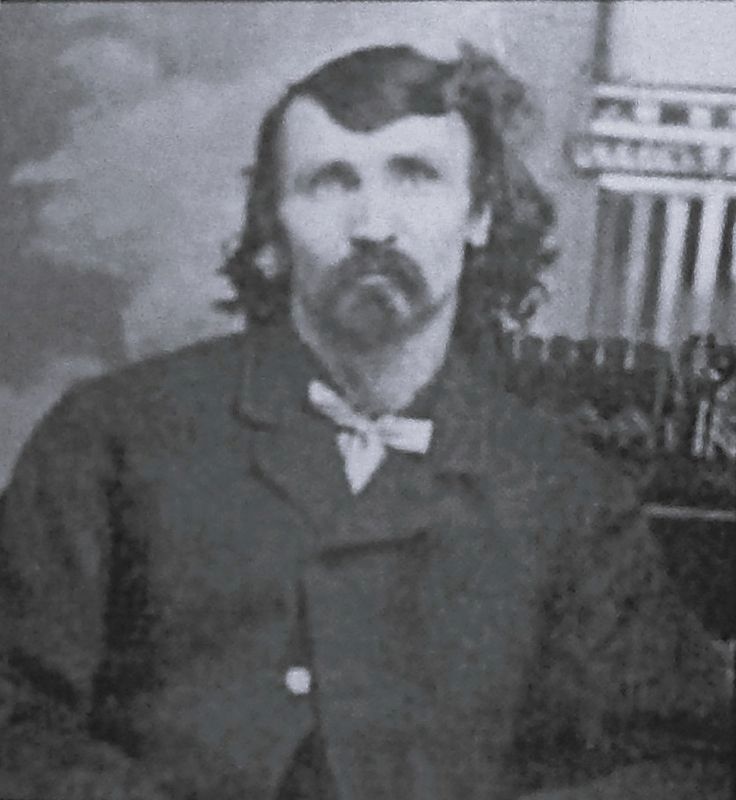
2. Marker detail: Alfred Packer
You and your victims had had a weary march, and when the shadow of the mountains fell upon your little party and night drew her sable curtain around you, your unsuspecting victims lay down the ground and were soon lost in the sleep of the weary; and when thus sweetly unconscious of danger from any quarter, and particularly from you, their trusted companion; you cruelly and brutally slew them all. Whether your murderous hand was guided by the misty light of the moon, or the flickering blaze of the camp fire, you can only tell. No eye saw the bloody deed performed, no ear save your own caught the groans of your dying victims. You then and there robbed the living of life, and then
Photographed by Cosmos Mariner, July 21, 2025
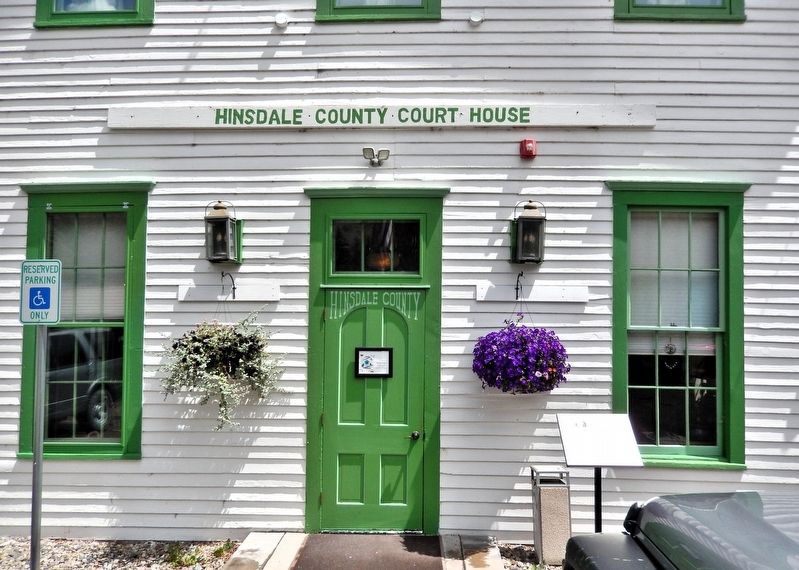
3. Alfred Packer's Trial Marker
The marker is on the right side of the Hinsdale County Courthouse west entrance.
Photographed by Cosmos Mariner, July 21, 2025
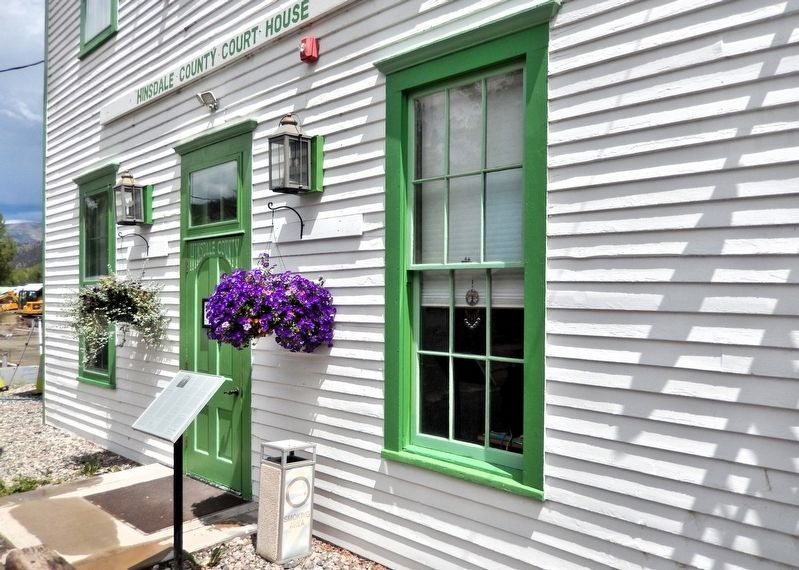
4. Alfred Packer's Trial Marker
With God it is different. He will not forget, but will forgive. He pardoned the dying thief on the cross. He is the same God today as then — a God of love and of mercy, of long suffering and for kind forbearance; a God who tempers the wind to the shorn lamb, and promotes rest to all the weary and heart-broken children of men; and it is this God I commend you.
Close up your ears to the blandishments of hope. Listen not to its flattering promises of life; but prepare for the dread certainty of death. Prepare to meet thy God; prepare to meet that aged father and mother of whom you have spoken and who still love their dear boy.
For nine long years you have been a wanderer upon the face of the earth, bowed and broken in spirit; no home; no loves; no ties to bind you to earth. You have been indeed, a poor, pitiable waif of humanity. I hope and pray that in the spirit land to which you are so fast and surely drifting, you will find that peace and rest for your weary spirit which this world cannot give.
Alfred Packer, the judgment of this Court is that you be removed from hence to the Jail of Hinsdale County,
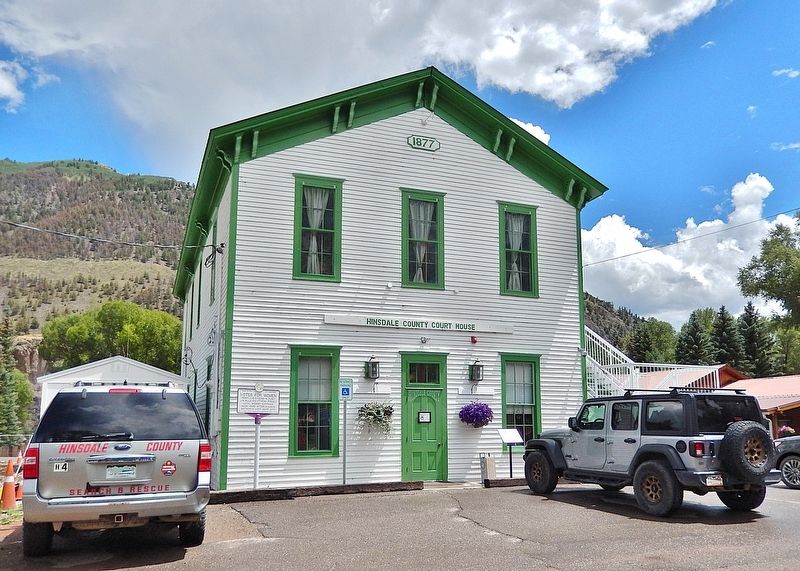
Photographed by Cosmos Mariner, July 21, 2025
5. Hinsdale County Courthouse (west elevation)
Packer's Second Confession
I, Alfred Packer, desire to make true and voluntary statement in regard to the occurrences in Southern Colorado during the winter of 1873-1874. I wish to make it to General Adams because I have made one once before about the same matter.State of Colorado County of Arapahoe
When we left Ouray's camp we had about seven days of food for one man, we traveled two or three days and it came a storm. We came to a mountain, crossed a gulch and came onto another mountain, found the snow so deep, had to follow the mountain on the top and on about the 4th day we had about a pint of flour left; we followed the mountain, until we came to the main range, do not remember how many days we were traveling then — about 10 days — living on rosebuds and pine gum and some men were crying and praying. Then we came over the main range we camped twice on a stream which runs into a big Lake, the second time just above the lake. The next morning we crossed the lake cut holes into the ice to catch fish, there were no fish so we tried to catch snails, the ice was thin, so some broke through. We crossed the lake and went into a grove of timber, all the men crying and one of them was angry — Swan asked me to go up and find out whether I could see something from the mountains — I took the gun and went up the hill. Found a gulch and came onto another mountain, found a big rosebush with buds sticking through the snow, but could see nothing but snow all around. I was a kind of a guide for them but I did not know the mountains from that side. When I came back to camp after being gone nearly all day I found the redheaded man [Bell] who acted crazy in the morning sitting near the fire roasting a piece of meat which he had cut out of the leg of the German butcher [Miller] the latter's body was lying the furthest off from the fire down the stream, his skull was crushed in with the hatchet. The other three men were lying near the fire, they were cut in the forehead with the hatchet some had two some three cuts — I came within a rod of the fire, when the man saw me, he got up with his hatchet towards me when I shot him sideways through the belly, he fell on his face, the hatchet fell forwards. I grabbed it and hit him in the top of the head. I camped that night at the fire, sat up all night, the next morning I followed my tracks up the mountain but I could not make it, the snow was too deep and I came back, I went sideways into a piece of pine timber set up two sticks and covered it with pine boughs and then made a shelter about three feet high, this was my camp until I came out. I went back to the fire covered the men up and fetched to the camp the piece of meat that was near the fire. I made a new fire near my camp and cooked the piece of meat and ate it. I tried to get away every day but could not so I lived off the flesh of these men, the bigger part of the 60 days I was out. Then the snow began to have a crust and I started out up the creek to a place where a big slide seemed to come down the mountain of yellowish clay there I started to get up but got my feet wet and having only piece of blanket around them I froze my feet under the toes and I camped before I reached the top of the hill making a fire on top of a log — and on two logs close together [and] I camped [there]. I cooked some of the flesh and carried it with me for food. I carried one blanket. There was seventy dollars amongst the men I fetched it out with me and one gun. The redheaded men had a 50 Dollar Bill in his pocket all the others together had only 20 Dollars. I had 20 Dollars myself. If there was any more money in the outfit, I did not know of it and it remains there. At the last camp just before I reached the Agency I ate my last pieces of meat. This meat I cooked at the camp before I started out and put it in to a bag and carried the bag with me. I could not eat but a little at a time. When I went out with the party to search for the bodies, we came to the mountains overlooking the stream but I did not want to take them further. I did not want to go back to the camp myself. If I had stood in that vicinity longer I would have taken you [Mr. Adams] right to the place, but they advised me to go away [refusing to tell the names of the parties]. When I was at the Sheriff in Saguache I was passed a key made out of a pen knife blade with which I could unlock the irons. I went to the Arkansas and worked all summer for John Gill 18 miles below Pueblo, then I rented Gilberts ranch still further down, put in a crop of corn, sold it to John Gill and went to Arizona.
I, Al Packer, of my own free will and voluntarily do swear that the above statement is true, the whole truth and nothing but the truth, So help me God, Alferd Packer.
Subscribed and sworn before me this 16th day of March A.D., 1883, Sim. W. Cantril —Notary Public
Packer's Third Confession
Letter to D. C. Hatch of Denver Rocky Mountain News 8/7/1897
Mr. D.C. Hatch, 842 Larimer Street, Denver, Colo.:
My Kind Friend — Your welcome favor of the 22nd inst, Has been received, and in reply to your request I gladly comply by giving to you as complete a statement as it is possible for me to, viz: In the fall of 1873 a party of men left Salt Lake City by wagon, there being teams and pack animals. In leaving we were deficient in supplies for the entire journey. But this matter can hardly be attributed to either myself or anyone else of the party of twenty one (21), for the agreement was that the men who owned the teams were to furnish our sustenance. But unfortunately our supplies were exhausted by the time that we reached the Green River, at the head of the Colorado. And now, my kind friend let me impress upon you the painful fact that thus early in our journey we were suffering most terrible from the pangs of hunger. For about five days we had been surviving on horse feed, which was chopped barley. Just at this point we... Ouray and a band of fifty Indians, from whom we received assistance. And, being informed by Chief Ouray that the mountains were impassable, owing to the great amount of snow, we availed ourselves of his invitation and camped within two mile of him, and from whom we purchased supplies.
After having been in this camp for about one week a man by the name of Lutzenheiser and four other men started for the agency, having been informed by Chief Ouray that from his camp to the Indian Agency it was forty miles, while in fact, by air line, it was eighty miles. Lutzenheizer and his party had no other provisions, only what each man carried, they being on foot.
As a result their provisions soon became exhausted. And these five men had concluded to cast lot to see who should be food for the others. But just at this time a coyote was seen, which was immediately killed, and was the means of saving one of that party from a tragical fate. And, as this party neared the cattle camp where Gunnison now stands. Lutzenheiser saw a cow fast in the snow and he crawled up to her and shot her with his revolver. The man who had charge of the cattle, happening to be out looking for his herd saw the tracks which Lutzenheiser had left, and, following these tracks, he soon found Lutzenheiser in an exhausted condition. He took him into this camp and followed his trail back and found the remaining four of the party, whom he also took into the camp, a man by the name of George Driver being the last, who was carrying the head of the coyote. Here they remained until they had become physically recruited, when they started for the Los Pinos agency, which was forty miles into the mountains, at which place they were again picked up in a fainting condition. All of which was sworn to at the time of my trial and is a matter of court record.
And now I return to my own party, which composed six men, myself included. There being two trails to the agency, about one week after Lutzenheiser's party left, we took the upper trail for the purpose of reaching the same destination. We also were on foot, and carried what provisions we could in blankets. After nine days our provisions were entirely exhausted. The snow being deep, we were compelled to keep on top of the divide, in order to travel at all. And these divides led to the top of the Rocky mountains. Our matches had all been used, and were carrying our fire in an old coffee pot. Three or four days after our provisions were all consumed we took our moccasins, which were made of raw hide, and cooked them, and, of course, ate them. Our suffering at this time was most intense, such, in fact, that the inexperienced cannot imagine. We could not retrace our steps, for our trail was entirely drifted over. In places the snow had been blown away from patches of wild rose bushes, and we were gathering the buds from these bushes, stewing them and eating them. In following these divides we soon gained the tip of the Rocky Mountains, and the snow being blown away from the top of the mountains and our feet encased in pieces of blankets, we were enabled to travel along steadily. Now my friend, you can imagine our condition, on top of the mountains, with nothing to kill for food and not even any of those rose bushes.
Starvation had fastened its deathly talons upon us, and was slowly but most tortuously driving us into the state of imbecility; in fact, Bell, the strongest and most able-bodied man of our party, had succumbed to the power of mental derangement and was causing the party to be very much afraid of him, as well as that which they felt to be the inevitable doom of each, mentally. I am at a loss to fully express our feelings at this stage, but we consulted each other and conclude to come down off the mountain. For we could not tell whether we had passed the agency or not, for It was either snowing or blowing constantly. And, as it happened, we descended to the lake fork of the Gunnison river. We camped one night just above the lake. In the morning I ascended the mountain for the next purpose of ascertaining if there were any visible signs of civilization on the opposite side. The snow being very deep. It required the entire day to make this trip and return.
As I neared the camp on my return I was confronted by a terrible sight. As I came near I saw no one but Bell. I spoke to him, and then, with the look of a terrible maniac, his eyes glaring and burning fearfully, he grabbed a hatchet and started for me, whereupon I raised my Winchester and shot him. The report from rifle did not arouse the camp, so I hastened to the campfire and found my comrades dead.
Can you imagine my situation — my companions dead and I left alone, surrounded by the midnight horrors of starvation as well as those of utter isolation? My body weak, my mind acted upon in such an awful manner that the greatest wonder is that I ever returned to a rational condition.
In looking about I saw a piece of flesh on the fire, which Bell had cut from Miller's leg. I took this flesh from the fire and lay it to one side, after which I covered the bodies of my dead comrades. I remained here with them during the night. In the morning I moved about 1,000 yards below, where there was a grove of pine trees. I distinctly remember of taking a piece of the flesh and boiling it in a tin cup. I also know that I became sick and suffered most terribly. My mind at this period failed me. But I am satisfied that I must have eaten some of the flesh, but my mind was a total blank for a considerable period of time. When my mind returned I found, by my tracks, that I had been visiting around the adjacent territory, seeking rose buds, which I apparently found, for I noticed that by force of habit I had been stewing them in my tin cup. The record of time now becomes a nonentity. I do not know how long I remained here. I did not know how near I was to the close of the year. I could not tell how near spring was. But the weather began to moderate and I wandered around seeking rose buds for food, when all of a sudden I was confronted by the Los Pinos agency. It would be a mild assertion for me to say that I was surprised. And most agreeable it was, too, I found out that in my searching for food and civilization I had traveled forty miles from the lake fork of the Gunnison.
For three weeks I was taken care of at the agency. I have learned that Lutzenheiser and his party had crossed the mountains into Siwatch. The remaining of the twenty-one men now at the end of this three weeks came through with a band of Indians. They questioned me as to where my comrades were. I replied that I had killed Bell and that evidently he had killed the others. In a day or two we left the agency and started with the teams to go over to Siwatch. We remained in Siwatch until General Adams, the Indian agent, returned from Denver. I then explained to the general all I knew about my dead comrades, and an expedition was fitted out to return and bury them. We had not gone far on this journey before we were compelled to turn back to the agency, owing to the great depth of snow and the crust which was upon it. After returning to the agency I was turned over to the sheriff of Siwatch, with whom I remained until the middle of July. At this time the sheriff, Amos Wall, asked me if I could realize what I had passed through. In reply I gave him as complete an explanation as I could, after which he told me to go away and not permit it to longer worry me.
I did as he advised, so far as to the going away, and after the lapse of ten years I was arrested in 1885 upon the charge of having murdered my companions. The result of my trial is well known to all; how the supreme court granted me a new trial, and how I was convicted of manslaughter upon five different indictments, tried by one and the same jury, receiving an accumulative sentence of forty years, being eight years for each.
Now, my kind friend, in conclusion permit me to say that I am today, as ever before, a member of the human family, although isolated and away from that which is dear to the heart of every man. Am I the villainous wretch which some have asserted me to be? No man can be more heartily sorry for the acts of twenty-four years ago than I. I am more a victim of circumstances than of atrocious designs. No human being living can say that I in cold blood, with evil intent, murdered my companions upon that awful occasion. What could be the object of my taking their lives in a wanton manner? I bear no malice towards living man. Even though I may feel that I have been unjustly dealt with, still that Supremacy which rules over all knows that I forgive as I would wish to be forgiven.
In this the darkest hour of my earthly existence I feel, as I have long felt, that I would have far better off had my execution taken place years ago, and I might now be with those companions, whose ghosts, I assure you do not haunt me, for if the soul has existence beyond this mortal life, each and every one of those unfortunate men knows that I am innocent. As it is there is some unexplainable power which retrains my hand from freeing my soul. Hence all the brightness in the firmament of my earthly future is centered in the hope that I may eventually be given an opportunity of proving to the world that I am “less black than has been painted.” And to all my kind friends I can but reiterate that my heart today, as before, abounds with thankful gratitude for your many expressions of good will. I should like to be set at liberty under the banner of a pardon, but if that should not be deemed best, I would gladly avail myself of the opportunity that a commute would give of showing that I came into existence under circumstances similar to that of others, and that I still possess a desire to live and do right. Oh my friend! Were it not for the flame of hope which forever burns within the human heart, life would certainly be beyond endurance. Gratefully Yours, Alfred Packer
Each confession contradicts the earlier version. The consistent story is that Packer admitted to killing Bell after Bell attacked him and that Packer ate human flesh due to hunger and starvation. Packer escaped from jail and lived as “John Schwartze” for a time. He was found hiding in Fort Fetterman, Wyoming, and was arrested and returned to lake City where he was tried and sentenced to death for the murder of Israel Swan. The death sentence was reversed by the Colorado Supreme Court due to a “grandfathers clause” — a technicality since the crime occurred before jurisdiction was established. In 1886, he was tried and convicted in Gunnison on five counts of manslaughter and sentenced to eight years in prison on each count. Due to health reasons, Packer was allowed conditional parole.
Governor Charles S. Thomas' Conditional Parole
1/7/1901
Alfred Packer #1389, heretofore made application for parole, at which time his case was examined and parole denied. He has since renewed his application which has been approved by the properly constituted authorities, the principal additional ground there of being upon his bad physical condition. It is certified by the prison physician that he is suffering from hydrocele and Brights' Disease, which with his advanced age makes his condition extremely precarious and continued confinement dangerous. He also presents a petition signed by leading men of different sections of the State urging his release under the provisions of the indeterminate sentence act. Without changing my opinion concerning the offense, and because of the second recommendation and additional grounds therefore, I am constrained to grant the application confining the prisoner, nevertheless, within the limit of the State of Colorado.
It is, therefore, ordered that the said application be granted and that the said Packer be paroled and permitted to go at large, but within the State of Colorado subject to the terms and conditions of said act, and the rules prescribed and to be prescribed thereunder, and the agreement to be signed by him as a condition thereof.
Erected by Town of Lake City, Hinsdale County Historical Society, and National Park Service.
Topics. This historical marker is listed in this topic list: Law Enforcement. A significant historical date for this entry is April 13, 1883.
Location. 38° 1.744′ N, 107° 18.897′ W. Marker is in Lake City, Colorado, in Hinsdale County. It can be reached from Henson Street north of 3rd Street. The marker is beside the Hinsdale County Courthouse west entrance. Touch for map. Marker is at or near this postal address: 317 Henson Street, Lake City CO 81235, United States of America. Touch for directions.

Regionally, this marker is in the Colorado High Rockies. It is also in the American Mountain West. Globally, it is in North America, the Rocky Mountains, the Western Hemisphere, the Western World, and the Anglosphere.
Other nearby markers. At least 8 other markers are within walking distance of this marker: Votes for Women (here, next to this marker); Susan B. Anthony Speaks at Courthouse on September 20, 1877 (a few steps from this marker); Susan B. Anthony in Lake City (within shouting distance of this marker); Lake City's First Post Office (within shouting distance of this marker); G & M Cabins — 1936, 1947 (about 300 feet away, measured in a direct line); Green Garage — 1917 (about 500 feet away); Hough Block — Built 1880-82 (about 600 feet away); Architectural Contrasts — 1877, 1947 (about 600 feet away). Touch for a list and map of all markers in Lake City.
Related markers. Click here for a list of markers that are related to this marker.
Also see . . . Alfred “Alferd” Packer (Find A Grave).
(Littleton Cemetery Littleton, Arapahoe County, Colorado, USA) Excerpt: In January 1901, Colorado Governor Charles S. Thomas, convinced by newspaper muckraker Poly Pry, granted Packer conditional parole, and he was freed from prison but not allowed to leave the state of Colorado. Upon release from prison, he moved to Deer Creek, Jefferson County, Colorado, where he lived for the rest of his life, as a vegetarian. He died in Phillipsburg, Colorado, on April 23, 1907 (aged 65). In 1980, the story was made into a movie, "The Legend of Alfred Packer", a folk song was written about the incident by Phil Ochs and inspired a film musical, "Cannibal! The Musical" (1993) from South Park co-creators Trey Parker & Matt Stone.(Submitted on January 26, 2026, by Cosmos Mariner of Cape Canaveral, Florida.)
—biography by Kit and Morgan Benson
Credits. This page was last revised on January 26, 2026. It was originally submitted on January 17, 2026, by Cosmos Mariner of Cape Canaveral, Florida. This page has been viewed 89 times since then. Photos: 1. submitted on January 19, 2026, by Cosmos Mariner of Cape Canaveral, Florida. 2, 3, 4, 5. submitted on January 20, 2026, by Cosmos Mariner of Cape Canaveral, Florida.
