
Aiken in Aiken County, South Carolina — The American South (South Atlantic)
The Transit of Venus
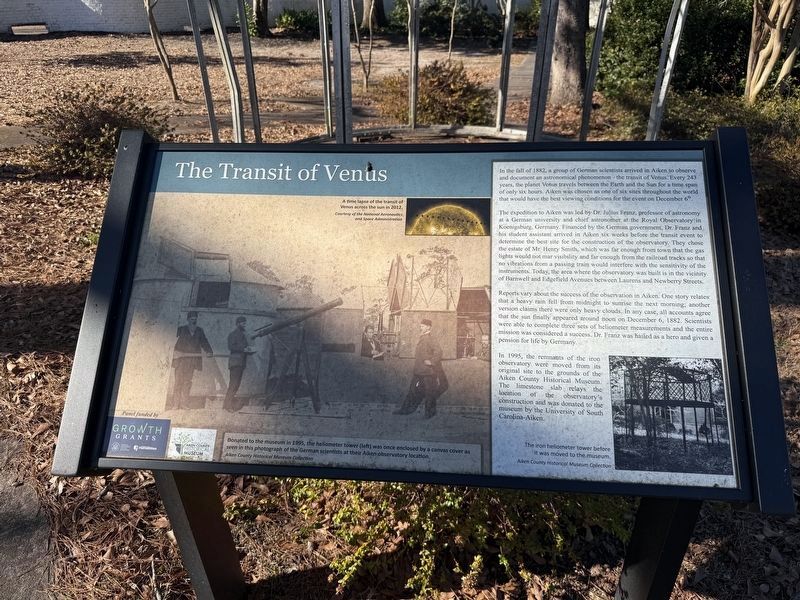
In the fall of 1882, a group of German scientists arrived in Aiken to observe and document an astronomical phenomenon - the transit of Venus. Every 243 years, the planet Venus travels between Earth and the Sun for a time span of only six hours. Aiken was chosen as one of six sites throughout the world that would have the best viewing conditions for the event on December 6th.
The expedition to Aiken was led by Dr. Julius Franz, professor of astronomy at a German university and chief astronomer at the Royal Observatory in Koenigsburg, Germany. Financed by the German government, Dr. Franz and his student assistant arrived in Aiken six weeks before the transit event to determine the best site for the construction of the observatory. They chose the estate of Mr. Henry Smith, which was far enough from the town that the gas lights would not mar visibility and far enough from the railroad tracks so that no vibrations from a passing train would interfere with the sensitivity of the instruments. Today, the area where the observatory was built is in the vicinity of Barnwell and Edgefield Avenues between Laurens and Newberry Streets.
Reports
this page online
In 1995, the remnants of the iron observatory were moved from its original site to the grounds of the Aiken County Historical Museum. The limestone slab relays the location of the observatory's construction and was donated to the museum by the University of South Carolina-Aiken.
[Caption:]
Donated to the museum in 1995, the heliometer tower (left) was once enclosed by a canvas cover as seen in this photograph of the German scientists at their Aiken observatory location.
Erected by Friends of the Aiken County Historical Museum, with panel funding by Growth Grants via the National Endowment for the Humanities and South Carolina Humanities.
Topics. This

Location. 33° 33.291′ N, 81° 43.544′ W. Marker is in Aiken, South Carolina, in Aiken County. It can be reached from the intersection of Newberry Street Southwest and New Lane Southwest, on the right when traveling south. Touch for map. Marker is at or near this postal address: 339 New Ln SW, Aiken SC 29801, United States of America. Touch for directions.

Regionally, this marker is in Greater Augusta and in the Midlands. It is also in the American South and specifically in the Deep South. Globally, it is in North America, the Western Hemisphere, the Western World, and the Anglosphere. Historically, it finds itself in what was once the territory of the Mississippian Culture, one of the original Thirteen Colonies, one of the Confederate States of America, and the Antebellum South.
Other nearby markers. At least 8 other markers are within walking distance of this marker: Leah Walker (within shouting distance of this marker); "Banksia" (within shouting distance of this marker); Aiken County Museum (within shouting distance of this marker); Aiken County Courthouse Bell (within shouting distance of this marker); a different marker also named Banksia (about 300 feet away); Hitchcock Woods (about 300 feet away); Ergle Family Log Cabin (about 400 feet away); Frederick Ergle Log Cabin (about 400 feet away). Touch for a list and map of all markers in Aiken.
Other markers no longer nearby. Transit of Venus Observatory Structure, 1882 (was a few steps from this marker but has been replaced with another marker now near it); a different marker also named Aiken County Courthouse Bell (was about 300 feet away, measured in a direct line but has been replaced with another marker now near it).
Credits. This page was last revised on January 20, 2026. It was originally submitted on January 20, 2026, by Devry Becker Jones of Washington, District of Columbia. This page has been viewed 60 times since then. Photos: 1, 2. submitted on January 20, 2026, by Devry Becker Jones of Washington, District of Columbia.
