Lake City in Hinsdale County, Colorado — The American Mountains (Southwest)
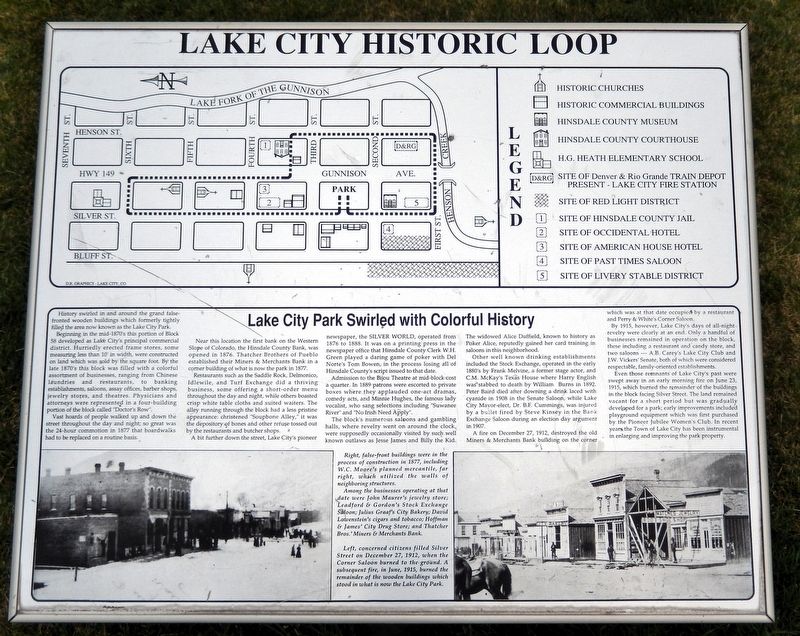
Lake City Historic Loop
Lake City Park Swirled with Colorful History
Photographed by Cosmos Mariner, July 21, 2025
1. Lake City Historic Loop Marker
History swirled in and around the grand false-fronted wooden buildings which formerly tightly filled the area now known as the Lake City Park.
Beginning in the mid-1870's this portion of Block 58 developed as Lake City's principal commercial district. Hurriedly erected frame stores, some measuring less than 10' in width, were constructed on land which was sold by the square foot. By the late 1870's this block was filled with a colorful assortment of businesses, ranging from Chinese laundries and restaurants, to banking establishments, saloons, assay offices, barber shops, jewelry stores, and theatres. Physicians and attorneys were represented in a four-building portion of the block called "Doctor's Row".
Vast hordes of people walked up and down the street throughout the day and night; so great was the 24-hour commotion in 1877 that boardwalks had to be replaced on a routine basis.
Near this location the first bank on the Western Slope of Colorado, the Hinsdale County Bank, was opened in 1876. Thatcher Brothers of Pueblo established their Miners & Merchants Bank in a corner building of what is now the park in 1877.
Restaurants
this page online
A bit further down the street, Lake City's pioneer newspaper, the SILVER WORLD, operated from 1876 to 1888. It was on a printing press in the newspaper office that Hinsdale County Clerk W.H. Green played a daring game of poker with Del Norte's Tom Bowen, in the process losing all of Hinsdale County's script issued to that date.
Admission to the Bijou Theatre at mid-block cost a quarter. In 1889 patrons were escorted to private boxes where they applauded one-act dramas, comedy acts, and Minnie Hughes, the famous lady vocalist, who sang selections including "Suwanee River" and "No Irish Need Apply".
The block's numerous saloons and gambling halls, where revelry went on around the clock, were supposedly occasionally visited by such
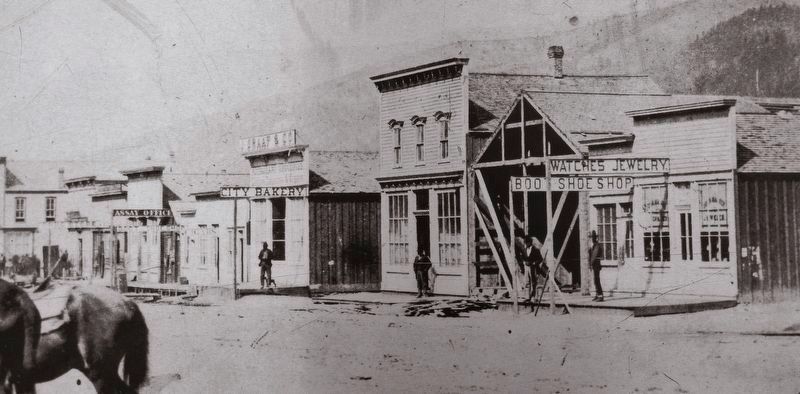
2. Marker detail: False-front buildings in the process of construction in 1877
Including W.C. Moore's planned mercantile, far right, which utilized the walls of neighboring structures. Among the businesses operating at that date were John Maurer's jewelry store; Leadford & Gordon's Stock Exchange Saloon; Julius Graaf's City Bakery; David Lowenstein's cigars and tobacco; Hoffman & James' City Drug Store; and Thatcher Bros.' Miners & Merchants Bank.
Other well known drinking establishments included the Stock Exchange, operated in the early 1880's by Frank Melvine, a former stage actor, and C.M. McKay's Texas House where Harry English was stabbed to death by William Burns in 1892. Peter Baird died after downing a drink laced with cyanide in 1908 in the Senate Saloon, while Lake City Mayor-elect, Dr. B.F. Cummings, was injured by a bullet fired by Steve Kinsey in the Bank Exchange Saloon during an election day argument in 1907.
A fire on December 27, 1912, destroyed the old Miners & Merchants Bank building on the corner which was at that date occupied by a restaurant and Perry & White's Corner Saloon.
By 1915, however, Lake City's days of all-night revelry were clearly at an end. Only a handful of businesses remained in operation on the block, these including a restaurant and candy store, and two saloons — A.B. Carey's Lake City Club and J.W. Vickers' Senate, both of which were considered respectable,
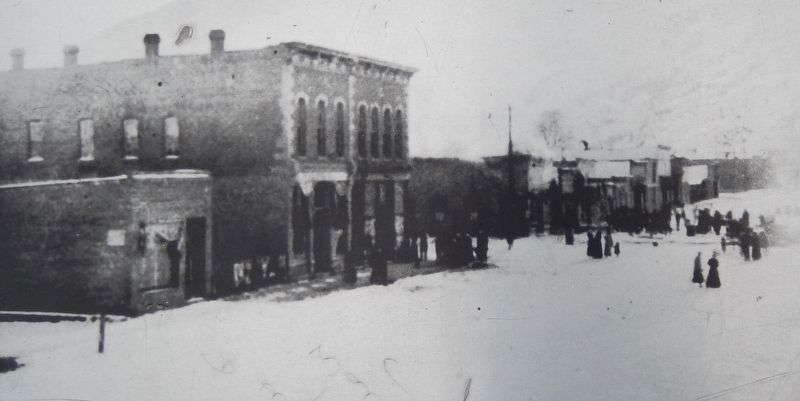
3. Marker detail: Concerned citizens filled Silver Street on December 27, 1912
The Corner Saloon burned to the ground. A subsequent fire, in June, 1915, burned the remainder of the wooden buildings which stood in what is now the Lake City Park.
Even those remnants of Lake City's past were swept away in an early morning fire on June 23, 1915, which burned the remainder of the buildings in the block facing Silver Street. The land remained vacant for a short period but was gradually developed for a park; early improvements included playground equipment which was first purchased by the Pioneer Jubilee Women's Club. In recent years, the Town of Lake City has been instrumental in enlarging and improving the park property.
Topics. This historical marker is listed in these topic lists: Architecture • Industry & Commerce • Parks & Recreational Areas • Settlements & Settlers. A significant historical year for this entry is 1876.
Location. 38° 1.715′ N, 107° 19.03′ W. Marker is in Lake City, Colorado, in Hinsdale County. It is on Silver Street just south of 3rd Street, on the left when traveling south. The marker is on the west side of Lake City Town Park. Touch for map. Marker is in this post office area: Lake City CO 81235, United States of America. Touch for directions.

Regionally, this marker is in the Colorado High Rockies. It is also
Photographed by Cosmos Mariner, July 21, 2025
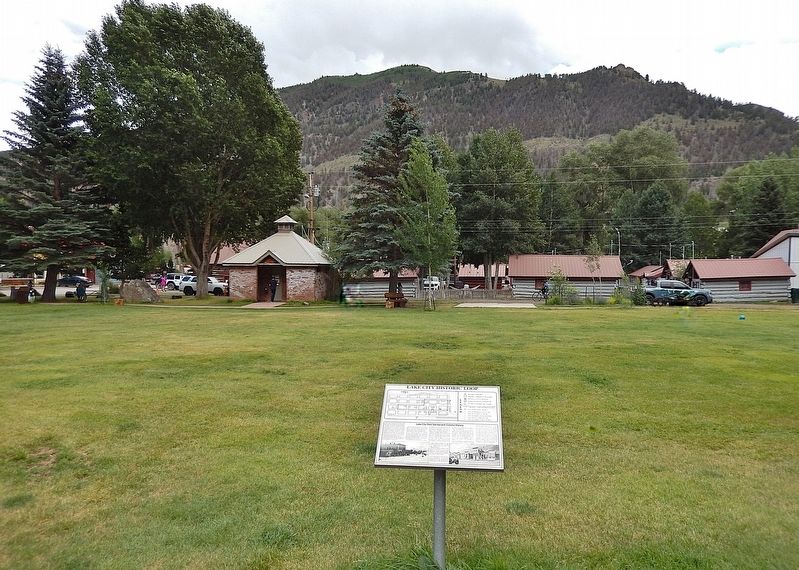
4. Lake City Historic Loop Marker
Looking east across Lake City Town Park.
Other nearby markers. At least 8 other markers are within walking distance of this marker: Stone Bank Block — Built 1877 (within shouting distance of this marker); 1984 New Orleans World's Fair Flag Pole (within shouting distance of this marker); Crystal Lake Lodge No. 34 A.F. & A.M. (within shouting distance of this marker); Hough Block — Built 1880-82 (within shouting distance of this marker); Architectural Contrasts — 1877, 1947 (about 300 feet away, measured in a direct line); Armory Hall — Built 1883 (about 300 feet away); Hughes Cabin — 1876 (about 300 feet away); The Colorado-Yule Marble Company (about 400 feet away). Touch for a list and map of all markers in Lake City.
Also see . . . Lake City, Colorado (Wikipedia).
Excerpt: Lake City was platted in fall 1874 during construction of the Saguache & San Juan Wagon Toll Road, which opened the San Juan region for settlement. Town developers chose this location for the town site because of its flat terrain and(Submitted on January 24, 2026, by Cosmos Mariner of Cape Canaveral, Florida.)abundant water. They laid out a 260-acre town site that occupied the entire valley floor - 72 blocks of 32 uniform city lots, 25' x 125' in size. To promote the speculative town, Otto Mears subsidized The Silver World newspaper and published the first issue on June 19, 1875.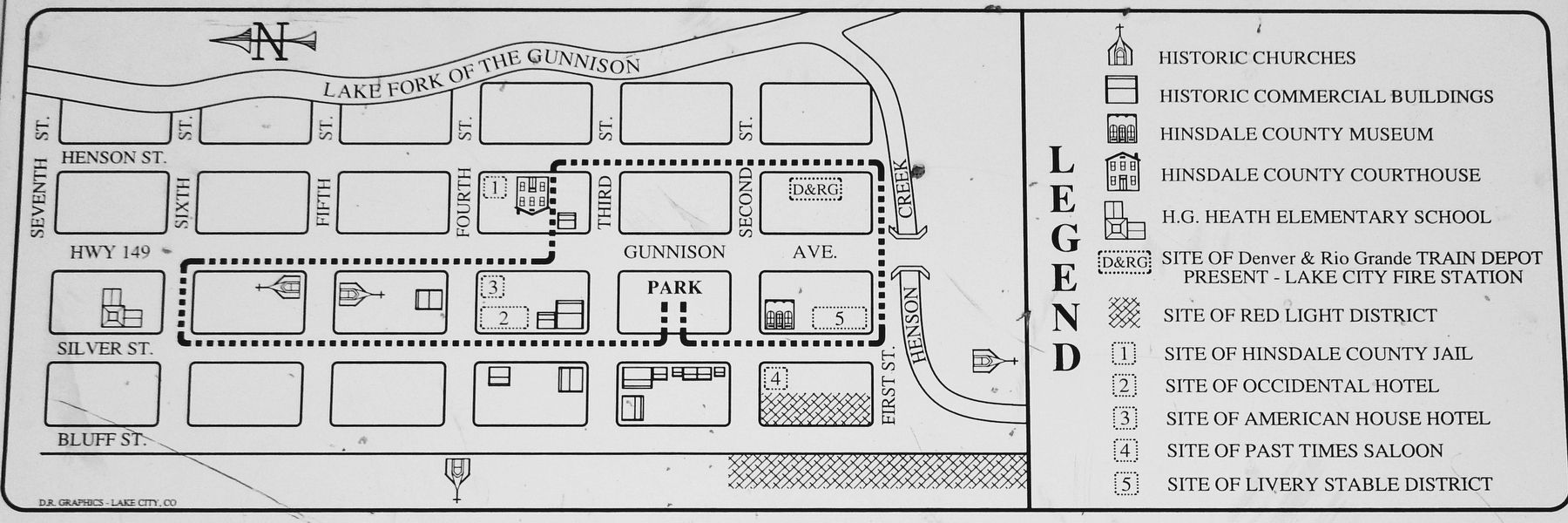 5. Marker detail: Lake City Historic Loop Map
It was not unusual for mining towns to grow into boom towns within a matter of only a few months, and Lake City was no exception. Promoted as the "Metropolis of San Juan", the town flourished as a distribution point for goods and supplies forwarded to mines and camps in the northern Hinsdale County mining districts. The initial influx of pioneers, prospectors, and miners attracted scores of merchants and dozens of lawyers and assayers to provide goods, supplies, and services. Merchants profited by outfitting the surge of prospectors who flooded into the area in 1876 and 1877 and by supplying dozens of mines in the outlying mining districts. Constructed of rapidly built wooden structures, much of the town was destroyed by a fire in 1879.
Credits. This page was last revised on January 24, 2026. It was originally submitted on January 21, 2026, by Cosmos Mariner of Cape Canaveral, Florida. This page has been viewed 44 times since then. Photos: 1. submitted on January 23, 2026, by Cosmos Mariner of Cape Canaveral, Florida. 2, 3, 4, 5. submitted on January 24, 2026, by Cosmos Mariner of Cape Canaveral, Florida.
