Midtown - Downtown in Columbia in Richland County, South Carolina — The American South (South Atlantic)
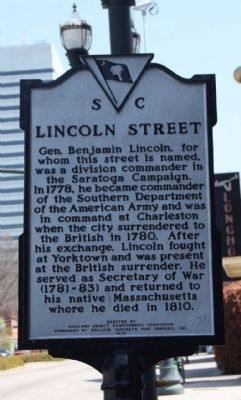
Lincoln Street
Photographed by Mike Stroud, 2010
1. Lincoln Street Marker
Erected 1988 by the Richland County Bicentennial Commission; sponsored by Wallace Concrete Pipe Company, Inc. (Marker Number 40-76.)
Topics and series. This historical marker is listed in these topic lists: Roads & Vehicles • War, US Revolutionary. In addition, it is included in the South Carolina Historical Markers series list. A significant historical year for this entry is 1778.
Location. 33° 59.976′ N, 81° 2.325′ W. Marker is in Columbia, South Carolina, in Richland County. It is in Midtown - Downtown. It is at the intersection of Gervais Street (U.S. 1/378) and Lincoln Street, on the right when traveling east on Gervais Street. Touch for map. Marker is in this post office area: Columbia SC 29201, United States of America. Touch for directions.

Regionally, this marker is in the Midlands. It is also in the American South and specifically in the Deep South. Globally, it is in North America, the Western Hemisphere, the Western World, and the Anglosphere. Historically, it finds itself in what was once the territory of the Mississippian Culture, one of the original Thirteen Colonies, one of the Confederate States of America, and the Antebellum South.
Other nearby markers. At least 8 other markers are within walking distance of this marker: Seaboard Air-Line Railway Station #1 (within shouting distance of this marker); DuPre Building (within
this page online
Also see . . .
1. History of War- Benjamin Lincoln. The Savannah River was the border between South Carolina and Georgia, and it was now falling into British hands. As Lincoln moved to join with the survivors of Howe’s force, the British moved to secure control over Georgia. Augusta soon fell, and the British issued a proclamation inviting the Georgians to renew their oaths of loyalty to George III. At least initially, the response to this call was everything the British could have hoped for. Lincoln now had to rebuild his army. He camped at Puryburg, on the Carolinian side of the Savannah River, where he was able to gather 1,400 men.... (Submitted on March 28, 2010, by Mike Stroud of Bluffton, South Carolina.)
2. Benjamin Lincoln, Wikipedia entry.
Photographed by Mike Stroud, March 27, 2010
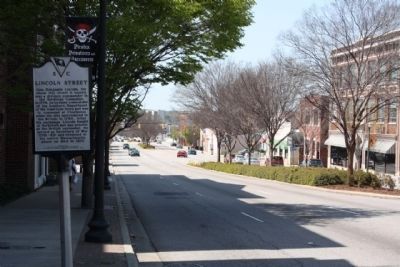
2. Lincoln Street Marker, looking back west along Gervais Street (US 1, US 378)
Photographed by Wikipedia, Charles Willson Peale
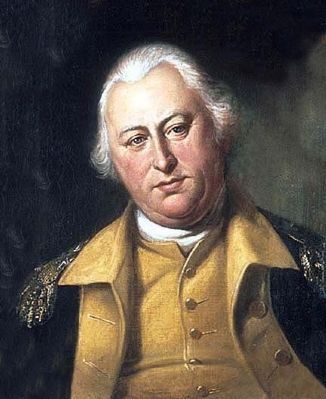
3. Gen. Benjamin Lincoln
Credits. This page was last revised on February 16, 2023. It was originally submitted on March 28, 2010, by Mike Stroud of Bluffton, South Carolina. This page has been viewed 1,024 times since then and 35 times this year. Photos: 1, 2, 3. submitted on March 29, 2010, by Mike Stroud of Bluffton, South Carolina. • Kevin W. was the editor who published this page.
