Lake City in Hinsdale County, Colorado — The American Mountains (Southwest)
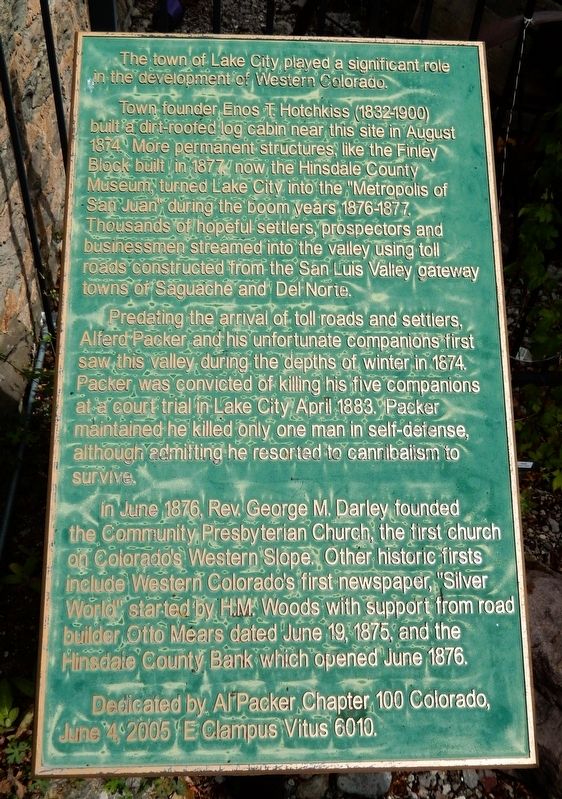
Lake City Played a Significant Role in the Development of Western Colorado
Photographed by Cosmos Mariner, July 21, 2025
1. Lake City Played a Significant Role in the Development of Western Colorado Marker
Predating the arrival of toll roads and settlers, Alferd Packer and his unfortunate companions first saw this valley during the depths of winter in 1874. Packer was convicted of killing his five companions at a court trial in Lake City April 1883. Packer maintained he killed only one man in self-defense, although admitting he resorted to cannibalism to survive.
In June 1876, Rev. George M. Darley founded the Community Presbyterian Church, the first church on Colorado’s Western Slope. Other historic firsts include Western Colorado’s first newspaper, “Silver World” started by H.M. Woods with support from road builder Otto Mears dated June 19, 1875, and the Hinsdale County
this page online
Erected 2005 by Al Packer Chapter 100 Colorado, E Clampus Vitus. (Marker Number 6010.)
Topics and series. This historical marker is listed in these topic lists: Industry & Commerce • Religion & Religious Structures • Roads & Vehicles • Settlements & Settlers. In addition, it is included in the E Clampus Vitus series list. A significant historical month for this entry is August 1874.
Location. 38° 1.65′ N, 107° 19.062′ W. Marker is in Lake City, Colorado, in Hinsdale County. It is at the intersection of Silver Street and 2nd Street (County Road 20), on the right when traveling north on Silver Street. The marker is beside the southwest corner of the Hinsdale County Museum building. Touch for map. Marker is at or near this postal address: 130 Silver Street, Lake City CO 81235, United States of America. Touch for directions.

Regionally, this marker is in the Colorado High Rockies. It is also in the American Mountain West. Globally, it is in North America, the Rocky Mountains, the Western Hemisphere, the Western World, and the Anglosphere.
Other nearby markers. At least 8 other markers are within
Photographed by Cosmos Mariner, July 21, 2025
2. Lake City Played a Significant Role in the Development of Western Colorado Marker
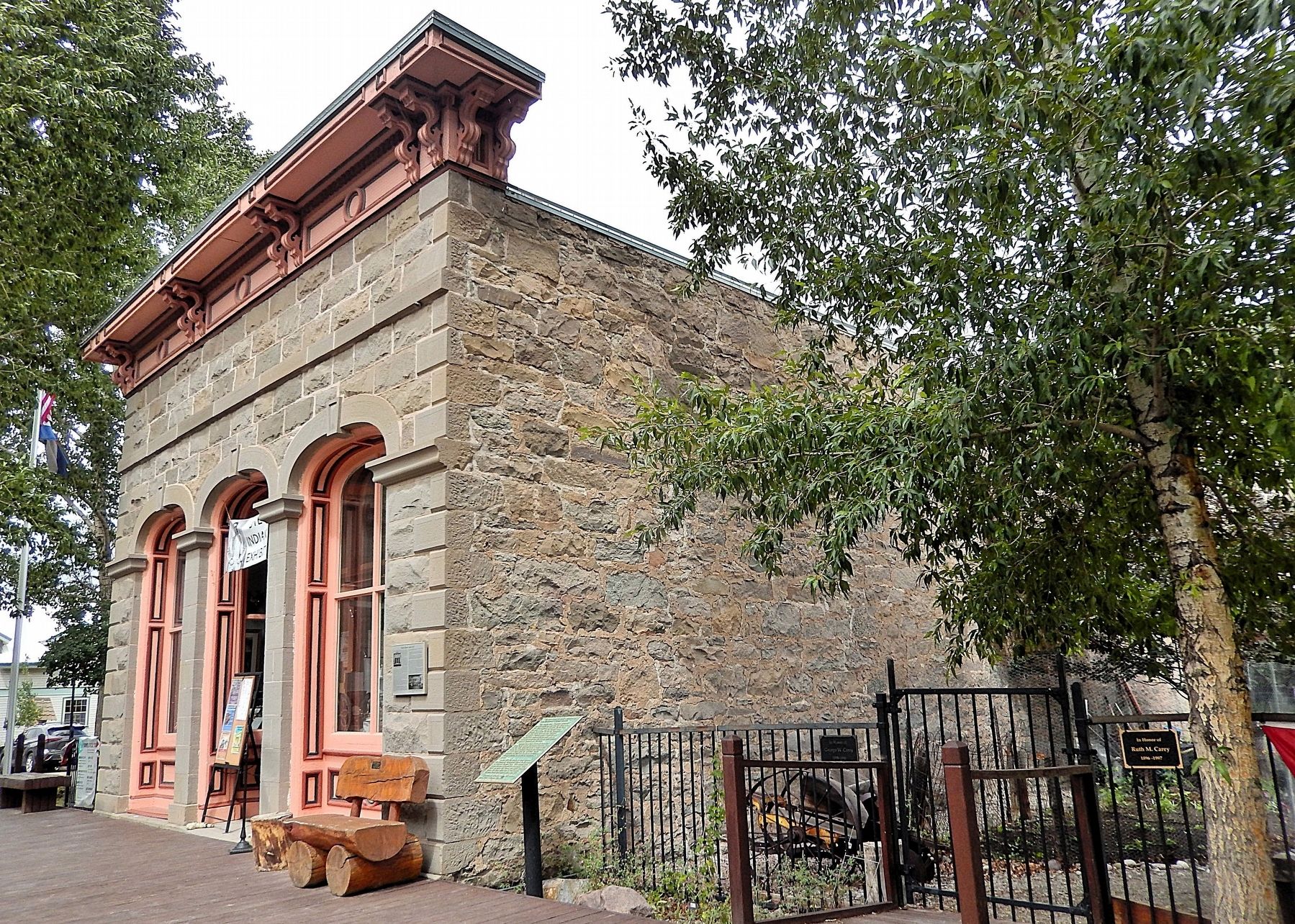
The marker is beside the southwest corner of the Hinsdale County Museum building, which was built as the Finley Block in 1877.
Related markers. Click here for a list of markers that are related to this marker.
Also see . . . Lake City, Colorado (Wikipedia).
Excerpt: With the completion of the first road into the mountains in this region, Lake City served as a supply center for the many miners and prospectors flooding into the area. As a supply center, the town boomed to as many as 3,000 to 5,000 settlers. But as the first-discovered deposits were found to be only moderately productive and no new extensive or rich deposits of minerals were found, by 1879 the boom had subsided. With the arrival of the Denver & Rio Grande Railroad in 1889, Lake City saw a second upturn in the economy that lasted into the 1890s.(Submitted on January 26, 2026, by Cosmos Mariner of Cape Canaveral, Florida.)By 1905, the mining era was over and Lake City entered a decades-long period of economic decline. Population figures hovered at 1,000 then dropped to 400 after 1910. Although mining continued throughout the twentieth century, it consisted primarily of exploration and speculation rather than productive operation. Beginning in 1915, visitors began coming to Lake City for the entire summer season and by the 1930s tourism had emerged as a viable industry.
Credits. This page was last revised on January 26, 2026. It was originally submitted on January 23, 2026, by Cosmos Mariner of Cape Canaveral, Florida. This page has been viewed 35 times since then. Photos: 1, 2. submitted on January 26, 2026, by Cosmos Mariner of Cape Canaveral, Florida.
