Lake City in Hinsdale County, Colorado — The American Mountains (Southwest)
Finley Block — Built 1877
Photographed by Cosmos Mariner, July 21, 2025
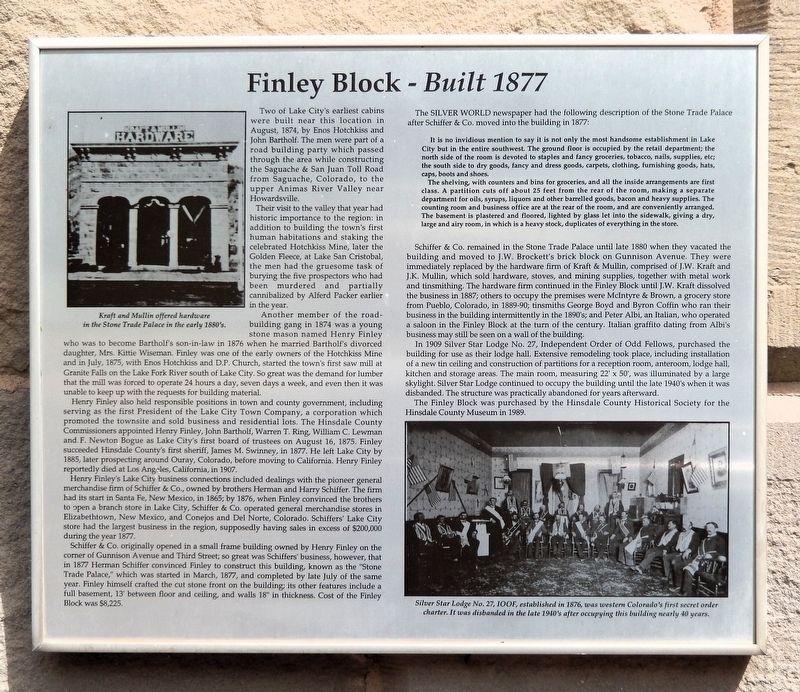
1. Finley Block — Built 1877 Marker
Two of Lake City's earliest cabins were built near this location in August, 1874, by Enos Hotchkiss and John Bartholf. The men were part of a road building party which passed through the area while constructing the Saguache & San Juan Toll Road from Saguache, Colorado, to the upper Animas River Valley near Howardsville.
Their visit to the valley that year had historic importance to the region: in addition to building the town's first human habitations and staking the celebrated Hotchkiss Mine, later the Golden Fleece, at Lake San Cristobal, the men had the gruesome task of burying the five prospectors who had been murdered and partially cannibalized by Alferd Packer earlier in the year.
Another member of the road-building gang in 1874 was a young stone mason named Henry Finley who was to become Bartholf's son-in-law in 1876 when he married Bartholf's divorced daughter, Mrs. Kittie Wiseman. Finley was one of the early owners of the Hotchkiss Mine and in July, 1875, with Enos Hotchkiss and D.P. Church, started the town's first saw mill at Granite Falls on the Lake Fork River south of Lake City. So great was the demand for
this page online
Henry Finley also held responsible positions in town and county government, including serving as the first President of the Lake City Town Company, a corporation which promoted the townsite and sold business and residential lots. The Hinsdale County Commissioners appointed Henry Finley, John Bartholf, Warren T. Ring, William C. Lewman and F. Newton Bogue as Lake City's first board of trustees on August 16, 1875. Finley succeeded Hinsdale County's first sheriff, James M. Swinney, in 1877. He left Lake City by 1885, later prospecting around Ouray, Colorado, before moving to California. Henry Finley reportedly died at Los Angeles, California, in 1907.
Henry Finley's Lake City business connections included dealings with the pioneer general merchandise firm of Schiffer & Co., owned by brothers Herman and Harry Schiffer. The firm had its start in Santa Fe, New Mexico, in 1865; by 1876, when Finley convinced the brothers to open a branch store in Lake City, Schiffer & Co. operated general
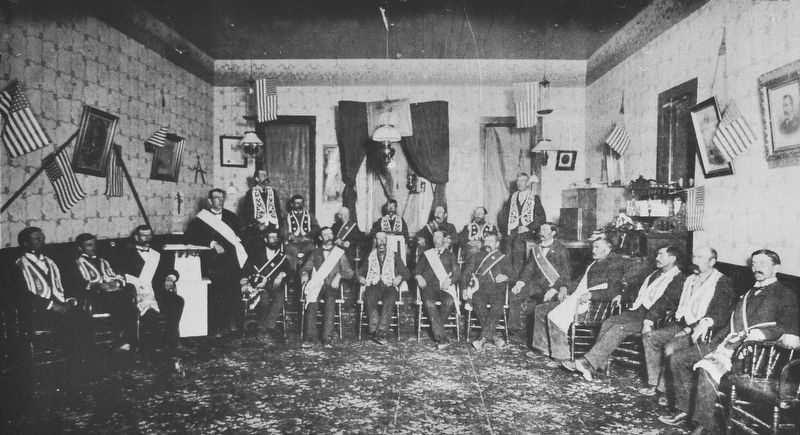
2. Marker detail: Silver Star Lodge No. 27, IOOF
Schiffer & Co. originally opened in a small frame building owned by Henry Finley on the corner of Gunnison Avenue and Third Street; so great was Schiffers' business, however, that in 1877 Herman Schiffer convinced Finley to construct this building, known as the "Stone Trade Palace," which was started in March, 1877, and completed by late July of the same year. Finley himself crafted the cut stone front on the building; its other features include a full basement, 13' between floor and ceiling, and walls 18" in thickness. Cost of the Finley Block was $8,225.
The SILVER WORLD newspaper had the following description of the Stone Trade Palace after Schiffer & Co. moved into the building in 1877:
It is no invidious mention to say it is not only the most handsome establishment in Lake City but in the entire southwest. The ground floor is occupied by the retail department; the north side of the room is devoted to staples andSchiffer & Co. remained in the Stone Trade Palace until late 1880 when they vacated the building and moved to J.W. Brockett's brick block on Gunnison Avenue. They were immediately replaced by the hardware firm of Kraft & Mullin, comprised of J.W. Kraft and J.K. Mullin, which sold hardware, stoves, and mining supplies, together with metal work and tinsmithing. The hardware firm continued in the Finley Block until J.W. Kraft dissolvedfancy groceries, tobacco, nails, supplies, etc; the south side to dry goods, fancy and dress goods, carpets, clothing, furnishing goods, hats, caps, boots and shoes.Photographed by Cosmos Mariner, July 21, 20253. Finley Block — Built 1877 MarkerThe marker is mounted at eye level on the southwest corner of the building, facing Silver Street.
The shelving, with counters and bins for groceries, and all the inside arrangements are first class. A partition cuts off about 25 feet from the rear of the room, making a separate department for oils, syrups, liquors and other barrelled goods, bacon and heavy supplies. The counting room and business office are at the rear of the room, and are conveniently arranged. The basement is plastered and floored, lighted by glass let into the sidewalk, giving a dry, large and airy room, in which is a heavy stock, duplicates of everything in the store.
Photographed by Cosmos Mariner, July 21, 2025
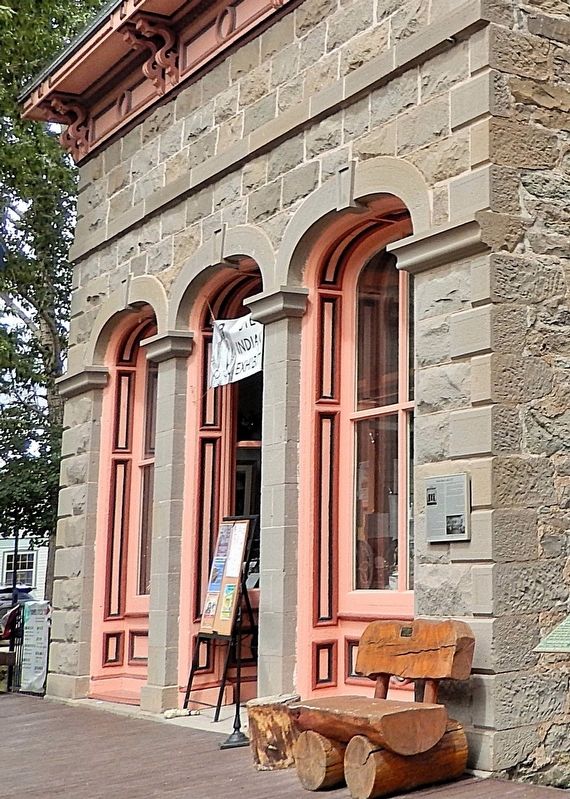
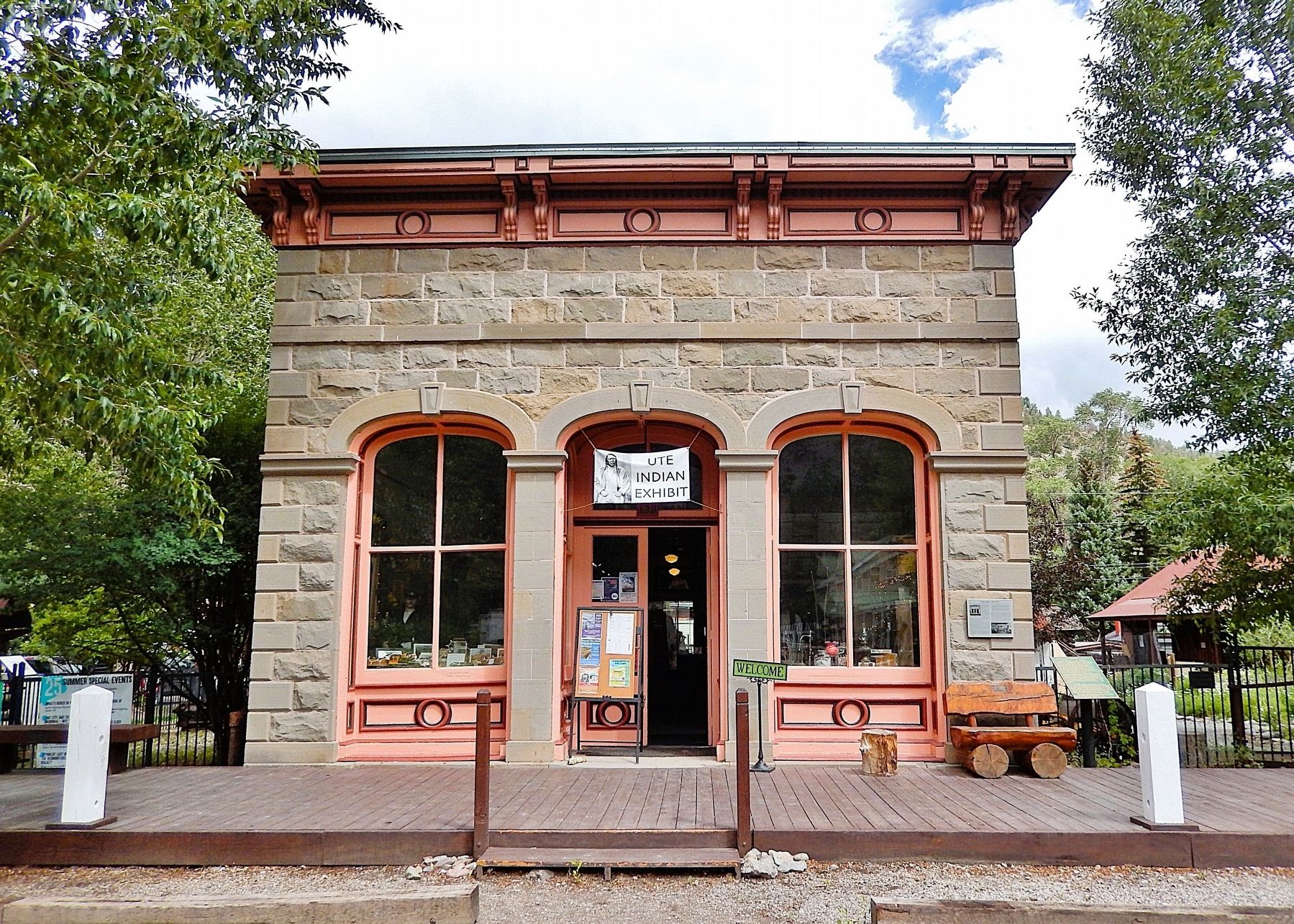
4. Finley Block — Built 1877
The historical marker is between the right [south] window and right edge of the facade. Today this building houses the Hinsdale County Museum.
In 1909 Silver Star Lodge No. 27, Independent Order of Odd Fellows, purchased the building for use as their lodge hall. Extensive remodeling took place, including installation of a new tin ceiling and construction of partitions for a reception room, anteroom, lodge hall, kitchen and storage areas. The main room, measuring 22' x 50', was illuminated by a large skylight. Silver Star Lodge continued to occupy the building until the late 1940's when it was disbanded. The structure was practically abandoned for years afterward.
The Finley Block was purchased by the Hinsdale County Historical Society for the Hinsdale County Museum in 1989.
[top left photo caption] Kraft and Mullin offered hardware in the Stone Trade Palace in the early 1880’s.
Topics and series. This historical marker is listed in these topic lists: Architecture • Industry & Commerce • Roads & Vehicles • Settlements & Settlers. In addition, it is included in the National Register of Historic Places (NRHP) series list. A significant historical year for this entry is 1877.
Location. 38° 1.65′ N, 107° 19.062′ W. Marker is in Lake City, Colorado, in Hinsdale County. It is at the intersection of Silver Street and 2nd Street (County Road 20), on the right when traveling north on Silver Street. The marker is mounted on the southwest corner of the Hinsdale County Museum building, facing Silver Street. Touch for map. Marker is at or near this postal address: 130 Silver Street, Lake City CO 81235, United States of America. Touch for directions.

Regionally, this marker is in the Colorado High Rockies. It is also in the American Mountain West. Globally, it is in North America, the Rocky Mountains, the Western Hemisphere, the Western World, and the Anglosphere.
Other nearby markers. At least 8 other markers are within walking distance of this marker: Lake City Played a Significant Role in the Development of Western Colorado (here, next to this marker); Colonel Channing Franklin Meek (a few steps from this marker); Bachelor Cabins, Carson (a few steps from this marker); The Colorado-Yule Marble Company (a few steps from this marker); Gaskill Hydrant (a few steps from this marker); Slag Cart (a few steps from this marker); Curtis Planer (within shouting distance of this marker); Car 211 (within shouting distance of this marker). Touch for a list and map of all markers in Lake City.
Regarding Finley Block — Built 1877. Contributing property, Lake City Historic District, National Register of Historic Places № 78000859. Also Colorado State Register of Historic Properties Site № 5HN.68.50
From the National Register Nomination prepared by Suzanne Mason, 3/1/1977:
The Italianate style is reflected in the facade with its ashlar quoins, belt course between the cornice and windows, elaborate bracketed cornice, and flattened-arched doorway with keystones. The front facade is dominated by three elliptical cut stone arches with dropped keystones. The building is crowned by an elaborately scrolled wood cornice and trusses.
George Bauer and Carl Schultz constructed the Finley Block. Sandstone for the Finley Block was cut from a quarry northwest of the townsite. Several different companies manufactured brick from clay from the Slumgullion Earth flow.
Also see . . .
1. Hinsdale County Museum — Finley Block (Society of Architectural Historians).
(by Thomas J. Noel) Excerpt: Henry Finley, the president of the Lake City Town Company, had this one-story store built with both dressed and rough stone. The facade has three elliptical-arched front openings, the center one being a recessed doorway. As the first stone edifice in town, the Finley Block marked Lake City's graduation from the tent, log, and frame stage of town building. Celebrated as the “Stone Trade Palace,” the building served as the Odd Fellows Hall for decades until 1974, when the Hinsdale County Historical Society converted it to a museum. This jewel retains its large storefront windows, double-bracketed metal cornice, and interior hardwood floors and pressed metal ceiling.(Submitted on January 26, 2026, by Cosmos Mariner of Cape Canaveral, Florida.)
2. Entrepreneurs: Henry Finley (Town of Lake City).
Excerpt: Henry Finley was instrumental in the development of the upper Lake Fork valley through his varied ownerships of sawmills, brick yards and toll roads, as well as serving as President of the Lake City Town Company. Finley constructed Finley Hall and other early frame commercial structures in 1875 and 1876, although none of these are extant. In 1877, Finley hired stone masons Bauer & Schultz to erect a fine emporium at 130 Silver Street. In 1880, Finley in partnership with Dr. J.P. Richardson, founded the Finley & Richardson brick company, which employed 25 men manufacturing 15,000 to 20,000 bricks per day.(Submitted on January 26, 2026, by Cosmos Mariner of Cape Canaveral, Florida.)
Credits. This page was last revised on January 26, 2026. It was originally submitted on January 23, 2026, by Cosmos Mariner of Cape Canaveral, Florida. This page has been viewed 45 times since then. Photos: 1, 2, 3, 4. submitted on January 26, 2026, by Cosmos Mariner of Cape Canaveral, Florida.
