Kipahulu in Hana in Maui County, Hawaii — Hawaiian Island Archipelago (Pacific Ocean)
'Ike Aku, 'Ike Mai, Kokua Aku, Kokua Mai, Pela Ka Nohona 'Ohana
Haleakāla National Park
| — | National Park Service, U.S. Department of the Interior | — |
Photographed by Darren Jefferson Clay, December 8, 2025
1. 'Ike Aku, 'Ike Mai, Kokua Aku, Kokua Mai, Pela Ka Nohona 'Ohana Marker
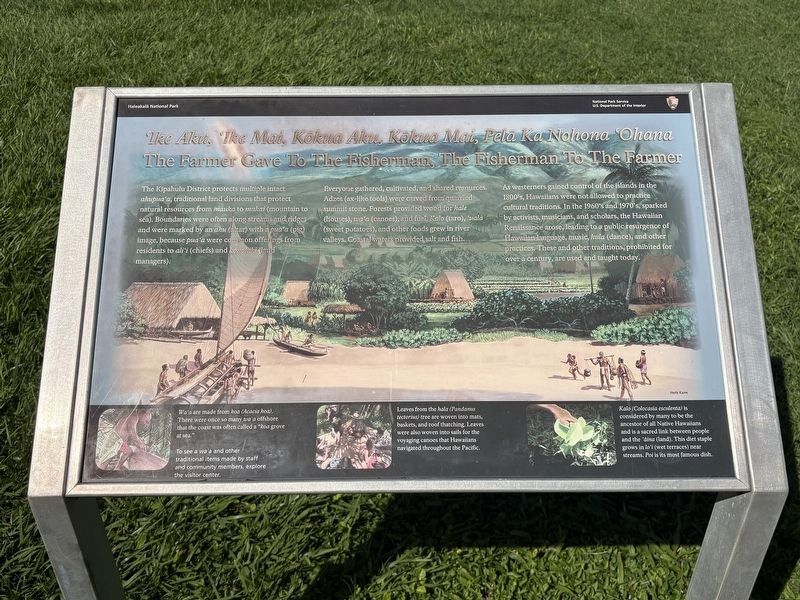
The Kipahulu District protects multiple intact ahupua'a, traditional land divisions that protect natural resources from mauka to makai (mountain to sea). Boundaries were often along streams and ridges and were marked by ahu (alter) with a pua'a (pig) image, because pua'a were common offerings from residents to ali'i (chiefs) and konohiki (land managers).
Everyone gathered, cultivated, and shared resources Adzes (ax-like tools) were carved from quarried summit stone. Forests provided wood for hale houses), wa'a (canoes), and fuel, Kalo (taro), 'uala (sweet potatoes), and other foods grew in river valleys. Coastal waters provided salt and fish.
As westerners gained control of the islands in the 1800's, Hawaiians were not allowed to practice cultural traditions. In the 1960s and 1970's, sparked by activists, musicians, and scholars, the Hawaiian Renaissance arose, leading to a public resurgence of Hawaiian language, music, hula (dance), and other practices. These and other traditions, prohibited for over a century, are used and taught today."
[Captions:]
Wa'a are made from koa (Acacia koa). There were once so many wa'a offshore that the coast was often called a "koa grove at sea."
To see a waa and other traditional items made by staff and community members, explore the visitor center
Leaves from the hala (Pandamus tectorius) trees are woven into mats, baskets, and roof thatching. Leaves were also woven into sails for the voyaging canoes that Hawaiians navigated throughout the Pacific.
Kale (Colocasia esculenta) is considered by many to be the ancestor of all Native Hawaiians and is a sacred link between people and the 'aina (land). This diet staple grows in lo'i (wet terraces) near streams. Pol is its most famous dish.
Erected by National
this page online
Topics. This historical marker is listed in these topic lists: Asian Americans • Natural Features • Settlements & Settlers.
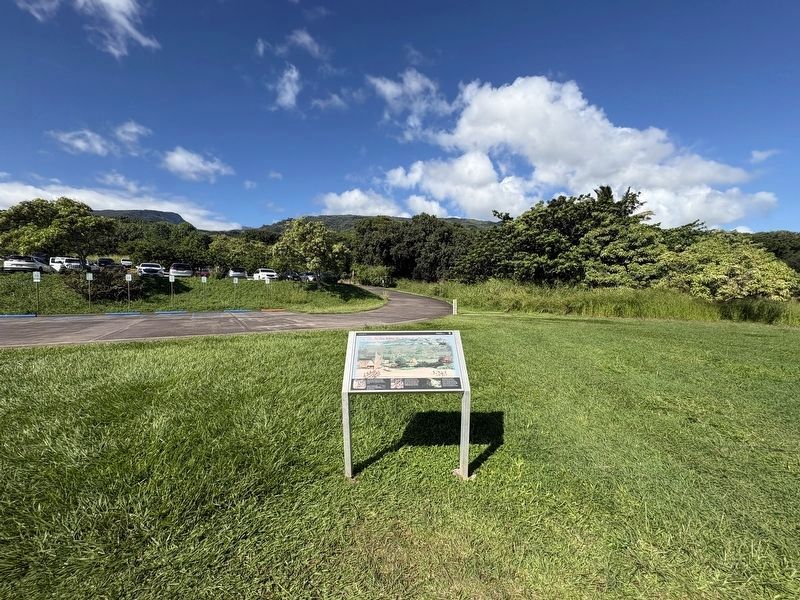
Location. 20° 39.707′ N, 156° 2.679′ W. Marker is in Hana, Hawaii, in Maui County. It is in Kipahulu. It can be reached from Kuloa Point Loop Trail. Marker can be found along the Kuloa Point Loop Trail. Touch for map. Marker is at or near this postal address: 42215 Kuloa Pt Lp Trl, Hana HI 96713, United States of America. Touch for directions.

Regionally, it is in North America, in Polynesia, in the Pacific Ocean, in North Pacific, on the Pacific Rim, in the Western Hemisphere, in the Western World, and in the Anglosphere.
Other nearby markers. At least 8 other markers are within walking distance of this marker: Ma Ka Hana Ka 'Ike / Insight Through Experience (here, next to this marker); The 1967 Kipahulu Expedition (a few steps from this marker); Hale Halawai - A House for Meeting, Eating, and Exchanging (within shouting distance of this marker); He Huliau ma Kipahulu or Change in Kipahulu (about
Photographed by Darren Jefferson Clay, December 8, 2025
2. 'Ike Aku, 'Ike Mai, Kokua Aku, Kokua Mai, Pela Ka Nohona 'Ohana Marker
Credits. This page was last revised on February 1, 2026. It was originally submitted on January 28, 2026, by Darren Jefferson Clay of Duluth, Georgia. This page has been viewed 78 times since then. Photos: 1, 2. submitted on January 31, 2026, by Darren Jefferson Clay of Duluth, Georgia. • Devry Becker Jones was the editor who published this page.
