Near Lake City in Hinsdale County, Colorado — The American Mountains (Southwest)
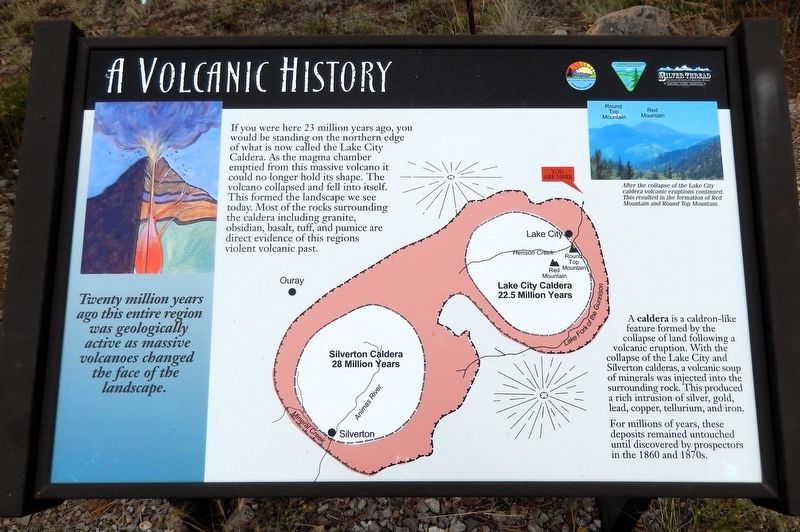
A Volcanic History
Photographed by Cosmos Mariner, July 21, 2025
1. A Volcanic History Marker
Twenty million years ago this entire region was geologically active as massive volcanoes changed the face of the landscape.
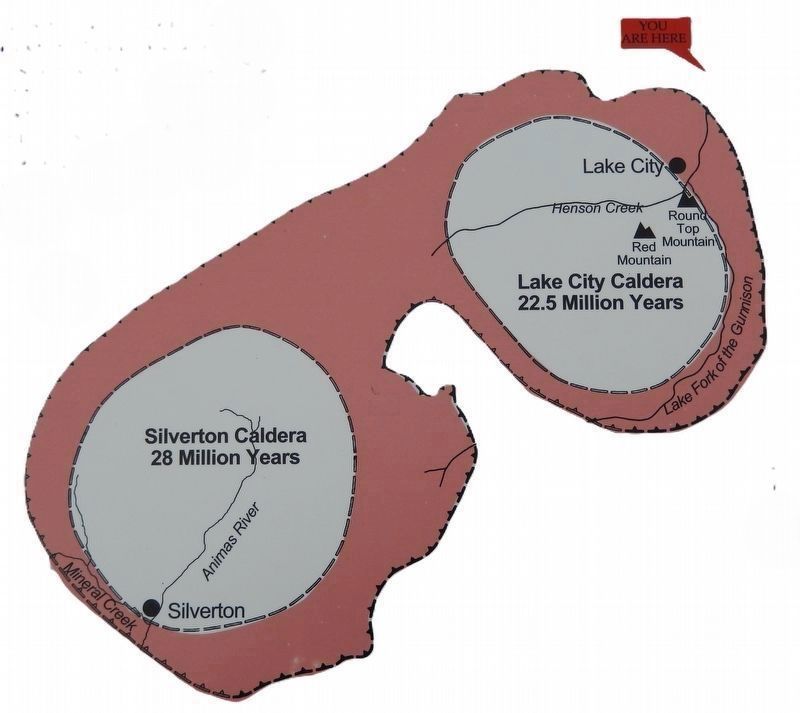
If you were here 23 million years ago, you would be standing on the northern edge of what is now called the Lake City Caldera. As the magma chamber emptied from this massive volcano it could no longer hold its shape. The volcano collapsed and fell into itself. This formed the landscape we see today. Most of the rocks surrounding the caldera including granite, obsidian, basalt, tuff, and pumice are direct evidence of this regions violent volcanic past.
A caldera is a caldron-like feature formed by the collapse of land following a volcanic eruption. With the collapse of the Lake City and Silverton calderas, a volcanic soup of minerals was injected into the surrounding rock. This produced a rich intrusion of silver, gold, lead, copper, tellurium, and iron.
For millions of years, these deposits remained untouched until discovered by prospectors in the 1860 and 1870s.
Erected by Western Colorado Interpretive Association and Bureau of Land Management, U.S. Department of the Interior.
Topics. This
this page online
Location. 38° 5.189′ N, 107° 17.612′ W. Marker is near Lake City, Colorado, in Hinsdale County. It is on Silver Thread Scenic Byway (State Highway 149 at milepost 76.8), 4 miles north of 8th Street, on the right when traveling north. The marker is in a scenic and interpretive wayside on the east side of the highway. Touch for map. Marker is in this post office area: Lake City CO 81235, United States of America. Touch for directions.

Regionally, this marker is in the Colorado High Rockies. It is also in the American Mountain West. Globally, it is in North America, the Rocky Mountains, the Western Hemisphere, the Western World, and the Anglosphere.
Other nearby markers. At least 8 other markers are within 4 miles of this marker, measured as the crow flies: Early Holocene Encampment (here, next to this marker); Roads into the Mountains (approx. 3.7 miles away); Metropolis of the San Juans (approx. 3.7 miles away); The Mountain People (approx. 3.7 miles away); Silver Thread Country (approx. 3.7 miles away); Colorado's Largest Narrow Leaf Cottonwood Tree
2. Marker detail: Lake City & Silverton Calderas
Also see . . . Lake City: Early History (History Colorado).
Excerpt: Prospectors had set up mining camps in the region as early as 1860, but the Utes and harsh winters drove them off. They returned in the early 1870s and made more significant discoveries, but large-scale mining could not occur until after 1873, when the local Ute population was removed under the Brunot Agreement.(Submitted on February 2, 2026, by Cosmos Mariner of Cape Canaveral, Florida.)On August 27, 1871, prospectors Harry Henson, Joel Mullen, Albert Meade, and Charles Goodwin discovered the Ute Ulay vein five miles above the mouth of Henson Creek, a tributary of the Lake Fork. On account of the Ute presence, they could not safely develop the vein at the time, but they returned in 1874 and established the first mining claim in what soon became Hinsdale County.
3. Marker detail: Red Mountain & Round Top Mountain
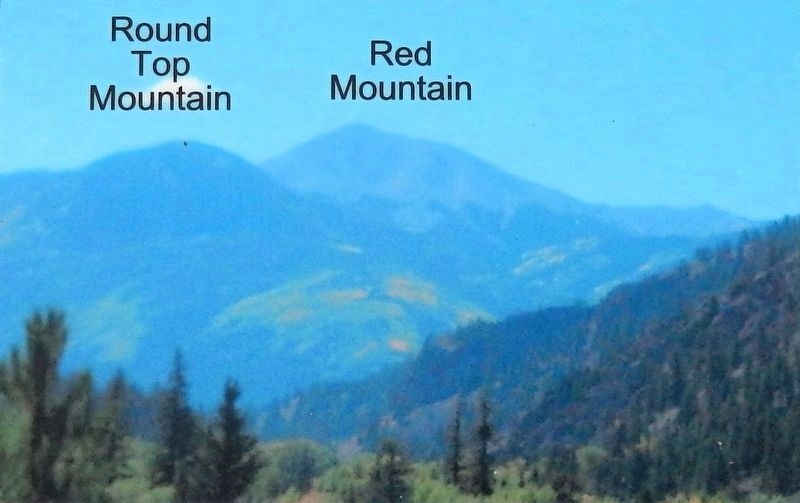
After the collapse of the Lake City caldera volcanic eruptions continued. This resulted in the formation of Red Mountain and Round Top Mountain.
Photographed by Cosmos Mariner, July 21, 2025
4. A Volcanic History Marker
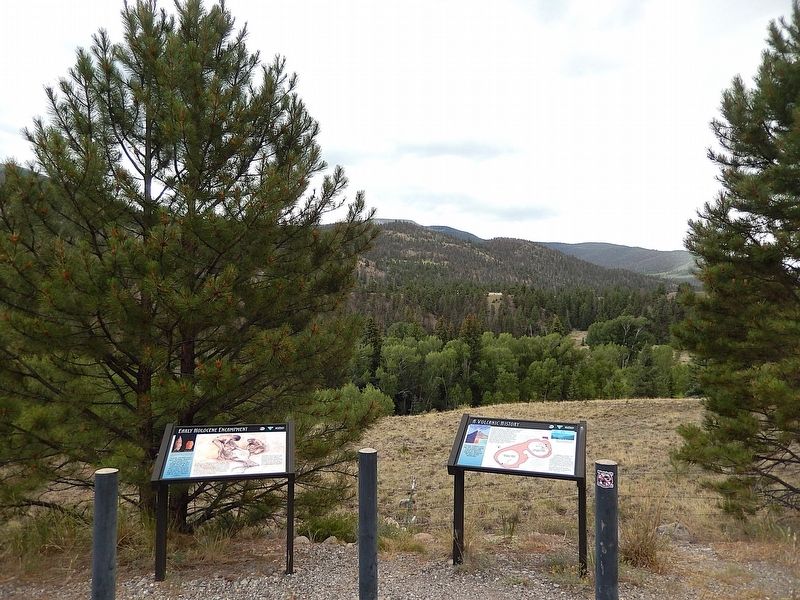
This marker is the rightmost of two interpretive panels at this location.
Credits. This page was last revised on February 2, 2026. It was originally submitted on January 29, 2026, by Cosmos Mariner of Cape Canaveral, Florida. This page has been viewed 44 times since then. Photos: 1, 2, 3, 4. submitted on February 2, 2026, by Cosmos Mariner of Cape Canaveral, Florida.
