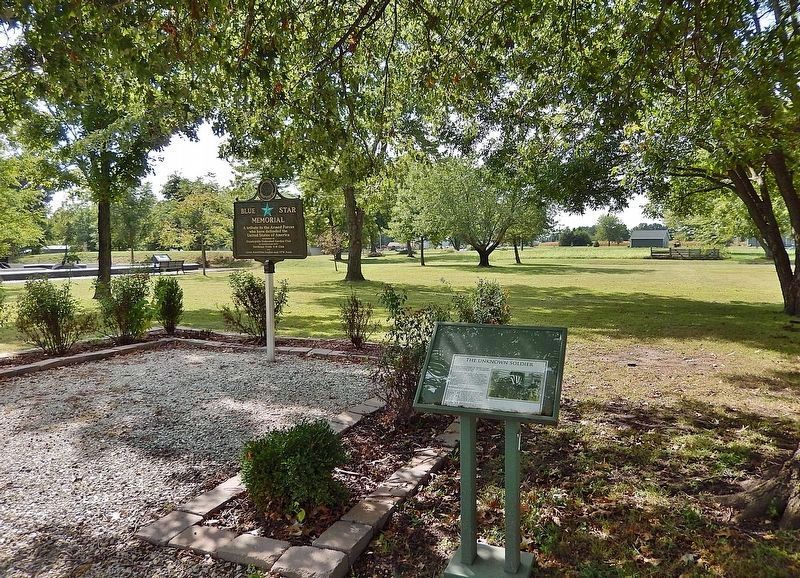
The Unknown Soldier

Sergeant Edward Younger was initially told that he had been picked to be one of the six pallbearers for unknowns of the A.E.F.
On October 24, 1921 at City Hall in Châlons-en-Champagne in a makeshift chapel, four flag draped caskets (each with an unknown from the major battlefields) were placed in a closed room. Sergeant Younger was informed that he would decide which remains would be chosen to receive flowers, and was handed a small bouquet of white roses.
He first prayed asking for guidance.
He then walked around the caskets three times. Stopping, he placed the bouquet of white roses atop the third casket from the left. Later he would say, “What caused me to stop, I do not know, it was as if something pulled me. I placed the roses on the casket in front of me.”
The remains were then transported to the U.S.S. Olympia to be brought back to the United States.
Topics and series. This historical marker is listed in these topic lists: Cemeteries & Burial Sites • Patriots & Patriotism • War, World I. In addition, it is included in the Distinguished Service Cross/Navy Cross/Air Force Cross Recipients, and the Medal of Honor Recipients
this page online
Location. 39° 47.392′ N, 93° 10.248′ W. Marker is in Laclede, Missouri, in Linn County. It can be reached from Olive Street just south of Ausmus Street, on the left when traveling north. The marker is beside the sidewalk, about 40 meters west of Olive Street. Touch for map. Marker is in this post office area: Laclede MO 64651, United States of America. Touch for directions.

Regionally, this marker is in North Missouri. It is also in the American Midwest, in the Lewis & Clark Corridor, and in the Corn Belt. Globally, it is in North America, the Western Hemisphere, the Western World, and the Anglosphere. Historically, it finds itself in what was once the territory of the Mississippian Culture, the Louisiana Purchase, and the Antebellum South.
Other nearby markers. At least 8 other markers are within walking distance of this marker: Suresnes American Cemetery and Memorial (within shouting distance of this marker); Meuse-Argonne American Cemetery and Memorial (within shouting distance of this marker); First World War Commemorative Garden (within shouting distance of
Also see . . .
1. Edward F. Younger (Wikipedia).
Excerpt: American United States Army soldier selected to choose the body that would become the American Unknown Soldier, representing all of those who were lost by the United States during World War I.(Submitted on February 2, 2026, by Cosmos Mariner of Cape Canaveral, Florida.)
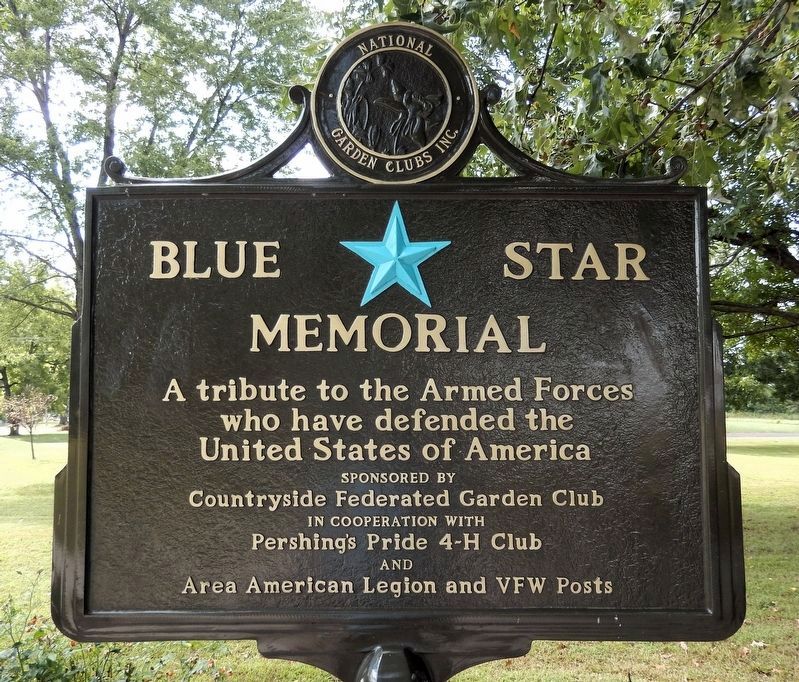
Younger enlisted in the Army in February 1917 and took part as an infantry sergeant in major engagements, including at Chateau-Thierry, St. Mihiel, the Somme Offensive, and the Meuse-Argonne Offensive. He was wounded twice, receiving the Purple Heart, and was highly decorated for valor with the Distinguished Service Cross. He then re-enlisted in 1919 and was stationed with the 15th Infantry,Army of Occupation, Mayen, Germany, when Washington officials named him as one of six soldiers to go to France to select the Unknown Soldier.Photographed by Cosmos Mariner, September 22, 20253. Blue Star MemorialA tribute to the Armed Forces
who have defended the United States of America
Sponsored by
Countryside Federated Garden Club
in cooperation with
Pershing's Pride 4-H Club
and
Area American Legion and VFW Posts
2. SGT Edward Francis Younger (Find A Grave).
(Arlington National Cemetery, Arlington, Virginia, USA) Excerpt: Sgt. Younger was selected from among the enlisted men who fought in World War I, to select the remains that would become the Unknown Soldier from “The War To End All Wars.” He was taken to a hotel room into which had been placed caskets of unidentifiable American war dead. He was given the task, by John J. Pershing, General of the Armies of the United States, of selecting which one would receive the singular distinction. He was selected due to an unblemished combat record, seeing action in every major offensive from 1917 to the end of the war, as well as having received the Distinguished Service Cross, the second highest valor decoration. Sgt. Younger took little time in making the selection, his choice designated by placing a lone flower on the casket. His memoirs reflect that he sensed the casket contained a chap seeming to tell him… “You fought with me.” The others were buried anonymously in an American War cemetery in France, while his choice received the US Medal of Honor, the Victoria Cross and the Medal Militaire. Younger became famous for this unsolicited role, his grave location at Arlington was long one of the most frequently requested. His book reflecting on the honor was entitled Known But Unto God.(Submitted on February 2, 2026, by Cosmos Mariner of Cape Canaveral, Florida.)
3. Tomb of the Unknown Soldier (Arlington National Cemetery) (Wikipedia).
Excerpt: The Tomb of the Unknown Soldier at Arlington National Cemetery in Arlington County, Virginia, United States is the burial site (and the white, marble sarcophagus above it) of a World War I soldier whose remains were unidentifiable. After a design competition was held in 1928, the winning project was completed in 1932. The World War I "Unknown" is a recipient of the Medal of Honor, the Victoria Cross, and several other foreign nations' highest service awards.(Submitted on February 2, 2026, by Cosmos Mariner of Cape Canaveral, Florida.)On Memorial Day, 1921, four unknown servicemen were exhumed from four World War I American cemeteries in France, Aisne-Marne, Meuse-Argonne, Somme, and St. Mihiel. U.S. Army Sgt. Edward F. Younger, who was wounded in combat, highly decorated for valor and received the Distinguished Service Cross, selected the Unknown of World War I from four identical caskets at the city hall in Châlons-en-Champagne, France, on 24 October 1921. Younger selected the World War I Unknown by placing a spray of white roses on one of the caskets. The chosen Unknown was transported to the United States aboard USS Olympia. Those remaining were interred in the Meuse Argonne Cemetery, France. The World War I Unknown lay in state in the Capitol Rotunda from his arrival in the United States until Armistice Day 1921. On 11 November 1921, President Warren G. Harding officiated at the interment ceremonies at the Memorial Amphitheater at Arlington National Cemetery.
Tomb of 1921
On 4 March 1921, the United States Congress approved the burial of an unidentified American serviceman from World War I in the plaza of the new Memorial Amphitheater. On 11 November 1921, the unknown soldier brought back from France was interred below a three-level marble tomb.Tomb of 1931
Since 1921, the intent was to place a superstructure on top of the Tomb, but it was not until 3 July 1926, that Congress authorized the completion of the Tomb and the expenditure of $50,000, equivalent to $707,000 in 2024. The Tomb was completed without formal ceremony on 9 April 1932.
Credits. This page was last revised on February 2, 2026. It was originally submitted on January 30, 2026, by Cosmos Mariner of Cape Canaveral, Florida. This page has been viewed 56 times since then. Photos: 1, 2, 3. submitted on February 2, 2026, by Cosmos Mariner of Cape Canaveral, Florida.
