Wailuku in Maui County, Hawaii — Hawaiian Island Archipelago (Pacific Ocean)
History of African Americans in Hawai'i
Photographed by Darren Jefferson Clay, December 7, 2025
1. History of African Americans in Hawai'i Marker
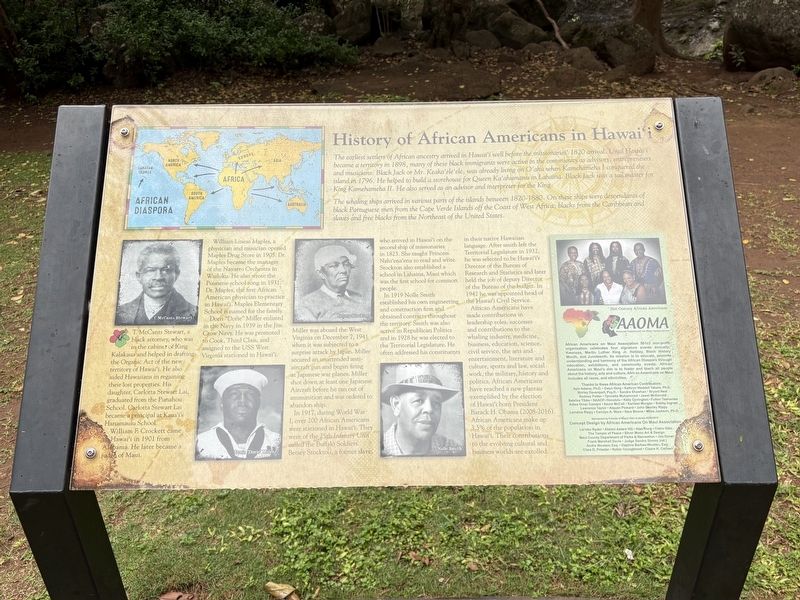
The earliest settlers of African ancestry arrived in Hawai'i well before the missionaries' 1820 arrival. Until Hawai'i became a territory in 1898, many of these black immigrants were active in the community as advisors, entrepreneurs and musicians. Black Jack or Mr. Keaka'ele'ele, was already living on O'ahi when Kamehameha I conquered the island in 1796. He helped build a storehouse for Queen Ka'ahumanu in Lahaina. Black Jack was a sail master for King Kamehameha II. He also served as an advisor and interpreter for the King.
The whaling ships arrived in various parts of the islands between 1820-1880. On these ships were descendants of black Portuguese men from Cape Verde Islands off the Coast of West Africa, blacks from the Caribbean and slaves and free blacks from the Northeast of the United States.
T.McCants Stewart, a black attorney, who was in the cabinet of King Kalakaua and helped in drafting the Organic Act of the new territory of Hawai'i. He also aided Hawaiians in regaining their lost properties. His daughter, Carlotta Stewart Lai, graduated from the Punahou School. Carlotta Stewart Lai became a principal
this page online
William F. Crockett came to Hawai'i in 1901 from Alabama. He later became a judge of Maui.
William Lineas Maples, a physician and musician opened Maples Drug Store in 1905. Dr. Maples became the manager of the Navarro Orchestra in Wailuku. He also wrote the Puunene school song in 1931. Dr. Maples, the first African American physician to practice in Hawai'i. Maples Elementary School is named for the family.
Doris "Dorie" Miller enlisted in the Navy in 1939 in the Jim Crow Navy. He was promoted to Cook, Third Class, and assigned to the USS West Virginia stationed in Hawai'i. Miller was aboard the West Virgina on December 7, 1941 when it was subjected to a surprise attack by Japan. Miller secured an unattended anti-aircraft gun and began firing at Japanese war planes. Miller shot down at least one Japanese Aircraft before he ran out of ammunition and was ordered to abandon ship.
In 1917, during World War I, over 200 African Americans were stationed in Hawai'i. They were of the 25th Infantry Unit called the Buffalo Soldiers.
Betsey Stockton, a former slave, who arrived in Hawai'i on the second
Photographed by Darren Jefferson Clay, December 7, 2025
2. History of African Americans in Hawai'i Marker
In 1919 Noelle Smith established his own engineering and construction firm and obtained contracts thoughout the territory. Smith was also active in Republican Politics and in 1928 he was elected to the Territorial Legislature. He ofter addressed his constituents in their native Hawaiian language. After Smith left the Territorial Legislature in 1932, he was selected to be Hawai'i's Director of the Bureau of Research and Statistics and later held the job of deputy Director of the Bureau of the budget. In 1942 he was appointed head of the Hawai'i Civil Service.
African Americans have made contributions in leadership roles, successes and contributions to the whaling industry, medicine, business, education, science, civil service, the arts and entertainment, literature and culture, sports and law, social work, the military, history and politics. African Americans have reached a new plateau exemplified by the election of Hawai'i born President Barack H. Obama (2008-2016). African Americans make up 3.5% of the population in Hawai'i. Their contributions to the evolving cultural and business worlds are extolled.
African Americans on Maui Association 501c3 non-profit organization celebrates four signature events annually: Kwanzaa, Martin Luther King Jr. Holiday, Black History Month, Juneteenth. Its mission is to educate, promote understanding and harmony of the African Disapora through education, exhibitions, and community events. African Americans on Maui's aim is to foster and teach all people about the history, arts and culture. African Americans on Maui includes all races and ethnicities.
Thanks to these African American Contributors: Ayin Adams, Ph.D. • Gwyn Gorg • Kathryn Waddell Takara, Ph.D. • Shirley Davenport, Psy.D • Sandra Shawshan • Bryant Neal • Rodney Potter • Tynnetta Muhammad • Jewel McDonald • Sabrina Tibbs • NAACP • Honolulu • Kelly Covington • Fulton Tashombe • Adisa Omar Camara • Azure McCall • Earnest Morgan • Bobby Ingram • Lawrence Taylor • Alquan Pinkard • John Stanley Rippy • Lorraine Rippy • Carolyn A. Ware • Nara Boone • Miles Jackson, Ph.D.
Sponsored by Friends of Mayor Alan Arakawa 02/02/2015
Concept Design by African Americans on Maui Association
Lei'ohu Ryder • Alalani Astara Hill • Alan Gorg • Claire Gibo • The Temple of Peace • Silver Moon Art & Design • Maui County Department of Parks & Recreation • Jim Doran • Frank Marshall Davis • Judge Sandra Simms (ret.) • Andre Wooten, Esq. • Daphne Barbee-Wooten, Esq. • Clara D. Priester • Robin Youngblood • Claara K. Carlsen
Topics. This historical marker is listed in these topic lists: African Americans • Immigration • Settlements & Settlers. A significant historical date for this entry is December 7, 1941.
Location. 20° 52.963′ N, 156° 32.089′ W. Marker is in Wailuku, Hawaii, in Maui County. It can be reached from Iao Valley Road west of Aulii Drive, on the left when traveling west. Marker can be found in the Kepaniwai Park. Touch for map. Marker is at or near this postal address: 870 Iao Valley Rd, Wailuku HI 96793, United States of America. Touch for directions.

Regionally, this marker is in Lahaina and West Maui. Globally, it is in North America, in Polynesia, in the Pacific Ocean, in North Pacific, on the Pacific Rim, in the Western Hemisphere, in the Western World, and in the Anglosphere.
Other nearby markers. At least 8 other markers are within walking distance of this marker: 726 Fraternal Association, Inc. (here, next to this marker); New England Exhibit (a few steps from this marker); Korean Emigrants (within shouting distance of this marker); Portuguese Exhibit (within shouting distance of this marker); Monument of Christian Faith (about 300 feet away, measured in a direct line); Arrival of Puerto Ricans in Hawaii (about 300 feet away); Japanese Exhibit (about 300 feet away); In Commeration of the Arrival of the First Japanese Immigrants to Hawai'i (about 400 feet away). Touch for a list and map of all markers in Wailuku.
Credits. This page was last revised on February 2, 2026. It was originally submitted on January 31, 2026, by Darren Jefferson Clay of Duluth, Georgia. This page has been viewed 62 times since then. Photos: 1, 2. submitted on January 31, 2026, by Darren Jefferson Clay of Duluth, Georgia. • Devry Becker Jones was the editor who published this page.
