
Wailuku in Maui County, Hawaii — Hawaiian Island Archipelago (Pacific Ocean)
Early Chinese Immigration to Tan Heong Shan: The Sandalwood Mountains
Photographed by Darren Jefferson Clay, December 7, 2025
1. Early Chinese Immigration to Tan Heong Shan: The Sandalwood Mountains Marker
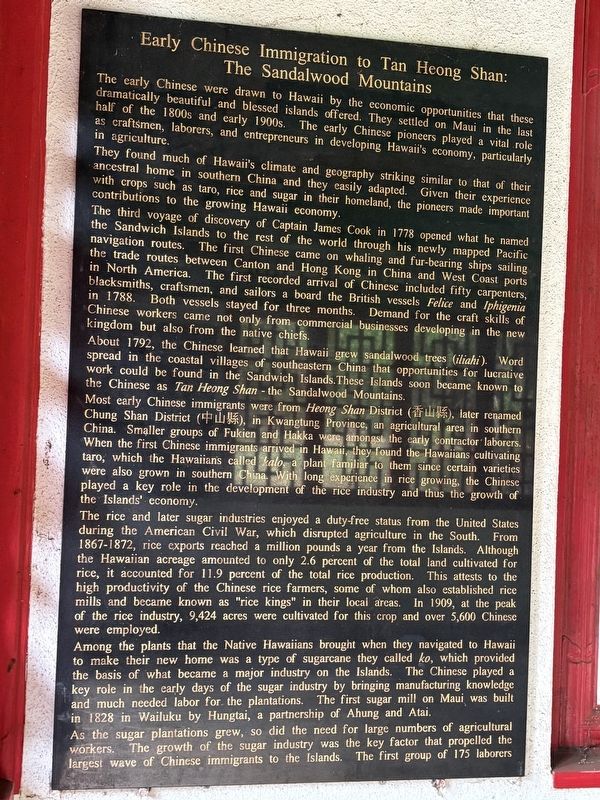
The early Chinese were drawn to Hawaii by the economic opportunities that these dramatically beautiful and blessed islands offered. They settled on Maui in the last half of the 1800s and early 1900s. The early Chinese pioneers played a vital role as craftsmen, laborers, and entrepreneurs in developing Hawaii's economy, particularly in agriculture.
They found much of Hawaii's climate and geography striking similar to that of their ancestral home in southern China and they easily adapted. Given their experience with crops such as taro, rice and sugar in their homeland, the pioneers made important contributions to the growing Hawaii economy.
The third voyage of discovery of Captain James Cook in 1778 opened what he named the Sandwich Islands to the rest of the world through his newly mapped Pacific navigation routes. The first Chinese came on whaling and fur-bearing ships sailing the trade routes between Canton and Hong Kong in China and West Coast ports in North America. The first recorded arrival of Chinese included fifty carpenters, blacksmiths, craftsmen, and sailors aboard the British vessels Felice and
this page online
About 1792, the Chinese learned that Hawaii grew sandalwood trees (iliahi). Word spread in the coastal villages of southeastern China that opportunities for lucrative work could be found in the Sandwich Islands. These Islands soon became known to the Chinese as Tan Heong Shan - the Sandalwood Mountains.
Most early Chinese immigrants were from Heong Shan District, later renamed Chung Shan District (l), in Kwangtung Province, an agricultural area in southern China. Smaller groups of Fukien and Hakka were amongst the early contractor laborers. When the first Chinese immigrants arrived in Hawaii, they found the Hawaiians cultivating taro, which the Hawaiians called kalo a plant familiar to them since certain varieties were also grown in southern China. With long experience in rice growing, the Chinese played a key role in the development of the rice industry and thus the growth of the Islands' economy.
The rice and later sugar industries enjoyed a
Photographed by Darren Jefferson Clay, December 7, 2025
2. Early Chinese Immigration to Tan Heong Shan: The Sandalwood Mountains Marker
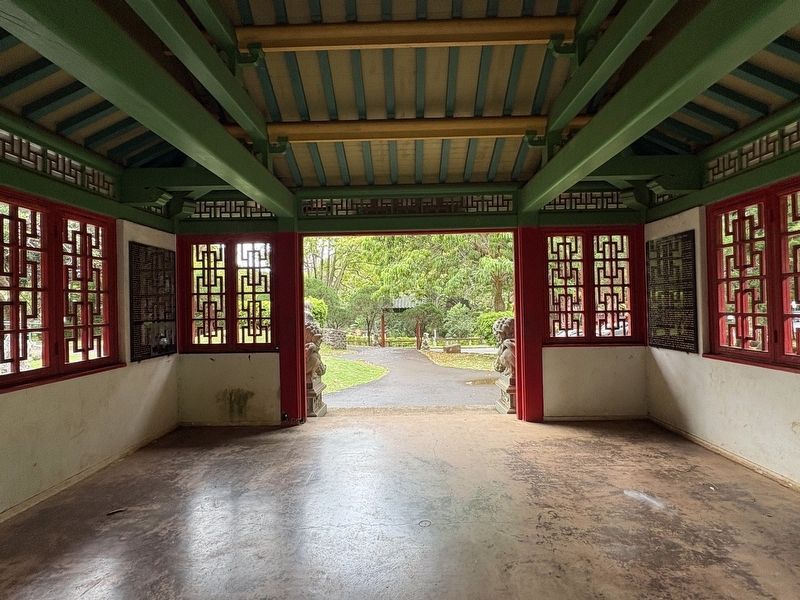
Marker is on right in the corner of the open air pagoda.
Among the plants that the Native Hawaiians brought when they navigated to Hawaii to make their new home was a type of sugarcane they called ko, which provided the basis of what became a major industry on the Islands. The Chinese played a key role in the early days of the sugar industry by bringing manufacturing knowledge and much needed labor for the plantations. The first sugar mill on Maui was built in 1828 in Wailuku by Hungtai, a partnership of Ahung and Atai.
As the sugar plantations grew,
Photographed by Darren Jefferson Clay, December 7, 2025
3. Early Chinese Immigration to Tan Heong Shan: The Sandalwood Mountains Marker
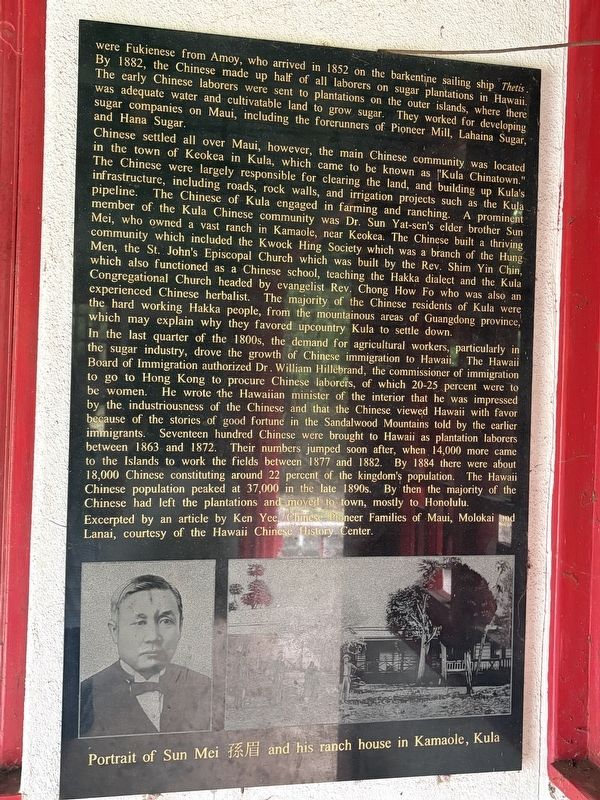
Chinese settled all over Maui, however, the main Chinese community was located in the town of Keokea in Kula, which came to be known as "Kula Chinatown." The Chinese were largely responsible for clearing the land, and building up Kula's infrastructure, including roads, rock walls, and irrigation projects such as the Kula pipeline. The Chinese of Kula engaged in farming and ranching. A prominent member of the Kula Chinese community was Dr. Sun Yat-sen's elder brother Sun Mei, who owned a vast ranch
Photographed by Darren Jefferson Clay, December 7, 2025
4. Early Chinese Immigration to Tan Heong Shan: The Sandalwood Mountains Marker
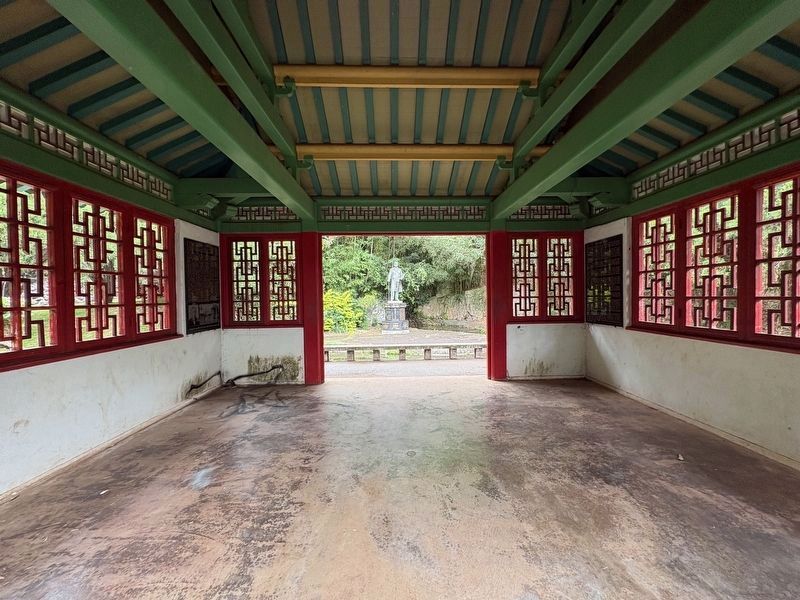
Marker is on left side, mounted on the wall of the open air pagoda.
In the last quarter of the 1800s, the demand for agricultural workers, particularly in the sugar industry, drove the growth of Chinese immigration to Hawaii. The Hawaii Board of Immigration authorized Dr. William Hillebrand, the commissioner of immigration to go to Hong Kong to procure Chinese laborers, of which 20-25 percent were to be women. He wrote the Hawaiian minister of the interior that he was impressed by the industriousness of the Chinese and that the Chinese viewed Hawaii with favor because of the stories of good fortune in the Sandlewood Mountains tolkd by the earlier immigrants. Seventeen hundred Chinese were brought to Hawaii as plantation laborers between 1863 and 1872. Their numbers jumped soon after, when 14,000 more came to the Islands to work the fields between 1877 and 1882. By 1884 there were about 18,000 Chinese constituting around 22 percent of the kingdom's population. The Hawaii Chinese population peaked at 37,000 in the late 1890s. By then the majority of the Chinese had left the plantations and moved to town, mostly to Honolulu.
Excerpted by an article by Ken Yee, Chinese Pioneer Families of Maui, Molokai, and Lanai, courtesy of the Hawaii Chinese History Center.
[Caption:]
Portrait of Sun Mei and his ranch home in Kamaole, Kula.
Topics. This historical marker is listed in these topic lists: Asian Americans • Immigration. A significant historical year for this entry is 1778.
Location. 20° 53.001′ N, 156° 32.15′ W. Marker is in Wailuku, Hawaii, in Maui County. It can be reached from Iao Valley Road west of Aulii Drive, on the left when traveling west. Marker can be found in the Kepaniwai Park. Marker is mounted on the wall of an open air pagoda. Touch for map. Marker is at or near this postal address: 870 Iao Valley Rd, Wailuku HI 96793, United States of America. Touch for directions.

Regionally, this marker is in Lahaina and West Maui. Globally, it is in North America, Polynesia, the Pacific Ocean, North Pacific, the Pacific Rim, the Western Hemisphere, the Western World, and the Anglosphere.
Other nearby markers. At least 8 other markers are within walking distance of this marker: Sun of Maui (here, next to this marker); In Commemmoration of the 200 Years Since the First Arrival of the Chinese in Hawaii (a few steps from this marker); Kapaniwai Chinese Heritage Garden / Sun Yat Sen Bronze Statue (a few steps from this marker); Chinese Exhibit (a few steps from this marker); Japanese Immigrants (a few steps from this marker); In Commeration of the Arrival of the First Japanese Immigrants to Hawai'i (a few steps from this marker); Japanese Centennial Monument (a few steps from this marker); Arrival of Puerto Ricans in Hawaii (a few steps from this marker). Touch for a list and map of all markers in Wailuku.
Credits. This page was last revised on July 19, 2026. It was originally submitted on February 1, 2026, by Darren Jefferson Clay of Duluth, Georgia. This page has been viewed 125 times since then. Photos: 1, 2, 3, 4. submitted on February 1, 2026, by Darren Jefferson Clay of Duluth, Georgia. • Devry Becker Jones was the editor who published this page.
