Jardin des Plantes in Paris in Département de Paris, Île-de-France, France — Western Europe
Monument à Jean-Baptiste Lamarck
⎯⎯⎯
Monument to Jean-Baptiste Lamarck
Léon Fagel (1851-1913)
| — | Statues | — |
Photographed by Andrew Ruppenstein, September 11, 2024
1. Monument to Jean-Baptiste Lamarck Marker

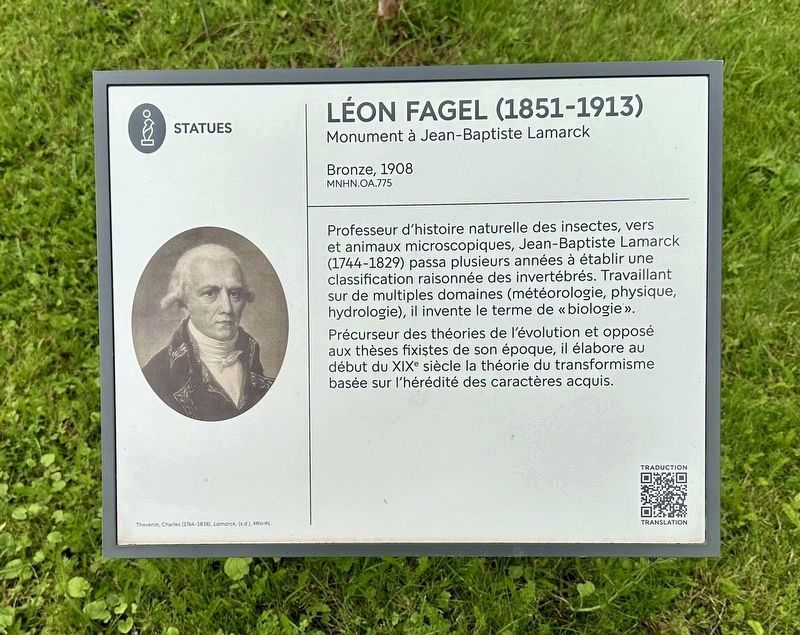
Professeur d'histoire naturelle des insectes, vers et animaux microscopiques, Jean-Baptiste Lamarck (1744-1829) passa plusieurs années à établir une classification raisonnée des invertébrés. Travaillant sur de multiples domaines (météorologie, physique, hydrologie), il invente le terme de «biologie».
Précurseur des théories de l'évolution et opposé aux thèses fixistes de son époque, il élabore au début du XIXe siècle la théorie du transformisme basée sur l'hérédité des caractères acquis.
Monument to Jean-Baptiste Lamarck
Professor of natural history specializing in insects, worms, and microscopic animals, Jean-Baptiste Lamarck (1744-1829) spent several years establishing a systematic classification of invertebrates. Working across multiple fields (meteorology, physics, hydrology), he coined the term "biology."
A precursor of evolutionary theories and opposed to the fixist theses of his time, he developed at the beginning of the 19th century the theory of transformism based on the heredity of acquired characteristics.
Topics. This
this page online
Location. 48° 50.641′ N, 2° 21.803′ E. Marker is in Paris, Île-de-France, in Département de Paris. It is in Jardin des Plantes. It is at the intersection of Esplanade Lamarck and Place Valhubert on Esplanade Lamarck. The marker is about 8 meters to the west of the statue of Lamarck in the Jardin des Plantes. Touch for map. Marker is at or near this postal address: Esplanade Lamarck, Paris, Île-de-France 75005, France. Touch for directions.

Regionally, it is in the North Atlantic Region, Europe, the European Union, Atlantic Europe, the Schengen Area, Western Europe, a coastal Mediterranean country, and the Western World. Historically, it finds itself in what was once a French colony and also the Roman Empire.
Other nearby markers. At least 8 other markers are within walking distance of this marker: Michel Saltzermann (about 90 meters away, measured in a direct line); Square Albert Tournaire (1926) (approx. 0.3 kilometers away); Marco Lazard (approx. 0.4 kilometers away); Guy Tessier
Photographed by Andrew Ruppenstein, September 11, 2024
2. Monument to Jean-Baptiste Lamarck Marker - wide view
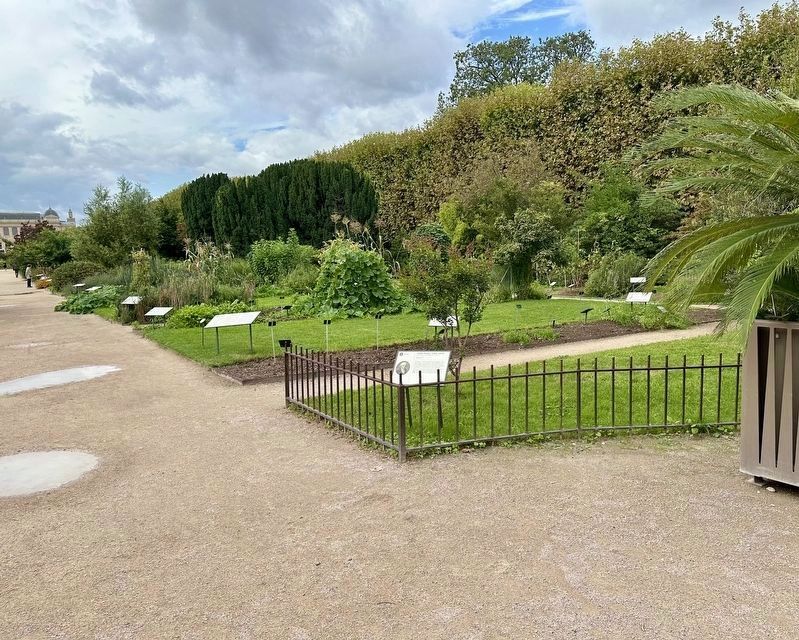
The marker is visible here just behind the low iron fence.
Also see . . .
1. Jean-Baptiste Lamarck (Wikipedia). Excerpt:
Jean-Baptiste Pierre Antoine de Monet, chevalier de Lamarck (1 August 1744 – 18 December 1829), often known simply as Lamarck, was a French naturalist, biologist, academic, and soldier. He was an early proponent of the idea that biological evolution occurred and proceeded in accordance with natural laws,[3] though the mechanism he suggested has been refuted at large.(Submitted on February 2, 2026.)
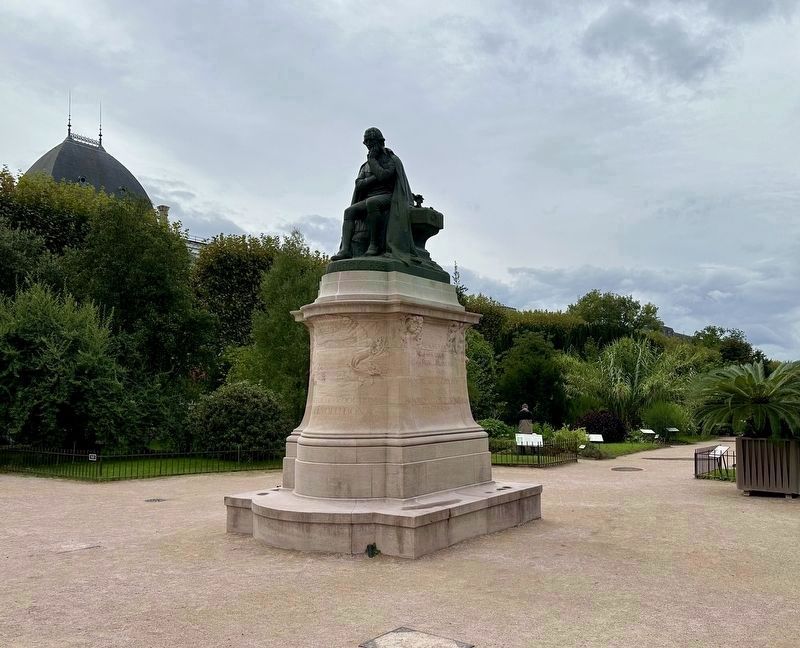
The modern era generally remembers Lamarck for a theory of inheritance of acquired characteristics, called Lamarckism (accurately named after him), soft inheritance, or use/disuse theory, which he described in his 1809 Philosophie zoologique. Though, the idea of soft inheritance antedates him, and while it was a small element of his theory of evolution, in his time it was acceptedby many natural historians. Lamarck's idea of use/disuse later aligned with Darwin's idea of natural selection and is believe to in part have inspired Darwin, who ended up contradicting Lamarckism. Lamarck's contribution to evolutionary theory consisted of the first truly cohesive theory of biological evolution, in which an alchemical complexifying force drove organisms up a ladder of complexity, and a second environmental force adapted them to local environments through use and disuse of characteristics, differentiating them from other organisms. Scientists have debated whether advances in the field of transgenerational epigenetics mean that Lamarck was to an extent correct, or not.Photographed by Andrew Ruppenstein, September 11, 20243. Monument to Jean-Baptiste Lamarck by Léon Fagel (1908)
2. Léon Fagel (Wikipedia). Overview:
Léon Fagel (1851–1913) was a French sculptor, best known for his busts.(Submitted on February 2, 2026.)
Photographed by Andrew Ruppenstein, September 11, 2024
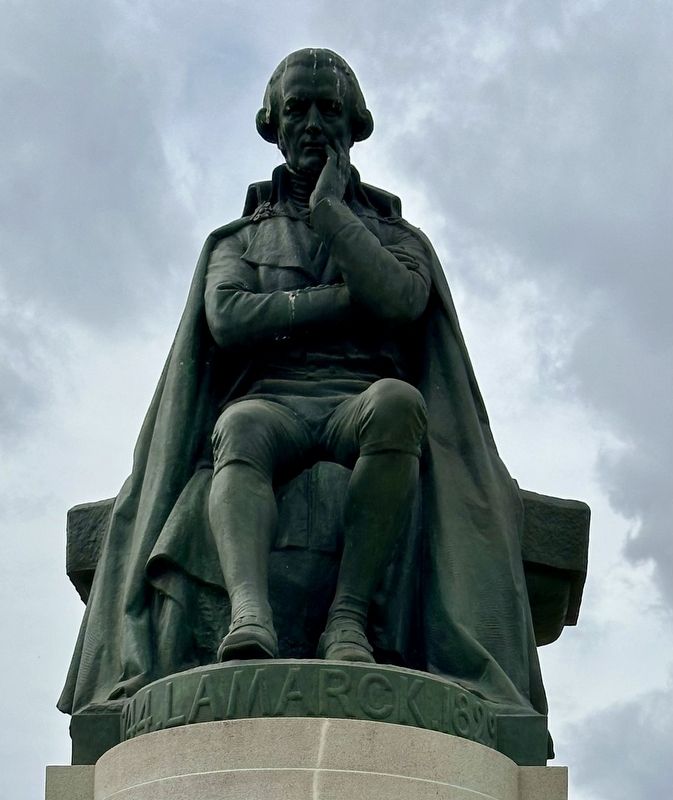
4. Statue of Lamarck atop the Monument
Photographed by Andrew Ruppenstein, September 11, 2024
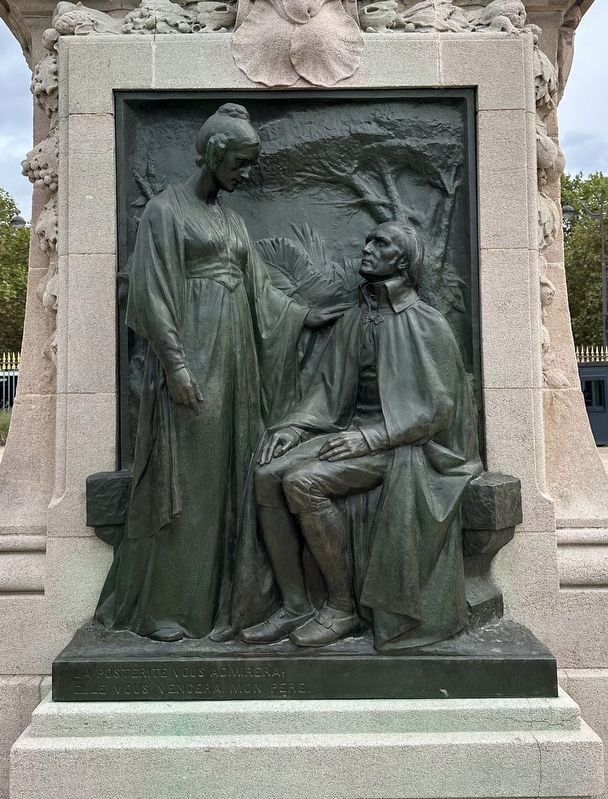
5. Monument to Jean-Baptiste Lamarck - detail
“Posterity will admire you, they will surpass you, my father.” (quote at the bottom of this relief, in translation)
Credits. This page was last revised on February 2, 2026. It was originally submitted on February 1, 2026, by Andrew Ruppenstein of Lamorinda, California. This page has been viewed 52 times since then. Photos: 1, 2, 3. submitted on February 1, 2026, by Andrew Ruppenstein of Lamorinda, California. 4. submitted on February 2, 2026, by Andrew Ruppenstein of Lamorinda, California. 5. submitted on February 1, 2026, by Andrew Ruppenstein of Lamorinda, California.
