
Ludwigsvorstadt-Isarvorstadt in München, Bavaria, Germany — Central Europe
Alter Südlicher Friedhof
⎯⎯⎯
Old Southern Cemetery

Photographed by Andrew Ruppenstein, March 14, 2025
1. Alter Südlicher Friedhof / Old Southern Cemetery Marker

Die Kapazität der Friedhöfe innerhalb der Stadtmauern Münchens reichte in der Mitte des 16. Jahrhunderts wegen verschiedener Pestepidemien nicht mehr aus. Deshalb wurde der Alte Südliche Friedhof - damals noch vor den Toren der Stadt - errichtet, an Ostern 1563 eingeweiht und seiner Bestimmung übergeben.
In den folgenden Jahrhunderten wurde die Anlage mehrmals erweitert und erhielt 1830 ihren sarkophagartigen Grundriss mit Arkaden, Leichenhaus und Verwaltungsgebäude. Der Architekt Friedrich von Gärtner ergänzte sie bis 1844 um den neuen quadratischen Teil zur Kapuzinerstraße hin und wurde dort auch beigesetzt (siehe im Plan Nr. 43, Neue Arkaden bei Gräberfeld 29).
Im Alten Südlichen Friedhof fanden nahezu alle bedeutenden Münchner Persönlichkeiten des 19. und des beginnenden 20. Jahrhunderts ihre letzte Ruhestätte. Insgesamt waren ca. 24.000 Grabstätten angelegt. Nahezu alle Gebäude, die Alten Arkaden und viele Grabstätten wurden bei den Bomben- angriffen auf München zerstört. Der Bestattungsbetrieb wurde am 1. Januar 1944 eingestellt; die Anlage ist aber nach wie vor als Friedhof gewidmet. Heute sind noch rund 5.000 Grabstätten vorhanden, die es in enger Zusammenarbeit mit den Denkmalschutzbehörden zu wahren gilt.
History
By the mid-16th century, the capacity of the cemeteries within Munich's city walls was no longer sufficient due to various plague epidemics. Therefore, the Old Southern Cemetery – then located outside the city gates – was established, consecrated, and opened at Easter 1563.
In the following centuries, the cemetery was expanded several times, and in 1830 it acquired its sarcophagus-like layout with arcades, a mortuary, and an administration building. The architect Friedrich von Gärtner added the new square section facing
this page online
Nearly all of Munich's prominent figures from the 19th and early 20th centuries found their final resting place in the Old Southern Cemetery. Approximately 24,000 graves were laid out there. Almost all the buildings, the Old Arcades, and many graves were destroyed in the bombing raids on Munich. Burials ceased on January 1, 1944; however, the site remains designated as a cemetery. Today, around 5,000 graves still exist, which must be preserved in close cooperation with the historic preservation authorities.
(famous burials, visiting hours not transcribed)
Erected by Städtische Friedhöfe München.
Topics. This historical marker is listed in this topic list: Cemeteries & Burial Sites. A significant historical year for this entry is 1563.
Location. 48° 7.842′ N, 11° 33.982′ E. Marker is in München, Bayern (Bavaria). It is in Ludwigsvorstadt-Isarvorstadt. It can be reached from Stephansplatz, on the left when traveling west. The marker is visible as one enters the cemetery from the entrance on Stephanplatz. Touch for map. Marker
Photographed by Andrew Ruppenstein, March 14, 2025
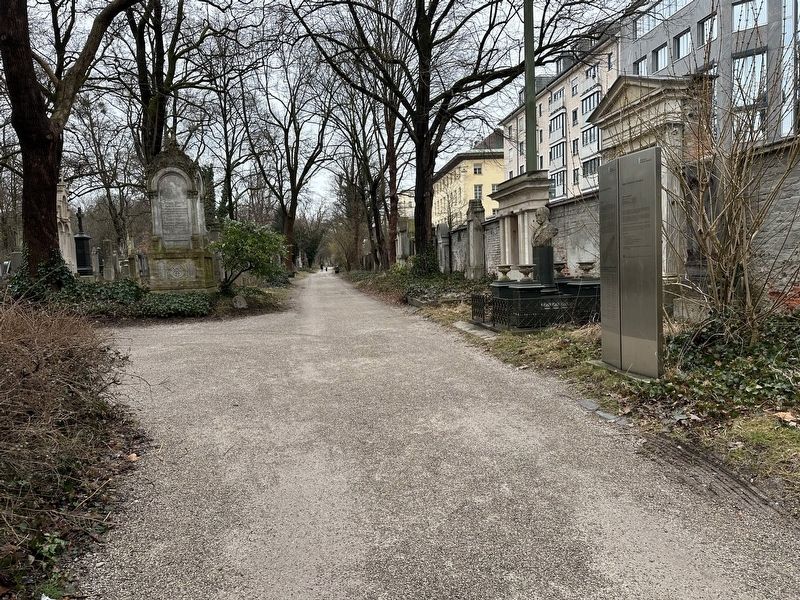
2. Alter Südlicher Friedhof / Old Southern Cemetery Marker - wide view, looking south
The marker is visible on the right.

Regionally, it is in Europe, the European Union, Atlantic Europe, Central Europe, the Schengen Area, Western Europe, and the Western World. Historically, it finds itself in what was once the Holy Roman Empire.
Other nearby markers. At least 8 other markers are within walking distance of this marker: Reserve-Feldartillerie-Regiment 6 WWI Memorial (a few steps from this marker); Allgemeines Krankenhaus / General Hospital (approx. 0.4 kilometers away); St. Maximilian Hospital and Monastery (approx. 0.4 kilometers away); Christian and Wilhelm Graf von Forbach (approx. half a kilometer away); Die Aussegnungshalle / The Funeral Chapel (approx. half a kilometer away); Franz Marc (approx. 0.7 kilometers away); Gottfried Keller (approx. 0.9 kilometers away); Albert Einstein (approx. 0.9 kilometers away). Touch for a list and map of all markers in München.
Also see . . . Alter Südfriedhof (Wikipedia). Overview:
The Alter Südfriedhof ("Old South Cemetery"), also known as Alter Südlicher Friedhof, is a cemetery in Munich,(Submitted on February 2, 2026.)Germany. It was founded by Duke Albrecht V as a plague cemetery in 1563 about half a kilometer south of the Sendlinger Gate between Thalkirchner and Pestalozzistraße.Photographed by Andrew Ruppenstein, March 14, 20253. Alter Südlicher Friedhof / Old Southern Cemetery Marker - general view
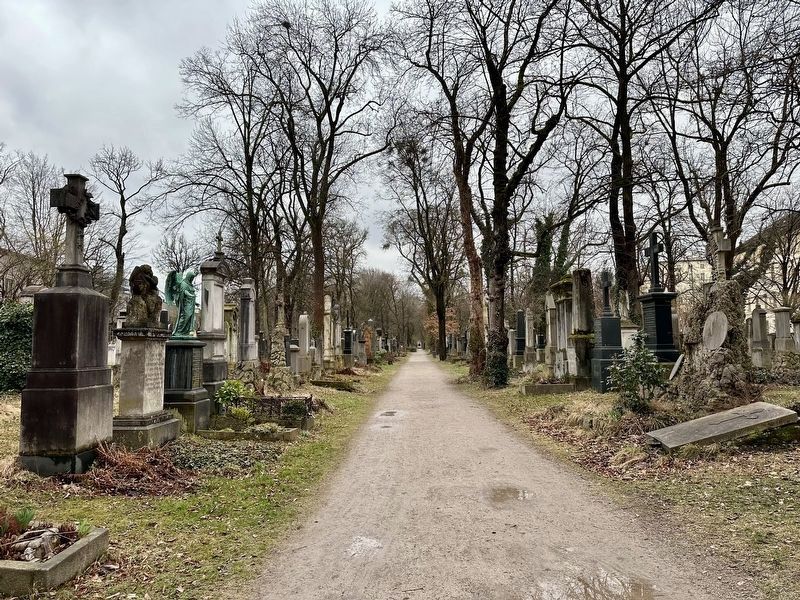
Photographed by Andrew Ruppenstein, March 14, 2025
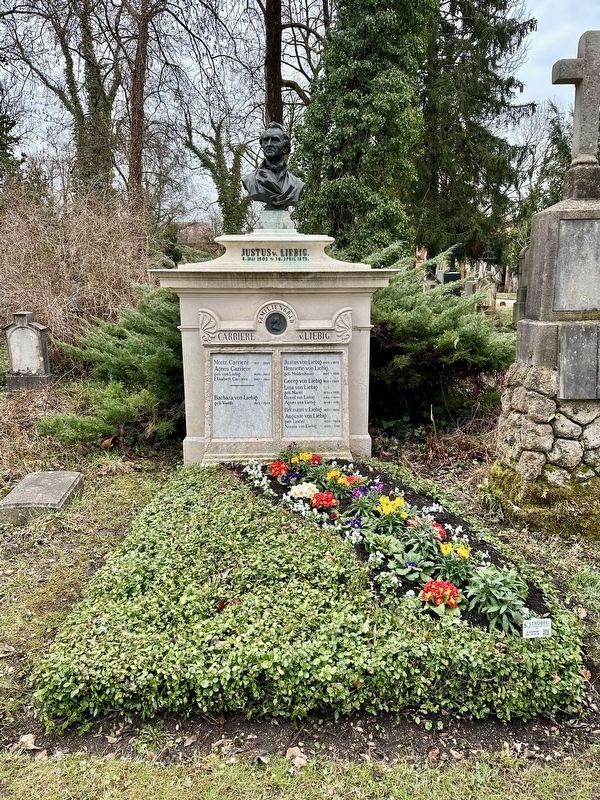
4. Grave of Justus von Liebig (Gräberfeld 40)
Justus Freiherr von Liebig (12 May 1803 – 18 April 1873) was a German scientist who made major contributions to the theory, practice, and pedagogy of chemistry, as well as to agricultural and biological chemistry; he is considered one of the principal founders of organic chemistry… -Wikipedia
Click for more information.
Click for more information.
Photographed by Andrew Ruppenstein, March 14, 2025
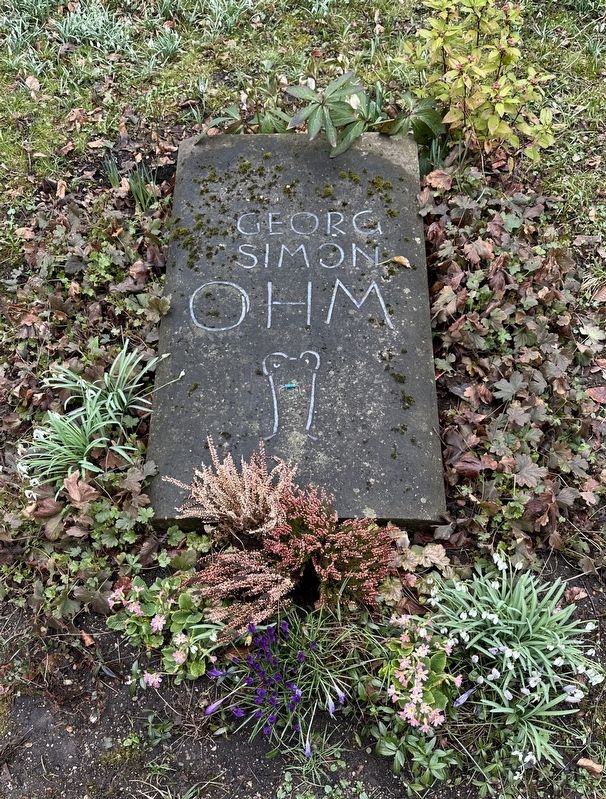
5. Grave of Georg Ohm (Gräberfeld 15)
Georg Simon Ohm (16 March 1789 – 6 July 1854) was a German mathematician and physicist. As a school teacher, Ohm began his research with the new electrochemical cell, invented by Italian scientist Alessandro Volta. Using equipment of his own creation, Ohm found that there is a direct proportionality between the potential difference (voltage) applied across a conductor and the resultant electric current; this relation is known as Ohm's law. - Wikipedia
Click for more information.
Click for more information.

Photographed by Andrew Ruppenstein, March 14, 2025
6. Grave of Max von Pettenkofer (Gräberfeld 31)
Max Joseph Pettenkofer, ennobled in 1883 as Max Joseph von Pettenkofer (3 December 1818 – 10 February 1901) was a Bavarian chemist and hygienist. He is known for his work in practical hygiene, as an apostle of good water, fresh air and proper sewage disposal… - Wikipedia
Credits. This page was last revised on February 2, 2026. It was originally submitted on February 2, 2026, by Andrew Ruppenstein of Lamorinda, California. This page has been viewed 50 times since then. Photos: 1, 2, 3, 4, 5, 6. submitted on February 2, 2026, by Andrew Ruppenstein of Lamorinda, California.
