
Islamorada in Monroe County, Florida — The American South (South Atlantic)
Lights of the Florida Keys
Heritage Monument Trail, Matacumbe Historical Trust
Photographed by James Hulse, January 10, 2026
1. Lights of the Florida Keys Marker
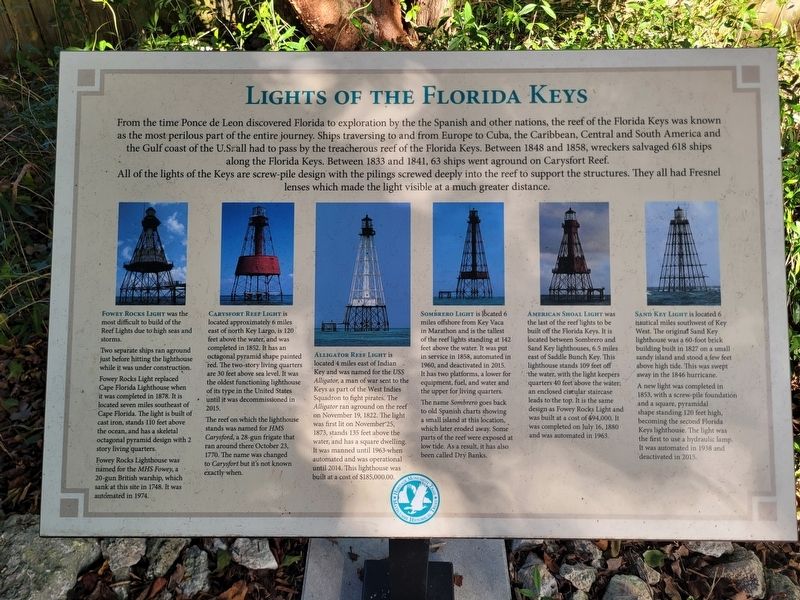
From the time Ponce de Leon discovered Florida to exploration by the the Spanish and other nations, the reef of the Florida Keys was known as the most perilous part of the entire journey. Ships traversing to and from Europe to Cuba, the Caribbean, Central and South America and the Gulf coast of the U.S. all had to pass by the treacherous reef of the Florida Keys. Between 1848 and 1858, wreckers salvaged 618 ships along the Florida Keys. Between 1833 and 1841, 63 ships went aground on Carysfort Reef. All of the lights of the Keys are screw-pile design with the pilings screwed deeply into the reef to support the structures. They all had Fresnel lenses which made the light visible at a much greater distance.
Fowey Rocks Light was the most difficult to build of the Reef Lights due to high seas and storms. Two separate ships ran aground just before hitting the lighthouse while it was under construction. Fowey Rocks Light replaced Cape Florida Lighthouse when it was completed in 1878. It is located seven miles southeast of Cape Florida. The light is built of cast iron, stands 110 feet above the ocean, and has a skeletal octagonal pyramid design with 2 story living quarters. Fowey Rocks Lighthouse was named for the MHS Fowey, a 20-gun British warship, which sank at this site in 1748. It was automated in
this page online
Carysfort Reef Light is located approximately 6 miles east of north Key Largo, is 120 feet above the water, and was completed in 1852. It has an octagonal pyramid shape painted red. The two-story living quarters are 30 feet above sea level. It was the oldest functioning lighthouse of its type in the United States until it was decommissioned in 2015. The reef on which the lighthouse stands was named for HMS Carysfort, a 28-gun frigate that ran around there October 23, 1770. The name was changed to Carysfort but it's not known exactly when.
Alligator Reef Light is located 4 miles east of Indian Key and was named for the USS Alligator, a man of war sent to the Keys as part of the West Indies Squadron to fight pirates. The Alligator ran aground on the reef on November 19, 1822. The light was first lit on November 25, 1873, stands 135 feet above the water, and has a square dwelling. It was manned until 1963 when automated and was operational until 2014. This lighthouse was built at a cost of $185,000.00.
Sombrero Light is located 6 miles offshore from Key Vaca in Marathon and is the tallest of the reef lights standing at 142 feet above the water. It was put in service in 1858, automated in 1960, and deactivated in 2015. It has two platforms, a lower for equipment, fuel, and water and the upper
Photographed by James Hulse, January 10, 2026
2. Lights of the Florida Keys Marker
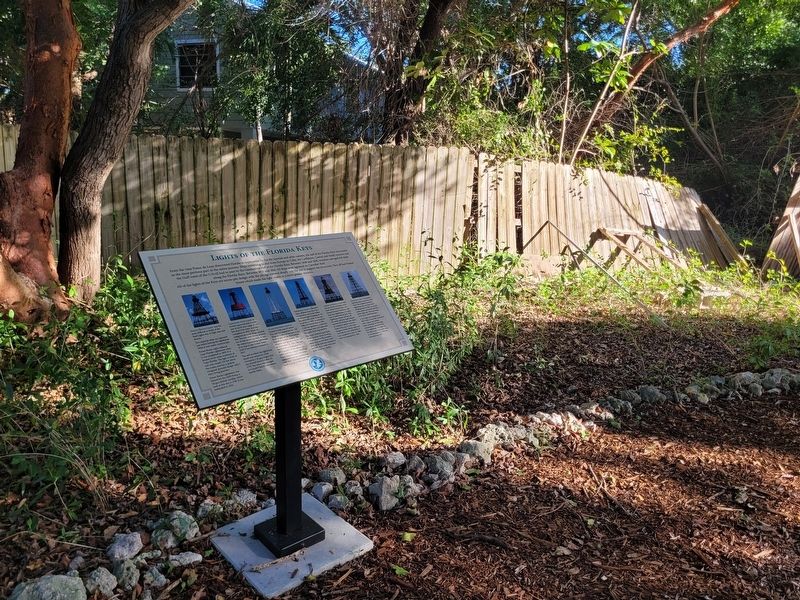
The view of the marker along the end of the trail at the park.
American Shoal Light was the last of the reef lights to be built off the Florida Keys. It is located between Sombrero and Sand Key lighthouses, 6.5 miles east of Saddle Bunch Key. This lighthouse stands 109 feet off the water, with the light keepers quarters 40 feet above the water; an enclosed circular staircase leads to the top. It is the same design as Fowey Rocks Light and was built at a cost of $94,000. It was completed on July 16, 1880 and was automated in 1963.
Sand Key Light is located 6 nautical miles southwest of Key West. The original Sand Key lighthouse was a 60-foot brick building built in 1827 on a small-sandy island and stood a few feet above high tide. This was swept away in the 1846 hurricane. A new light was completed in 1853, with a screw-pile foundation and a square, pyramidal shape standing 120 feet high, becoming the second Florida Keys lighthouse. The light was the first to use a hydraulic lamp. It was automated in 1938 and deactivated in 2015.
Erected by Heritage Monument Trail, Matacumbe Historical Trust.
Topics and series. This historical marker is listed in this topic list: Waterways & Vessels. In addition, it is included in the Lighthouses series list. A significant historical date for this entry is October 23, 1770.
Location. 24° 55.586′ N, 80° 37.578′ W. Marker is in Islamorada, Florida, in Monroe County. It is on Overseas Highway (U.S. 1) 0.1 miles south of Osprey Bay Road, on the right when traveling south. Touch for map. Marker is at or near this postal address: 82616 Overseas Hwy, Islamorada FL 33036, United States of America. Touch for directions.

Regionally, this marker is on the Florida Keys. It is also in the American South and on the Gulf Coast. Globally, it is in the North Atlantic Region, North America, a Gulf of Mexico state, the Western Hemisphere, the Western World, and the Anglosphere. Historically, it finds itself in what was once New Spain, the territory of the Mississippian Culture, one of the Confederate States of America, and the Antebellum South.
Other nearby markers. At least 8 other markers are within walking distance of this marker: Indian Key (here, next to this marker); Industry in the Florida Keys (a few steps from this marker); The Spanish Treasure Fleets (a few steps from this marker); Early Trade in the Florida Keys (a few steps from this marker); The Early Settlers of Upper Matecumbe Key (within shouting distance of this marker); Native Americans (within shouting distance of this marker); The Railway That Went To Sea (within shouting distance of this marker); Geological History of the Florida Keys (within shouting distance of this marker). Touch for a list and map of all markers in Islamorada.
Credits. This page was last revised on February 6, 2026. It was originally submitted on February 5, 2026, by James Hulse of Medina, Texas. This page has been viewed 56 times since then. Photos: 1, 2. submitted on February 6, 2026, by James Hulse of Medina, Texas.
