Key West in Monroe County, Florida — The American South (South Atlantic)
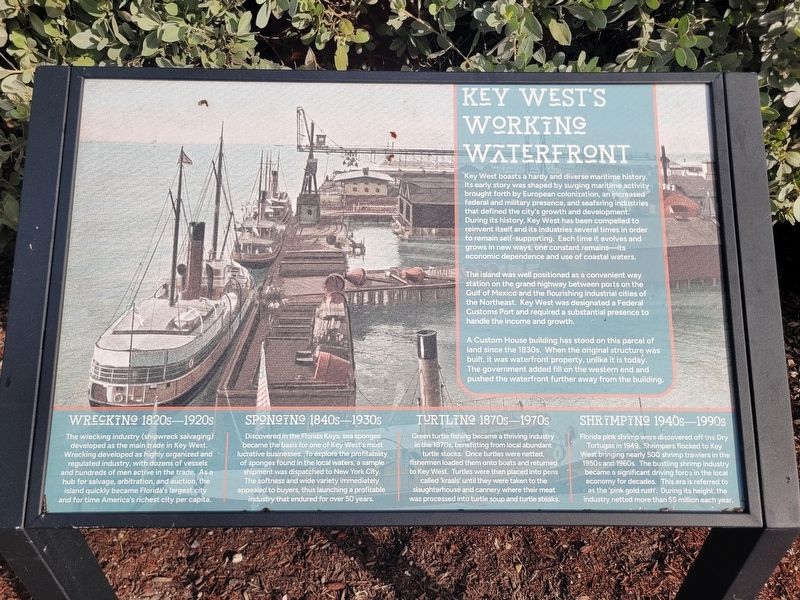
Key West's Working Waterfront
Photographed by James Hulse, January 11, 2026
1. Key West's Working Waterfront Marker
The island was well positioned as a convenient way station on the grand highway between ports on the Gulf of Mexico and the flourishing industrial cities of the Northeast. Key West was designated a Federal Customs Port and required a substantial presence to handle the income and growth.
A Custom House building has stood on this parcel of land since the 1830s. When the original structure was built, it was waterfront property, unlike it is today. The government added fill on the western end and pushed the waterfront further away from the building.
Wrecking 1820s-1920s
The wrecking industry (shipwreck
this page online
Sponging 1840s-1930s
Discovered in the Florida Keys, sea sponges became the basis for one of Key West's most lucrative businesses. To explore the profitability of sponges found in the local waters, a sample shipment was dispatched to New York City. The softness and wide variety immediately appealed to buyers, thus launching a profitable industry that endured for over 50 years.
Turtling 1870s-1970s
Green turtle fishing became a thriving industry in the 1870s, benefitting from local abundant turtle stocks. Once turtles were netted, fishermen loaded them onto boats and returned to Key West. Turtles were then placed into pens called 'kraals' until they were taken to the slaughterhouse and cannery where their meat was processed into turtle soup and turtle steaks.
Shrimping 1940s-1990s
Florida pink shrimp were

Photographed by James Hulse, January 11, 2026
2. Key West's Working Waterfront Marker
The marker is located on the far left of the Custom House’s southern entrance.
Topics. This historical marker is listed in these topic lists: Animals • Industry & Commerce • Waterways & Vessels. A significant historical year for this entry is 1949.
Location. 24° 33.49′ N, 81° 48.42′ W. Marker is in Key West, Florida, in Monroe County. It is at the intersection of Front Street and Greene Street, on the left when traveling north on Front Street. The marker is located along the southern entrance to the Custom House Building. Touch for map. Marker is at or near this postal address: 269 Front St, Key West FL 33040, United States of America. Touch for directions.

Regionally, this marker is on the Florida Keys. It is also in the American South and on the Gulf Coast. Globally, it is in the North Atlantic Region, North America, a Gulf of Mexico state, the Western Hemisphere, the Western World, and the Anglosphere. Historically, it finds itself in what was once New Spain, the territory of the Mississippian Culture, one of the Confederate States of America, and the Antebellum South.
Other nearby markers. At least 8 other markers are within walking distance of this marker: Custom House (here, next to this marker); Key West Custom House (a few steps from this marker); Sunken Treasure (within shouting distance of this marker); Anchors (1622) (within shouting distance of this marker); Clinton Square (within shouting distance of this marker); Navy Club of Key West Monument (within shouting distance of this marker); Naval Depot and Storehouse-Building One-U.S. Coast Guard Headquarters (within shouting distance of this marker); Mallory Homesite (within shouting distance of this marker). Touch for a list and map of all markers in Key West.
Credits. This page was last revised on February 7, 2026. It was originally submitted on February 6, 2026, by James Hulse of Medina, Texas. This page has been viewed 47 times since then. Photos: 1, 2. submitted on February 7, 2026, by James Hulse of Medina, Texas.
