
Caliente in Lincoln County, Nevada — The American Mountains (Southwest)
San Pedro, Los Angeles & Salt Lake Railroad: Caliente to Uvada
The People Who Built the “Salt Lake Route”

Photographed by Jeremy Snow, February 1, 2026
1. San Pedro, Los Angeles & Salt Lake Railroad: Caliente to Uvada side of marker
San Pedro, Los Angeles & Salt Lake Railroad: Caliente to Uvada
Beginning of the Railroad
At the end of the 19th century and beginning of the 20th century, the rail Salt Lake Route between Salt Lake City, Utah, and Los Angeles, California, was constructed. Two railroad companies, the San Pedro, Los Angeles, & Salt Lake Railroad (ST, LA & SL RR) (incorporated in 1901) that eventurally came under the leadership of Senator William A. Clark, and the Oregon Short Line Company (OSL) (incorporated in 1881 as a subsidiary of Union Pacific Railroad[UPRR]) that was eventually led by E.H. Harriman, had engaged in fierce competition over rights to the route. Both eager to assert control over the route, the SP, LA & WL RR began building from Los Angeles toward Salt Lake City, while OSL simultaneously started building south from Salt Lake City. One of the most hostly contested portions of the route was around what would eventually become known as Caliente.
Uvada Caliente Grad: "When they go to sleep, they keep both eyes open"
Both Harriman and Clark claimed the rights to the Clover Valley portion of the route baed on survey mapes
this page online
Uvada Cliente Grade: Meadow Valley Wash
The confusion over which line had the right to build near the Utah/Nevada border resulted in both the OSL and the SP, LA & SL RR furiously constructing parallel tracks through Meadow Valley Wash in September 1901. Suddenly, in November 1901, both sides halted work as a truce had been reached. The companies had previously conducted surveys to establish their route through Meadow Valley Wash independently, resulting in plans for two lines that crossed each other 26 times. After the truce, the companies agreed to work

Photographed by Jeremy Snow, February 1, 2026
2. The People Who Built the "Salt Lake Route" side of marker
But even after the resolution of the nuber of tracks through Meadow Valley Wash was reached, it was not smooth sailing. This section of track, subject to severe flooding, was completely washed out in 1907, 1910, and 1938, requiring numerous and expensive repairs.
SP, LA, & SL Railroad in Caliente
On February 9, 1905, the Salt Lake Route began operating with Caliente as a key stop along the route. The first depot, build in 1905, burned down in 1921. The second depot, which still stands today, was built in 1923.
The SP, LA & SL changed its name in 1916 to the Los Angeles & Salt Lake Railroad (LA&SL). In 1921, the Union Pacific Railroad (UPRR) acquired LA&SL's interests in the Salt Lake Route and began operating it as part of the UPRR system (Myrick 1963). The line

Photographed by Jeremy Snow, February 1, 2026
3. Both panels of the marker shown wit the Bixcar Museum
The People Who Built the "Salt Lake Route"
At the end of the 19th century and the beginning of the 20th century, the Salt Lake Route railway between Salt Lake City, Utah, and Los Angeles, California, was constructed. Two railroad companies, the San Pedro, Los Angeles & Salt Lake Railroad (WP, LA & WL RR) (incorporated in 1901), eventurally led by Senator William A. Clark, and the Oregon Short line Company (incorporated in 1881 as a subsidiary of Union Pacific Railroad), eventually lead by E.H. Harriman, engaged in a fierce competition over rights to the route. Eager to assert control over the route, the SP, LA & SL RR began building north from Los Angeles toward Salt Lake City, while the Oregon Short Line Company began building south from Salt Lake City, Utah.
Who Worked on the Railroad?
As the northern and southern sections of the future rail line raced towards each other, they faced labor shortages, which they addressed in unique ways. Railroad work could be dangerous and paid less than other industries, leading new or recent immigrants to the U.S. to fill many of the possitions. Northern railroad workers
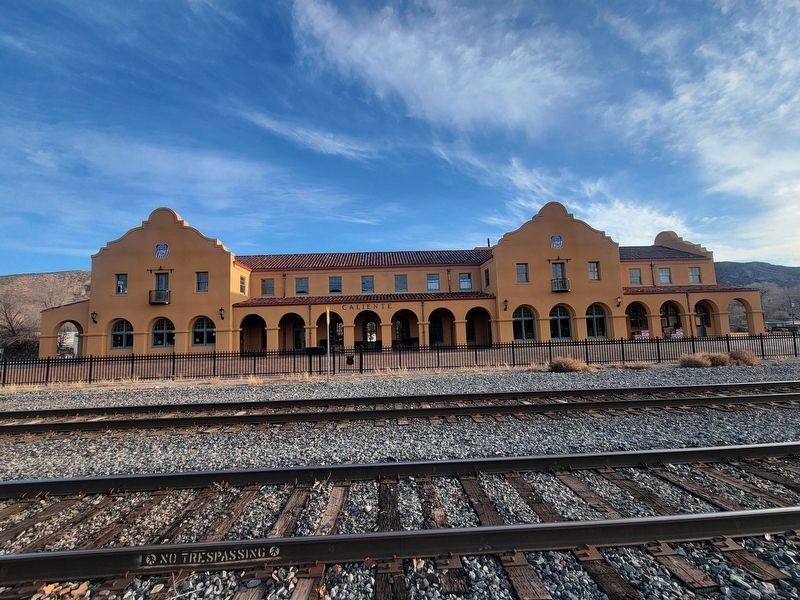
Photographed by Jeremy Snow, February 1, 2026
4. Caliente Station Depot
Contructed 1923
From the North
The Oregon Short Line, which would become a portion of the SP, LA, & SL RR, extending south from Salt Lake City, Utah was primarily constructed by laborers from Greece. Greek immigrants were aggressively recruited to work on the route by the infamous Greek "padrone" (from the Italian word for "patron") Leonidas G. Skliris, a native of Sparta who emigrated to the U.S. in the 1890s and who took up residence in Salt Lake City, Utah, in the early 20th century.
Skliris, who advertised heavily in both the U.S. and in Greece, charged exorbitant fees to find his patrons work and then required additional monthly payments. Additionally, Skliris formed partnerships with stores that his recruited workers were required to patronize and established ties with steamship operators. The "padrone" system was immensely profitable for Skliris and brutally exploitative of the workers but brought large numbers of Greek workers to Utah to construct the northern portion of what would become the SP. LA & SL RR in the early 1900s.
From the South
Prior to the railroad's construction, Mexicans formed a large portion of hte labor pool in southern California. Historical records indicate that the SP, LA & SL RR employed Mexican railroad workers as the line was built out of Los Angeles. An account of an incident in Pomona, California, indicates that approximately 50 Mexican railroad workes, or about half of the workers employed to work on the railroad at the time, were arrested and jailed (Los Angeles Times 1901, April 14 p.25). The same fate did not happen to the Irish crews working during the same incident.
Connecting the Line
Accounts of the rail lines' completion indicate that a "burley Greek laborer" drove the last spike, and that the Greek and Austrian workers from the north and Mexican laborers from the south cheered its completion.
Erected by US Department of the Interior.
Topics. This historical marker is listed in these topic lists: Immigration • Railroads & Streetcars. A significant historical year for this entry is 1896.
Location. 37° 36.745′ N, 114° 30.898′ W. Marker is in Caliente, Nevada, in Lincoln County. It is on Depot Avenue, on the right when traveling west. Near the entrance to the Caliente Heritage Boxcar Museum. Touch for map. Marker is at or near this postal address: 100 Depot Avenue, Caliente NV 89008, United States of America. Touch for directions.

Regionally, this marker is in Nevada’s Mojave Desert. It is also in the American Southwest and in the Mountain West. Globally, it is in North America, the Western Hemisphere, the Western World, and the Anglosphere. Historically, it finds itself in what was once New Spain and also Mexico’s Alta California.
Other nearby markers. At least 8 other markers are within 15 miles of this marker, measured as the crow flies: Caliente Union Pacific Depot (a few steps from this marker); Union Pacific Depot (about 300 feet away, measured in a direct line); Caliente (approx. 0.2 miles away); The 1910 Flood (approx. 0.4 miles away); Panaca (approx. 14.1 miles away); Panaca Mercantile (approx. 14.2 miles away); Panaca Ward Chapel (approx. 14.2 miles away); Cathedral Gorge (approx. 14½ miles away). Touch for a list and map of all markers in Caliente.
Credits. This page was last revised on February 19, 2026. It was originally submitted on February 8, 2026, by Jeremy Snow of Cedar City, Utah. This page has been viewed 108 times since then. Photos: 1, 2, 3, 4. submitted on February 8, 2026, by Jeremy Snow of Cedar City, Utah. • Andrew Ruppenstein was the editor who published this page.
