
Città Antica in Verona in Provincia di Verona, Venetia, Italy — Southern and Western Europe (Mediterranean)
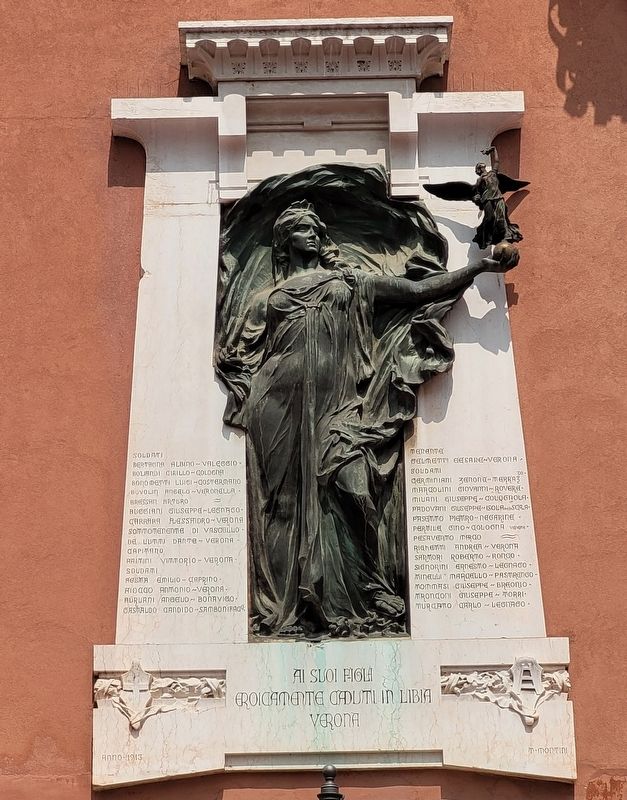
Monumento ai Caduti in Libia
⎯⎯⎯
Monument to the Fallen in Libya
Photographed by James Hulse, June 11, 2025
1. Monumento ai Caduti in Libia / Monument to the Fallen in Libya Marker

Ai suoi figli eroicamente caduti in Libia
Soldati Bertagna Albino — Valeggio • Boliandi Cirillo — Cologna • Bonometti Luigi — Costermano • Bovolin Angelo — Veronella • Bressan Arturo — Veronella • Buggiani Giuseppe — Legnago • Carrara Alessandro — Verona
Sottotenente di Vascello De Lummi Dante — Verona
Capitano Paitini Vittorio — Verona
Soldati Aesta Emilio — Caprino • Ammonio Antonio — Verona • Auruani Angelo — Bonavigo • Gastaudo Candido — San Bonifacio
Tenente Gelmetti Cesare — Verona
Soldati Germiniani Zenone — Terraz • Marcolini Giovanni — Rovere • Miuani Giuseppe — Colognola • Padovani Giuseppe — Isola della Scala • Pasetto Pietro — Negarine • Pertiue Gino — Cologna Veneta • Pesavento Marco — Cologna Veneta • Righetti Andrea — Verona • Sartori Roberto — Ronco • Signorini Ernesto — Legnago • Minelli Marcello — Pastrengo • Tommasi Giuseppe — Breonio • Tronconi Giuseppe — Torri • Turcato Carlo — Legnago
To its sons who fell heroically in Libya
Soldiers Bertagna Albino — Valeggio • Boliandi Cirillo — Cologna • Bonometti Luigi — Costermano • Bovolin Angelo — Veronella • Bressan Arturo — Veronella • Buggiani Giuseppe — Legnago • Carrara Alessandro — Verona
Sub-Lieutenant (Navy) De Lummi Dante — Verona
Captain Paitini Vittorio — Verona
Soldiers Aesta Emilio — Caprino • Ammonio Antonio — Verona • Auruani Angelo — Bonavigo • Gastaudo Candido — San Bonifacio
Lieutenant Gelmetti Cesare — Verona
Soldiers Germiniani Zenone — Terraz • Marcolini Giovanni — Rovere • Miuani Giuseppe — Colognola • Padovani Giuseppe — Isola della Scala • Pasetto Pietro — Negarine • Pertiue Gino — Cologna Veneta • Pesavento Marco — Cologna Veneta • Righetti Andrea — Verona • Sartori Roberto — Ronco • Signorini Ernesto — Legnago • Minelli Marcello — Pastrengo • Tommasi Giuseppe — Breonio • Tronconi Giuseppe — Torri • Turcato Carlo — Legnago
Erected 1913
this page online
Topics. This memorial is listed in this topic list: Wars, Non-US.
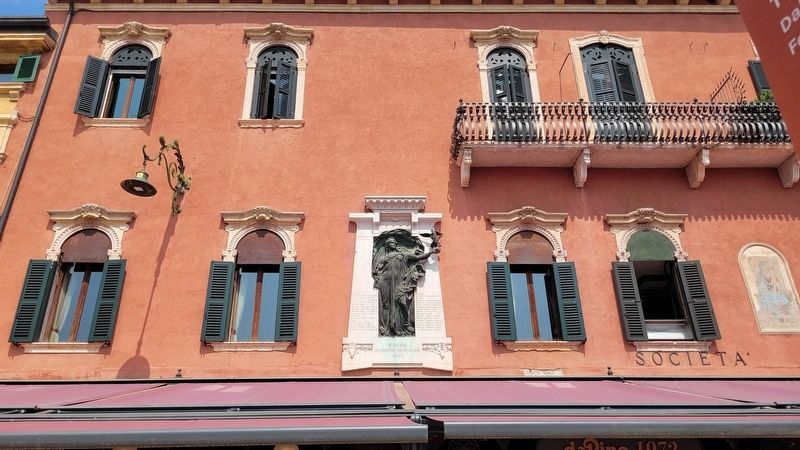
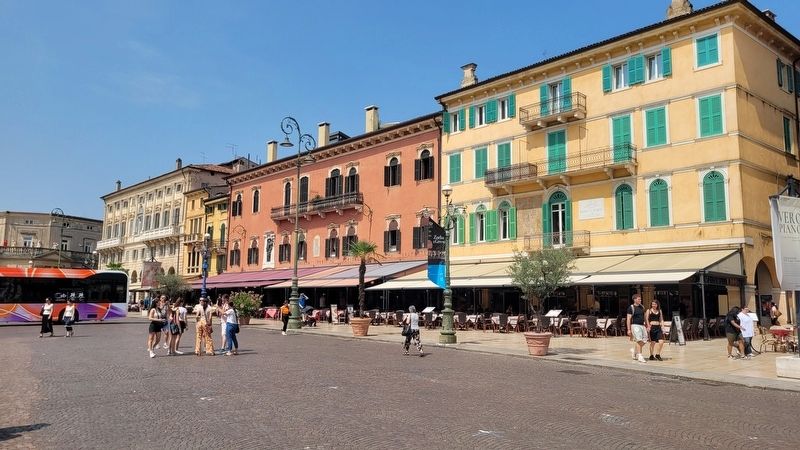
Location. 45° 26.333′ N, 10° 59.512′ E. Memorial is in Verona, Veneto (Venetia), in Provincia di Verona. It is in Città Antica. It is on Piazza Bra just north of Corso Porta Nuova. The marker is located on the upper floor of the building on the wall. Touch for map. Memorial is at or near this postal address: Piazza Bra 36, Verona, Veneto 37121, Italy. Touch for directions.

Regionally, it is in Europe, the European Union, the Schengen Area, a coastal Mediterranean country, and the Western World. Historically, it finds itself in what was once the Roman Empire and specifically also the Holy Roman Empire.
Other nearby markers. At least 8 other markers are within walking distance of this marker: Roma o Morte / Rome or Death! (within shouting distance of this marker); Vittorio Emanuele II (within shouting distance of this marker); Monumento ai Deportati nei Campi Nazisti / Monument to the Deportees in the Nazi Camps (within shouting distance of this marker); The City of Verona (about
Photographed by James Hulse, June 11, 2025
2. Monumento ai Caduti in Libia / Monument to the Fallen in Libya Marker
The view of the marker on the upper portion of the building.
Regarding Monumento ai Caduti in Libia / Monument to the Fallen in Libya. The Italo-Turkish War (1911–1912) was fought between the Kingdom of Italy and the Ottoman Empire for control of Ottoman territories in North Africa.
Also see . . . Italo-Turkish War. Wikipedia
The Italo-Turkish War saw some technological changes, most notably the use of airplanes in combat. On 23 October 1911, an Italian pilot, Capitano Carlo Piazza, flew over Turkish lines on the world's first aerial reconnaissance mission, and on 1 November, the first aerial bomb was dropped by Sottotenente Giulio Gavotti, on Turkish troops in Libya, from an early model of Etrich Taube aircraft. The Turks, using rifles, were the first to shoot down an airplane. Another use of new technology was(Submitted on February 11, 2026, by James Hulse of Medina, Texas.)a network of wireless telegraphy stations established soon after the initial landings. Guglielmo Marconi, the inventor of wireless telegraphy, came to Libya to conduct experiments with the Italian Corps of Engineers.Photographed by James Hulse, June 11, 20253. Monumento ai Caduti in Libia / Monument to the Fallen in Libya MarkerThe wide view of the marker in the piazza and the upper portion of the orange colored building.
Credits. This page was last revised on February 11, 2026. It was originally submitted on February 8, 2026, by James Hulse of Medina, Texas. This page has been viewed 60 times since then. Photos: 1, 2, 3. submitted on February 11, 2026, by James Hulse of Medina, Texas.
