Veronetta in Verona in Provincia di Verona, Venetia, Italy — Southern and Western Europe (Mediterranean)
Romea Postumia
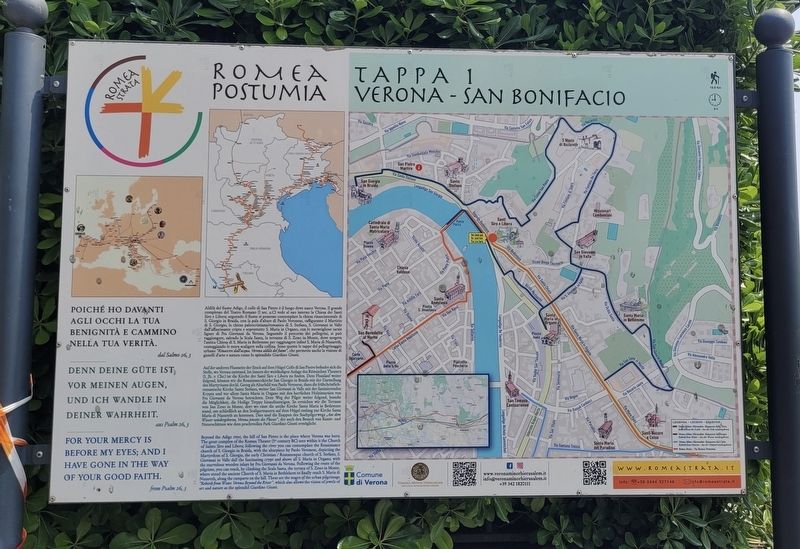
Tappa 1 Verona – San Bonifacio
⎯⎯⎯
Pilgrimage Route to Rome
Stage 1: Verona – San Bonifacio
Photographed by James Hulse, June 11, 2025
1. Romea Postumia / Pilgrimage Route to Rome Marker

Poiché ho davanti agli occhi la tua benignità e cammino nella tua verità. — dal Salmo 26, 3
Aldilà del fiume Adige, il colle di San Pietro è il luogo dove nasce Verona. Il grande complesso del Teatro Romano (I sec. a.C.) vede al suo interno la Chiesa dei Santi Siro e Libera; seguendo il fiume si possono contemplare la chiesa rinascimentale di S. Giorgio in Braida, con la pala d'altare di Paolo Veronese, raffigurante il Martirio di S. Giorgio, la chiesa paleocristiana/romanica di S. Stefano, S. Giovanni in Valle dall'affascinante cripta e soprattutto S. Maria in Organo, con le meravigliose tarsie lignee di Fra Giovanni da Verona. Seguendo il percorso dei pellegrini, si può raggiungere, salendo la Scala Santa, la terrazza di S. Zeno in Monte, dove sorgeva l'antica Chiesa di S. Maria in Betlemme per raggiungere infine S. Maria di Nazareth, costeggiando le mura scaligere sulla collina. Sono queste le tappe del pellegrinaggio urbano "Rinascere dall'acqua, Verona aldilà del fiume", che permette anche la visione di gioielli d'arte e natura come lo splendido Giardino Giusti.
Denn deine Güte ist
this page online
Auf der anderen Flussseite der Etsch auf dem Hügel Colle di San Pietro befindet sich die Stelle, wo Verona entstand. Im Innern der weitläufigen Anlage des Römischen Theaters (1. Jh. v. Chr.) ist die Kirche der Santi Siro e Libera zu finden. Dem Flusslauf weiter folgend, können wir die Renaissancekirche San Giorgio in Braida mit der Darstellung des Martyriums des hl. Georg als Altarbild von Paolo Veronese, dann die frühchristlich-romanische Kirche Santo Stefano, weiter San Giovanni in Valle mit der faszinierenden Krypta und vor allem Santa Maria in Organo mit den herrlichen Holzintarsien von Fra Giovanni da Verona betrachten. Dem Weg der Pilger weiter folgend, besteht die Möglichkeit, die Heilige Treppe hinaufzusteigen. So erreichen wir die Terrasse von San Zeno in Monte, dort wo einst die antike Kirche Santa Maria in Betlemme stand, um schließlich an den Scaligermauern auf dem Hügel entlang zur Kirche Santa Maria di Nazareth zu kommen. Dies sind die Etappen des Stadtpilgerwegs „Aus dem Wasser wiedergeboren, Verona jenseits des Flusses", der auch den Besuch von
Photographed by James Hulse
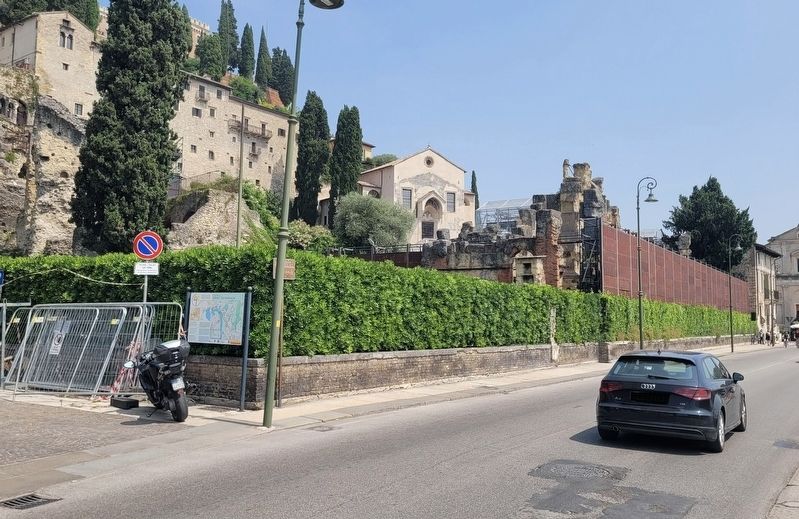
2. Romea Postumia / Pilgrimage Route to Rome Marker
The view of the marker along the street.
For your mercy is before my eyes; and I have gone in the way of your good faith. — from Psalm 26:3
Beyond the Adige river, the hill of San Pietro is the place where Verona was born. The great complex of the Roman Theater (1st century BC) sees within it the Church of Saints Siro and Libera; following the river you can contemplate the Renaissance church of S. Giorgio in Braida, with the altarpiece by Paolo Veronese, depicting the Martyrdom of S. Giorgio, the early Christian / Romanesque church of S. Stefano, S. Giovanni in Valle dall the fascinating crypt and above all S. Maria in Organo, with the marvelous wooden inlays by Fra Giovanni da Verona. Following the route of the pilgrims, you can reach, by climbing the Scala Santa, the terrace of S. Zeno in Monte, where stood the ancient Church of S. Maria in Bethlehem to finally reach S. Maria di Nazareth, along the ramparts on the hill. These are the stages of the urban pilgrimage "Rebirth from Water. Verona Beyond the River", which also allows the vision of jewels of art and nature as the splendid
Photographed by James Hulse, June 11, 2025
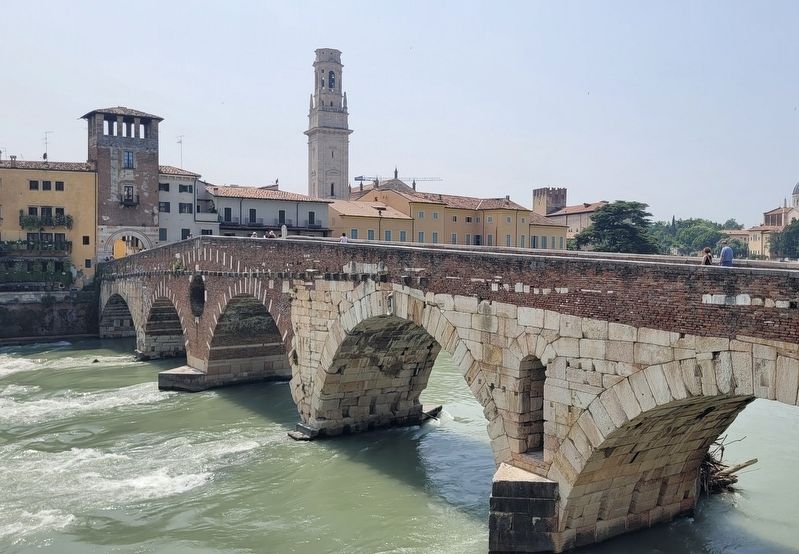
3. Romea Postumia / Pilgrimage Route to Rome Marker
The view of the Stone Bridge/Ponte Pietra over the Adige River near the marker.
Erected by Comune di Verona.
Topics. This historical marker is listed in these topic lists: Religion & Religious Structures • Roads & Vehicles.
Location. 45° 26.868′ N, 11° 0.063′ E. Marker is in Verona, Veneto (Venetia), in Provincia di Verona. It is in Veronetta. It is at the intersection of Rigaste Redentore and Vicolo Botte, on the left when traveling south on Rigaste Redentore. Touch for map. Marker is at or near this postal address: Rigaste Redentore 1, Verona, Veneto 37129, Italy. Touch for directions.

Regionally, it is in Europe, the European Union, the Schengen Area, a coastal Mediterranean country, and the Western World. Historically, it finds itself in what was once the Roman Empire and specifically also the Holy Roman Empire.
Other nearby markers. At least 8 other markers are within walking distance of this marker: Libro Percorso - una città ritrova il suo fiume / Book Route - a city finds its river again (about 90 meters away, measured in a direct line); Chiesa di Sant'Elena (secoli IX–XII) e Battistero di San Giovanni in Fonte (secolo XII)
Photographed by James Hulse, June 11, 2025
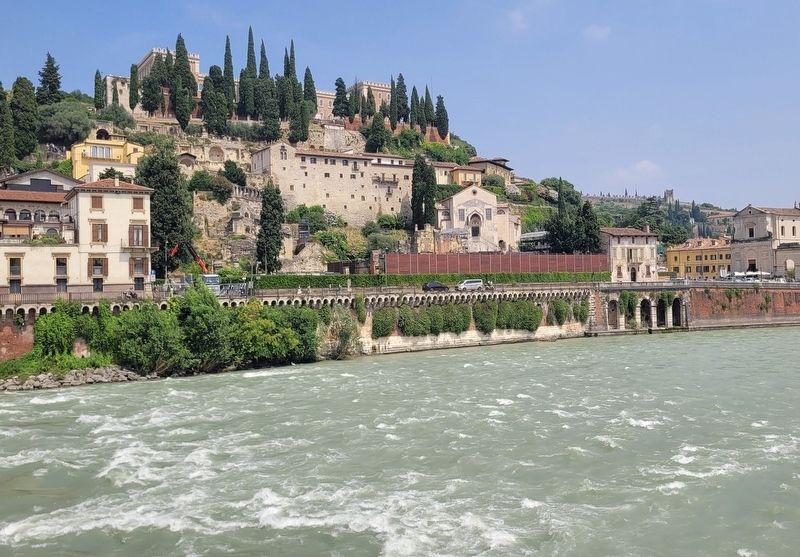
4. Romea Postumia / Pilgrimage Route to Rome Marker
The view of the Castel San Pietro over the Adige River. The marker is located near the truck (left side) with the red crane on the far side of the river.
Also see . . . Romea Strata - The longest route to Rome in Europe. Romea Strata Organization
The Romea Strata is a living path, a bridge between cultures and breathtaking landscapes, rich with ancient traces. Whether you are a pilgrim, hiker, or curious traveler, here you’ll find your guide to discover a unique heritage and live an authentic experience.(Submitted on February 14, 2026, by James Hulse of Medina, Texas.)
Credits. This page was last revised on February 14, 2026. It was originally submitted on February 9, 2026, by James Hulse of Medina, Texas. This page has been viewed 22 times since then. Photos: 1, 2, 3, 4. submitted on February 14, 2026, by James Hulse of Medina, Texas.
