
Poipu in Koloa in Kauai County, Hawaii — Hawaiian Island Archipelago (Pacific Ocean)
Ka Moolelo O Kauai
⎯⎯⎯
The Heritage of Kaua'i
Photographed by Darren Jefferson Clay, December 5, 2025
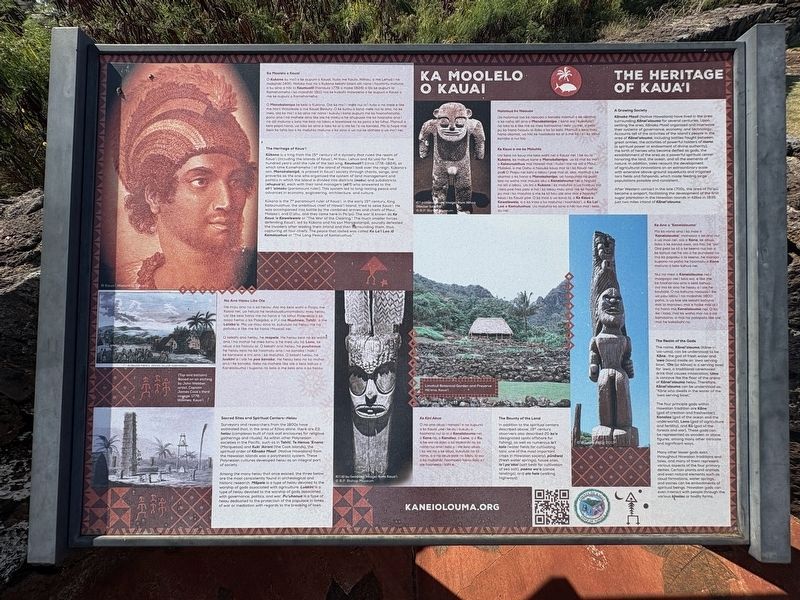
1. The Heritage of Kaua'i - Marker

[Top Left] The Heritage of Hawai'i
Kūhona is a king from the 15th century of a dynasty that ruled the realm of Kaua'i (including the islands of Kaua'i, Ni'ihau, Lehua and Ka'ula) for five hundred years until the rule of the last king, Kaumuali'i (circa 1778-1824), at which time Kamehameha I of the island of Hawai'i took over the reign. Kūkona's son, Manokalanipō, is praised in Kaua'i society through chants, songs, and proverbs as the one who organized the system of land management and politics in which the island is divided into districts (moku) and subdistricts (ahupua'a), each with their land managers (ail'i) who answered to the ail'i'aimoku (paramount ruler). This system led to a long-lasting peace and advances in economy, engineering, architecture, and culture.
Kūkona is the 7th paramount ruler of Kaua'i. In the early 15th century, King Kalaunulohua, the ambitious chief of Hawai'i Island, tried to seize Kaua'i. He was accompanied into battle by the combined armies and chiefs of Maui, Moloka'i, and O'ahu, and they came here in Po'ipū. The war
this page online
[Bottom Left] Sacred Sites and Spiritual Centers - Heiau
Surveyors and researchers from the 1800s have estimated that, in the area of Kōloa alone, there are 23 heiau (complexes built of rock wall enclosures for religious gatherings and rituals). As within other Polynesian societies in the Pacific, such as in Tahiti, Te Henua 'Enana Kuki'Airani (the Cook Islands), the spiritual order of Kānaka Maoli(Native Hawaiians) from the Hawaiian Islands was a polytheistic system. These Polynesian cultures developed heiau as an integral part of society.
Among the many heiau that once existed, the three below are the most consistently found in archaeological and historic research. Māpele is a type of heiau devoted to the worship of gods associated with agriculture.
Photographed by Darren Jefferson Clay, December 5, 2025
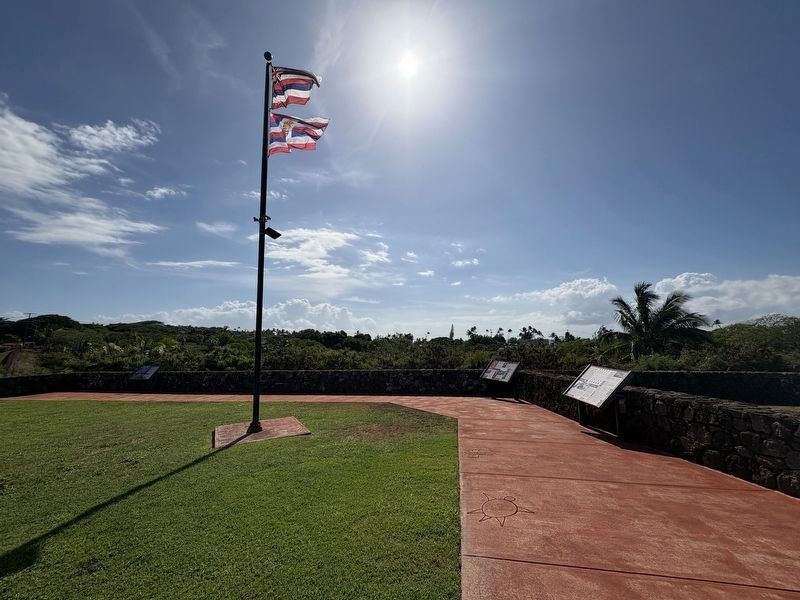
2. The Heritage of Kaua'i - Marker in context
[Top Right] A Growing Society
Kānaka Maoli (Native Hawaiians) have lived in the area surrounding Kānei'olouma for several centuries. Upon settling the area, Kānaka Maoli organized and interwove their systems of governance, economy, and technology. Accounts tell of the activities of the island's people in the area of Kānei'olouma, including battles fought between great armies, the activities of powerful holders of mana (a spiritual power or endowment of divine authority), the birth of heroes who became deified as gods, the establishment of the area as a powerful spiritual center honoring the land, the ocean, and all the elements of nature. In addition, tales recount the development of agricultural innovations on an extraordinary scale with extensive above-ground aqueducts and irrigated taro fields and fishponds, which made feeding large populations possible and consistent.
After Western contact in the late 1700s, the area of Po'ipu became a seaport, facilitating the development of the first sugar plantation in the Hawaiian Islands in Kōloa in 1835 just two miles inland of Kānei'olouma.
[Bottom Middle] The Bounty of the Land
In addition to the spiritual centers described above, 19th century observers also described 20 ko'a (designated spots offshore for fishing), as well as numerous lo'i kalo (water fields for cultivating taro, one of the most important crops in Hawaiian society), pūnāwai (fresh water springs), house sites, lo'i pa'akao (salt beds for cultivation of sea salt), paena wa'a (canoe landings), and ala hele (walking highways).
[Bottom Right] The Realm of the Gods
The name, Kānei'olouma (Kāne-i-'olo-uma), can be understood to be Kāne, the god of fresh water and 'awa (kava) inside a 'awa serving bowl. 'Olo (or kānoa) is a serving bowl for 'awa, a traditional ceremonial drink that causes intoxication. Uma is concave like the floor of the arena of
The four principle gods within Hawaiian tradition are Kāne (god of creation and freshwater), Kanaloa (god of the ocean and the underworld), Lono (god of agriculture and fertility), and Kū (god of the forests and war). These gods can be represented as wooden or stone figures, among many other intricate and significant ways.
Many other lesser gods exist throughout Hawaiian traditions and tales, and many of them represent various aspects of the four primary deities. Certain plants and animals and even natural elements such as cloud formation, water springs, and stones can be embodiments of spiritual beings. Hawaiian gods can even interact with people through the various kinolau or bodily forms.
[Top Left] Ka Moolelo o Kaual
O Kukona ka mo'l o ke aupuni o Kauai, huiia me Kaula, Nilhau, a me Lehua i na makahiki 1400. Noloko mai no o Kukona kekahi lalani alii nana i hoomalu maluna o ka aina a hiki ia Kaumualii (hanauia 1778 a make 1824) a lilo ke aupuni la Kamehameha i ka makahiki 1810 ma ke kuikahi mawaena o ke aupuni o Kauai a me ke aupuni o Kamehameha.
O Manokalanipo ke keiki a Kukona. Oia ka mo'l i mele nui ia'i iloko o na mele e like me Nani Waialeale a me Kauai Beauty. O ke kumu o kona mele nui ia ana, no ka mea, ola ka mo'i o ka aina nei nana i kukulu i kona aupuni me ka hoonohonoho pono ana i na mahele aina like ole he moku a he ahupuaa me ka hoonoho ana I na alii maluna o kela me kela na lakou e lawelawe no ka pono o ka lahui. Mamuli o keia papa hana, ua lako ka aina a lako ka ai a me ka l'a na kanaka. Ma ia hope mai ikeia ka laha loa o ka maluhia maluna a ka aina a ua nui ke alohaia o ua mo'i nei.
[Bottom Left] Na Ano Helau Like Ole
He mau ano no o ka heiau. Aia ma keia wahi o Poipu me Koloa nei, ua heluia he iwakaluakumamakolu mau helau. Ua like keia hana me na hana a na lahui Polenekia a ka aoao hema o ka Pakipika, e like me Nuuhiwa, Tahiti, a me Lalako'a. Ma ua mau aina la, kukuluia na heiau me na pohaku e like me ka hana i Hawaii nei.
O kekahi ano heiau, he mapele. He heiau keia no ka waiho ana i na mohai he mea kanu a he mea ulu no Lono, ke akua o ka hooulu ai. O kekahi ano helau, he puuhonua, he heiau keia no ka hoomalu ana i na kanaka I haki i ke kanawai e imi ana i ka maluhia. O kekahi heiau, he luakini a i ole he poo kanaka. He heiau keia no ka mohai ana i ke kanaka. Ikeia na mahele like ole o keia kahua o Kaneiolouma i kupono no kela a me keia ano o ka helau.
[Top Right] Holomua ka Naauao
Ua holomua loa ka naauao o kanaka mamuli o ke akamal o ka noho alii ana o Manokalanipo. I kona wa i kukuluia'i na loko ia e like me ka mea kamaaina i keia au nei, a peia pu ka hana hooulu ai iloko o ka loi kalo. Mamuli o keia mau hana akamal, ua hiki ke hoolakoia ka ai a me ka i'a i ka lahui kanaka a nui loa.
Ke Kaua a me ka Maluhia
Ua ikeia na kaua ma keia wahi nei o Kauai nei. I ke au la Kukona, ka makua kane o Manokalanipo, ua kii mai ka mo'l o Kalaunuiohua mai Hawaii mai i huiia'i me na alii o Maul, Molokai, a me Oahu a hoouka kaua mai la i ko Kauai nei poet O Poipu nei kahi a lakou i pae mai ai, aka, mamuli o ke akamai o ka hana a Manokalanipo, ua hoopuniia na puali koa no waho mai mauka aku o Kaneiolouma nei a hopuia na alii o lakou. Ua lini o Kukona i ka maluhia a ua hookuu ola i kela poe hoa paio e hoi i ko lakou mau aina me ka hoohiki pu mai i ka maluhia a me ke kii hou ole ana mai e hoouka kaua i ko Kaual poe. O ka inca o ua kaua la, o Ke Kaua o Kawelewele, a o ka inoa o ka maluhia i hoohikiia'i, ο Ka Lai Loa o Kamaluohua. Ua maluhia ka aina a hiki loa mai i kela au nei.
[Bottom Middle] Ke Kini Akua
O na ano akua i nanaia'i e na kupuna o ko Kauai poe I ke au i kukulu a hoohana nui ia ai o Kaneiolouma nei, o Kane no, o Kanaloa, o Lono, a o Ku, a he wa no iloko o ka makahiki no ka nana nui ana i kela a i ole keia akua I ka wa no o ke akua, kukuluia na kil nona, a a na akua aole no lakou ia wa a ka makahiki, hoomoeia lakou ilalo a i ole hooneeia i kahi e
[Bottom Right] Ke Ano o 'Kaneiolouma'
Ma ka nana ana i ka inaa o 'Kaneiolouma', manaoia o ke ano nui o ua inoa nei, oia o Kane, ke akua, iloko o ke kanoa awa, oia hoi, he 'olo'. Oiai pela ke kii o ke keena nui loa a ke kahua nei he olo a he punawai no ma ka papaku a ia keena, he manao kupono no paha he hoomalu o Kane maluna o keia kahua nei.
Nui na mea a Kaneiolouma nei i maopopo ole i keia wa, e like me ka hoohanaia ana a keia kahua, ina ma ke ano he heiau a i ole he kauhale. O na kahuna naauao i ike, ua pau lakou i na makahiki 1800 paha, a ua koe ale kekahi kahuna mai ia manawa mai e hoike mai ai i na hana ma Kaneiolouma nei. O ka ike i loaa, mai ka waha mai no o na kamaaina, a mai na palapala like ole mai he kakaikahi no.
Topics. This historical marker is listed in these topic lists: Indigenous Peoples and Communities • Industry & Commerce • Religion & Religious Structures • Settlements & Settlers. A significant historical year for this entry is 1400.
Location. 21° 52.579′ N, 159° 27.203′ W. Marker is in Koloa, Hawaii, in Kauai County. It is in Poipu. It is on Poipu Road east of Hoowili Road, on the right when traveling east. Touch for map. Marker is at or near this postal address: 2199 Poipu Rd, Koloa HI 96756, United States of America. Touch for directions.

Regionally, it is in North America, Polynesia, the Pacific Ocean, North Pacific, the Pacific Rim, the Western Hemisphere, the Western World, and the Anglosphere.
Other nearby markers. At least 8 other markers are within walking distance of this marker: Kilo Lani / Charting The Stars (here, next to this marker); Ka Moolelo O Kaneiolouma / The Story of Kanei'olouma (a few steps from this marker); Po‘ipū Beach Park (approx. 0.2 miles away); Kihāhouna Heiau (approx. 0.3 miles away); Hapa Road (approx. 0.3 miles away); Pā‘ū a Laka (Moir Gardens) (approx. 0.4 miles away); Pu‘uwanawana Volcanic Cone (approx. half a mile away); Keoneloa Bay (approx. 0.8 miles away). Touch for a list and map of all markers in Koloa.
More about this marker. Photo captions:
Top left: © Kaua'i Historical Society
Mid left and bottom left: Based on an etching by John Webber, artist, Captain James Cook's third voyage, 1778, Waimea, Kaua'i
Top centre: Ki'i pōhaku (stone image) from Hihoa (Necker Island). © B.P. Bishop Museum
Bottom mid-left: Ki'i Lā'au (wooden image) from Kaua'i. © B.P. Bishop Museum
Bottom mid-right: Limahuli Botanical Garden and Preserve, Hā'ena, Kaua'i © Joseph Ahad 2013
Bottom right: © Joseph Ahad 2013
Credits. This page was last revised on August 15, 2026. It was originally submitted on February 9, 2026, by Darren Jefferson Clay of Duluth, Georgia. This page has been viewed 63 times since then. Photos: 1, 2. submitted on February 10, 2026, by Darren Jefferson Clay of Duluth, Georgia. • Devry Becker Jones was the editor who published this page.
