Salida in Chaffee County, Colorado — The American Mountains (Southwest)
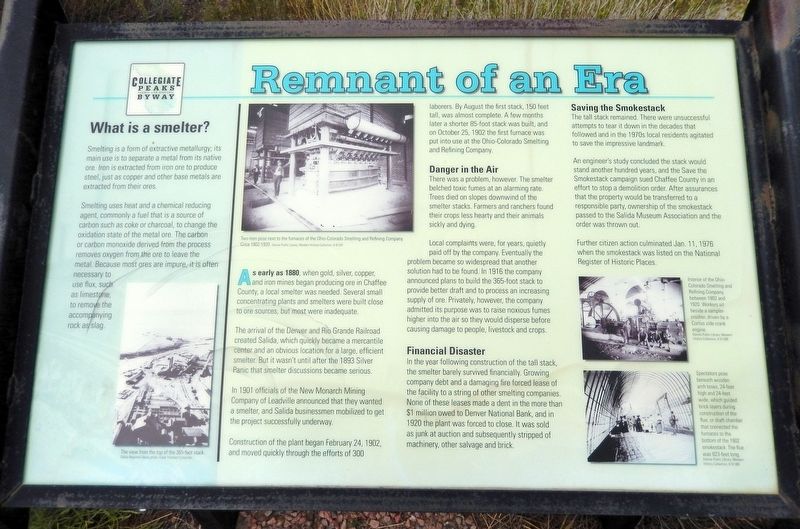
Remnant of an Era
| — | Collegiate Peaks Scenic and Historic Byway | — |
Photographed by Cosmos Mariner, July 23, 2025
1. Remnant of an Era Marker
As early as 1880, when gold, silver, copper, and iron mines began producing ore in Chaffee County, a local smelter was needed. Several small concentrating plants and smelters were built close to ore sources, but most were inadequate.
The arrival of the Denver and Rio Grande Railroad created Salida, which quickly became a mercantile center and an obvious location for a large, efficient smelter. But it wasn't until after the 1893 Silver Panic that smelter discussions became serious.
In 1901 officials of the New Monarch Mining Company of Leadville announced that they wanted a smelter, and Salida businessmen mobilized to get the project successfully underway.
Construction of the plant began February 24, 1902, and moved quickly through the efforts of 300 laborers. By August the first stack, 150 feet tall, was almost complete. A few months later a shorter 85-foot stack was built, and on October 25, 1902 the first furnace was put into use at the Ohio-Colorado Smelting and Refining Company.
Danger in the Air
There was a problem, however. The smelter belched toxic fumes at an alarming rate. Trees died on slopes downwind of the smelter
this page online
Local complaints were, for years, quietly paid off by the company. Eventually the problem became so widespread that another solution had to be found. In 1916 the company announced plans to build the 365-foot stack to provide better draft and to process an increasing supply of ore. Privately, however, the company admitted its purpose was to raise noxious fumes higher into the air so they would disperse before causing damage to people, livestock and crops.
Financial Disaster
In the year following construction of the tall stack, the smelter barely survived financially. Growing company debt and a damaging fire forced lease of the facility to a string of other smelting companies. None of these leases made a dent in the more than $1 million owed to Denver National Bank, and in 1920 the plant was forced to close. It was sold as junk at auction and subsequently stripped of machinery, other salvage and brick.
Saving the Smokestack
The tall stack remained. There were unsuccessful attempts to tear it down in the decades that followed and in the 1970s local
Photographed by Cosmos Mariner, July 23, 2025
2. Remnant of an Era Marker
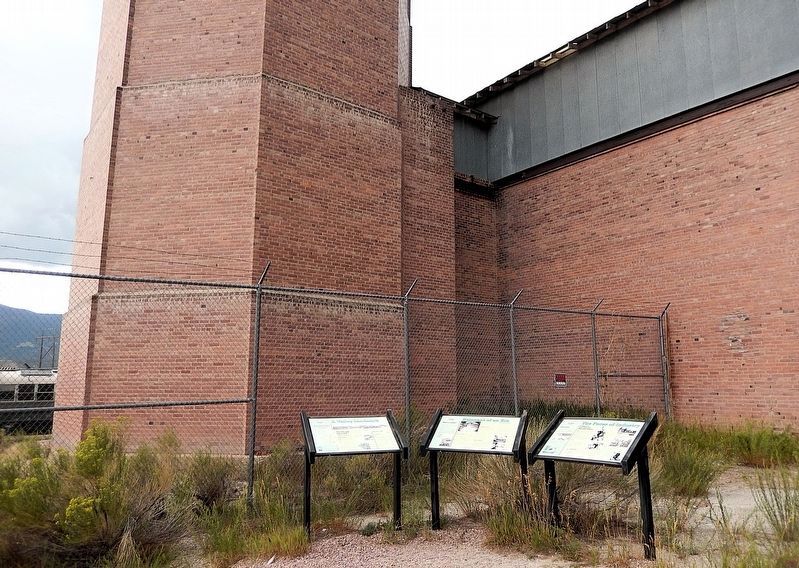
This is the center one of three related interpretive panels located near the base of the Ohio-Colorado Smelting & Refining Company Smokestack.
An engineer's study concluded the stack would stand another hundred years, and the Save the Smokestack campaign sued Chaffee County in an effort to stop a demolition order. After assurances that the property would be transferred to a responsible party, ownership of the smokestack passed to the Salida Museum Association and the order was thrown out.
Further citizen action culminated Jan. 11, 1976 when the smokestack was listed on the National Register of Historic Places.
What is a smelter?
Smelting is a form of extractive metallurgy; its main use is to separate a metal from its native ore. Iron is extracted from iron ore to produce steel, just as copper and other base metals are extracted from their ores.
Smelting uses heat and a chemical reducing agent, commonly a fuel that is a source of carbon such as coke or charcoal, to change the oxidation state of the metal ore. The carbon or carbon monoxide derived from the process removes oxygen from the ore to leave the metal. Because most ores are impure, it is often necessary to use flux, such as limestone, to remove the accompanying rock
Photographed by Cosmos Mariner, July 23, 2025
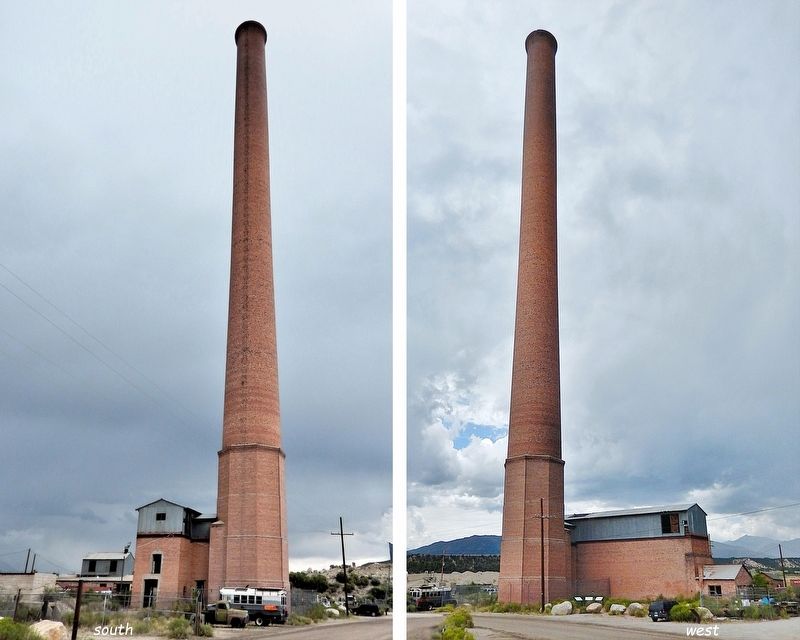
3. Ohio-Colorado Smelting & Refining Company Smokestack
[photo captions]
• Two men pose next to the furnaces of the Ohio-Colorado Smelting and Refining Company. Circa 1902-1920.
• Interior of the Ohio-Colorado Smelting and Refining Company, between 1902 and 1920. Workers sit beside a sampler-crusher, driven by a Corliss side crank engine.
• Spectators pose beneath wooden arch bows. 24-feet high and 24-feet wide, which guided brick layers during construction of the flue, or draft chamber that connected the furnaces to the bottom of the 1902 smokestack. The flue was 823-feet long.
• The view from the top of the 365-foot stack.
Erected 2009 by Federal Highway Administration, National Scenic Byways and Greater Arkansas River Nature Association.
Topics. This historical marker is listed in these topic lists: Environment • Industry & Commerce • Railroads & Streetcars. A significant historical date for this entry is February 24, 1902.
Location. 38° 33.144′ N, 106° 1.449′ W. Marker is in Salida, Colorado, in Chaffee County. It is on County Road 152 0.2 miles west of County Road 150. The marker is near the base of the historic Ohio-Colorado Smelting and Refining Company Smokestack, a landmark visible from anywhere in Salida. Touch for map. Marker is at or near this postal address: 8010 County Road 152, Salida CO 81201, United States of America. Touch for directions.

Regionally, this marker is in the Arkansas River Valley, in the Colorado High Rockies and on the Continental Divide. It is also in the American Mountain West. Globally, it is in North America, the Rocky Mountains, the Western Hemisphere, the Western World, and the Anglosphere.
Other nearby markers. At least 8 other markers are within 2 miles of this marker, measured as the crow flies: A Valley Landmark (here, next to this marker); The Faces of Industry (here, next to this marker); Chaffee County Courthouse (approx. 1.8 miles away); Old Rails New Trails (approx. 2 miles away); Heart of the Rockies (approx. 2 miles away); A Railroad Town (approx. 2 miles away); Water Use and Water Rights (approx. 2 miles away); The Salida Steam Plant (approx. 2 miles away). Touch for a list and map of all markers in Salida.
Regarding Remnant of an Era. National Register of Historic Places № 76000548.
Related markers. Click here for a list of markers that are related to this marker. The Smeltertown Smokestack
Also see . . . Salida Smokestack (Salida Museum).
Excerpt: Except for the big smokestack, little remained of the industry in the 1970s when interest in the historic landmark revived. The County, which had acquired the smelter property in 1938 and sold most of it to collect back taxes, became worried that the stack was a liability and threatened to demolish it. In response, more than 50 citizen activists organized the Save Our Stack (SOS) committee headed by Wendell Hutchinson and went to court with evidence that the masonry stack was structurally sound and that a responsible party would agree to accept the deed. The Salida Museum Association subsequently took title Oct. 24, 1974.(Submitted on February 15, 2026, by Cosmos Mariner of Cape Canaveral, Florida.)
In 1976, during the American Revolution Bicentennial, the smokestack was placed on the National Register of Historic Places as a “highly visible monument to the mining industry and its workers.” It was among the first to be so designated of some 40 historic structures in Chaffee County that now appear on the register or the State list of historic places.
In July 2009, three wayside exhibit panels were installed at the base of the smokestack to tell the mining story to tourists in words and pictures. The exhibit marks the site as part of the Collegiate Peaks Scenic and Historic Byway, which runs through Chaffee County.
Credits. This page was last revised on February 15, 2026. It was originally submitted on February 13, 2026, by Cosmos Mariner of Cape Canaveral, Florida. This page has been viewed 44 times since then. Photos: 1, 2, 3. submitted on February 15, 2026, by Cosmos Mariner of Cape Canaveral, Florida.
