
Taisnières-sur-Hon in Nord Department, Upper France, France — Western Europe
Memorial of the 1709 Military Campaign
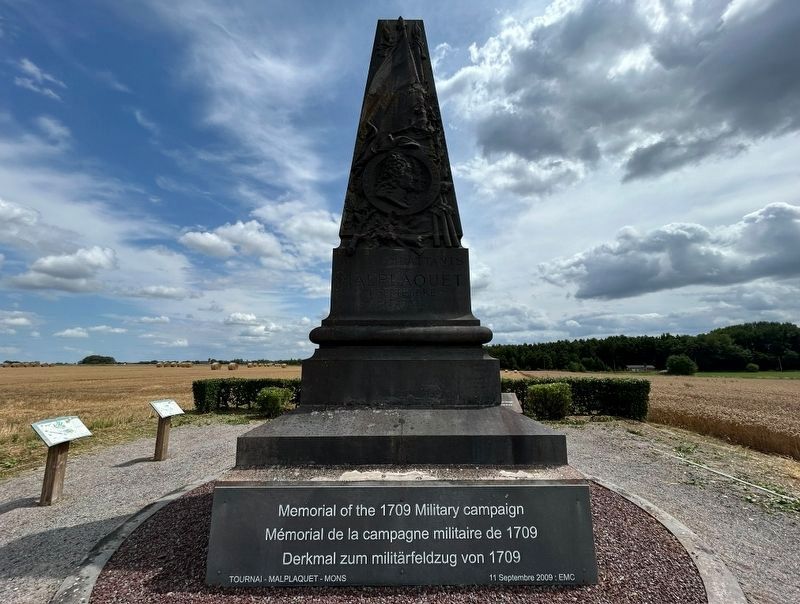
Photographed by Jonathan Woody, July 15, 2025
1. Memorial of the 1709 Military Campaign Marker

11 september 1709
Memorial of the 1709 Military Campaign
Erected 2009 by City of Tournai; Town of Malplaquet; City of Mons.
Topics. This memorial is listed in this topic list: Wars, Non-US.
Location. 50° 20.16′ N, 3° 52.397′ E. Memorial is in Taisnières-sur-Hon, Hauts-de-France (Upper France), in Nord Department. It is on Rte de Mons (County Route D932), on the left when traveling south. When driving southwest on Route de Mons (D932) from the Belgian border, the memorial will appear on your left on the opposite side of the road. Accessing the memorial can be difficult, as there is no parking space in front, only a very small and narrow gravel curb divides the memorial steps from the road, and this can be a busy road (speed limit is 50 km/h). Pulling up in the field on the right side (north side) of the road beside the memorial space is possible, but be cautious as the curb here has a shallow embankment. The left (south) side of the road has a steeper embankment so pulling off here is not advised. Touch for map. Memorial is in this post office area: Taisnières-sur-Hon,
this page online

Regionally, it is in the North Atlantic Region, Europe, the European Union, Atlantic Europe, the Schengen Area, Western Europe, a coastal Mediterranean country, and the Western World. Historically, it finds itself in what was once a French colony and also the Roman Empire.
Other nearby markers. At least 8 other markers are within 14 kilometers of this marker, measured as the crow flies: World War Il Sherman Tank / Char Sherman de la Seconde Guerre mondiale (approx. 14 kilometers away in Belgium); Jules Cornet (approx. 14 kilometers away in Belgium); To Its Fallen Combatants (approx. 14.1 kilometers away in Belgium); 5th Royal Irish Lancers (approx. 14.4 kilometers away in Belgium); Salon Baronne Betty Duesberg (approx. 14.4 kilometers away in Belgium); Mons Recaptured (approx. 14.4 kilometers away in Belgium); In Gratitude (approx. 14.4 kilometers away in Belgium); Palace of Justice/ Palais de Justice (approx. 14.5 kilometers away in Belgium).
More about this memorial. The memorial stands in the approximate center of the French artillery battery line of earthwork redans that spanned the center of Marshal Villars' battle line, with the defensive works here occupied by the Irish troops
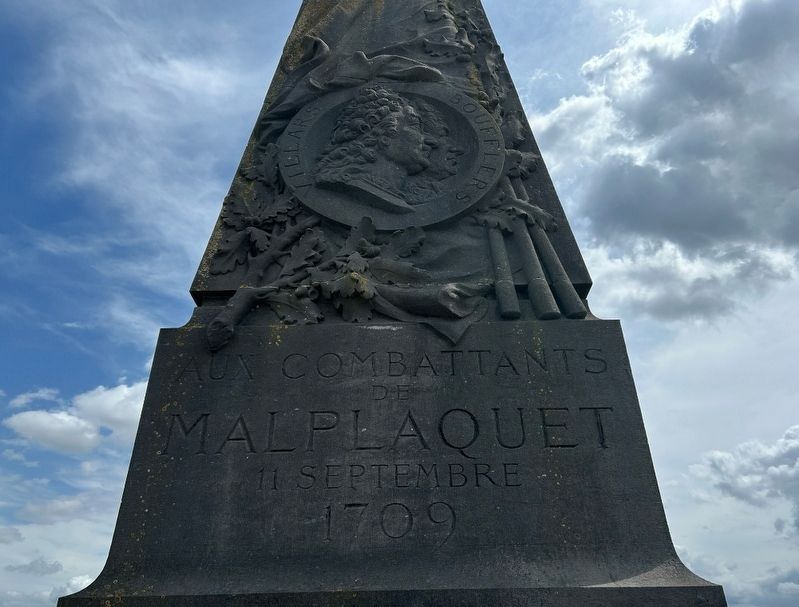
Photographed by Jonathan Woody, July 15, 2025
2. Closeup of the memorial's inscription and relief, depicting Marshals Villars and Boufflers.
Regarding Memorial of the 1709 Military Campaign. The Battle of Malplaquet, fought on September 11th, 1709, was the bloodiest battle of the entire 18th century, with a combined casualty count of around 33,000 killed, wounded, captured, or missing (c. 22,000 for the Grand Alliance, c. 11,000 for the French). Of these, an estimated 7,000 - 10,000 men were killed in action. The devastating casualties at Malplaquet would not be surpassed until the 1807 Battle of Eylau during the Napoleonic Wars - 98 years later. The battle was the climax of the Grand Alliance's 1709 campaign in Upper France. British Army Captain-General John Churchill, 1st Duke of Marlborough, together with Imperial Field Marshal Prince Eugene of Savoy led a multinational Grand Alliance army into Upper France to invade the country and force an end to the War of the Spanish Succession (1701 - 1714). The French Army of Flanders, led by Marshal Claude Louis Hector de Villars, 1st Duke of Villars, and Marshal Louis-François de Boufflers, Duke of Boufflers, entrenched themselves in strong positions around Malplaquet and its surrounding woods, where they made their stand on September 11th, 1709. Though Marlborough's and Eugene's army eventually succeeded in breaking their
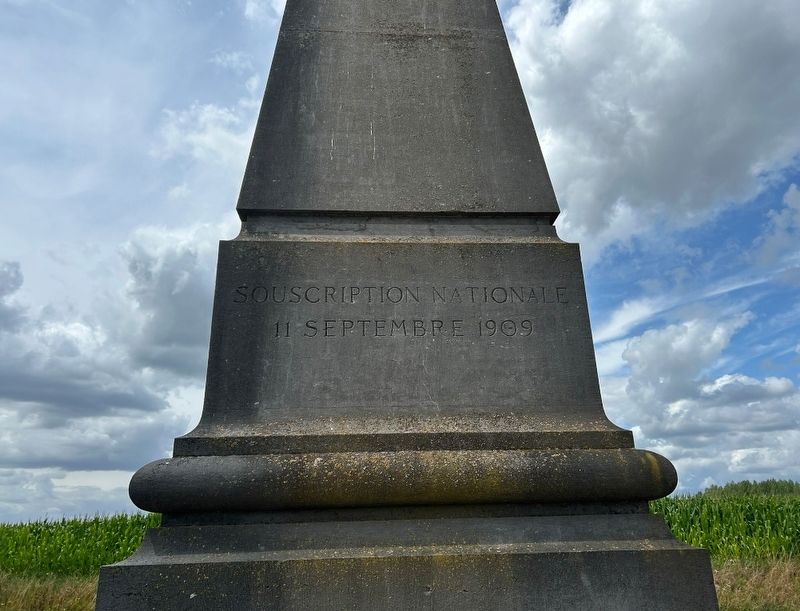
Photographed by Jonathan Woody, July 15, 2025
3. Back of the memorial and its original dedication date of 9/11/1909 for the bicentennial.
Additional keywords. War of the Spanish Succession; Battle of Malplaquet
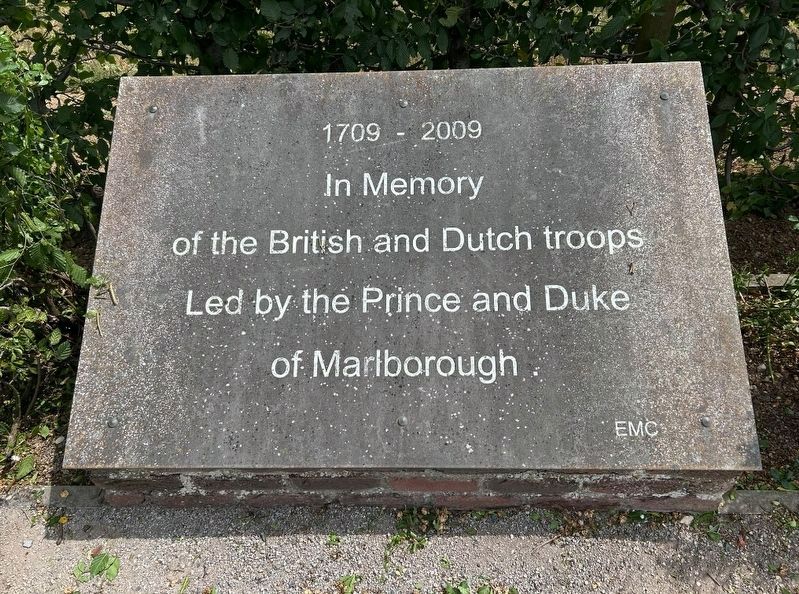
Photographed by Jonathan Woody, July 15, 2025
4. Memorial of the 1709 Military Campaign Marker
Memorial Stone added for the tricentennial dedicated to the British Army and Dutch States Army troops led by Captain-General John Churchill, 1st Duke of Marlborough, and General of Infantry Johan Willem Friso, Prince of Orange. These memorial stones are located behind the main memorial sculpture.
Photographed by Jonathan Woody, July 15, 2025
5. Memorial of the 1709 Military Campaign Marker
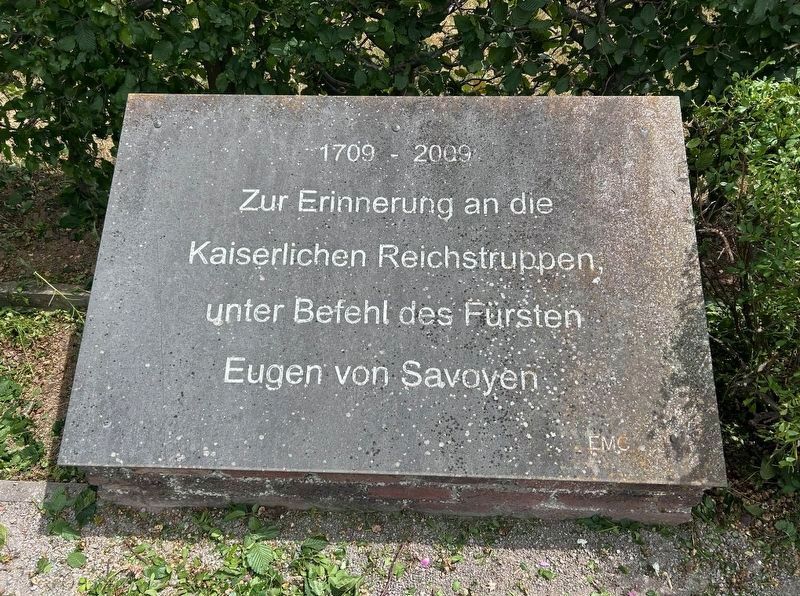
Memorial Stone added for the tricentennial dedicated to the Imperial Army (Austrian) troops and the German subsidy troops and auxiliaries (Prussians, Hanoverians, Hessians, Braunschweigers, Palatines, Saxons, Münsteraners, Mecklenburgers, and also the auxiliary Danish contingent), under the command of Imperial Field Marshal Prince Eugene of Savoy (the German auxiliaries were dispersed between Eugene's and Marlborough's two armies).
Photographed by Jonathan Woody, July 15, 2025
6. Memorial of the 1709 Military Campaign Marker
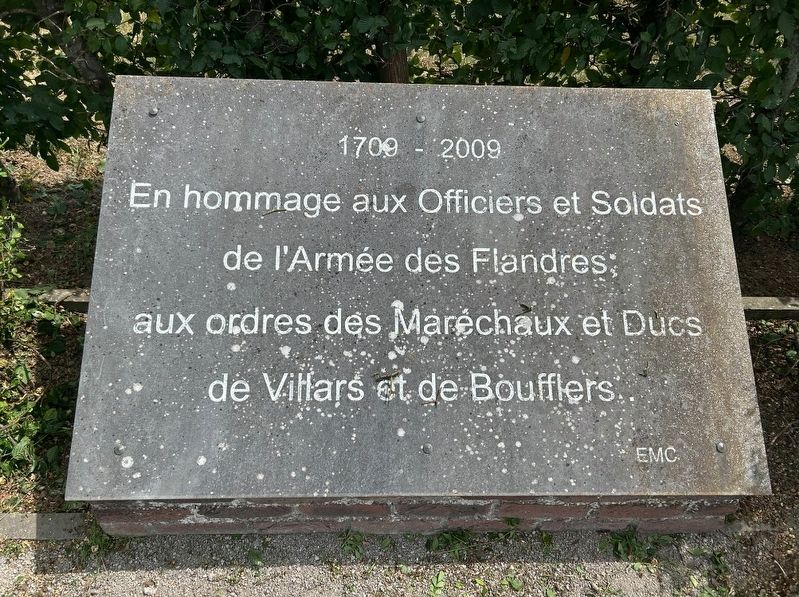
Memorial Stone added for the tricentennial dedicated to the French Army troops of the Army of Flanders led by Marshals Claude Louis Hector de Villars, 1st Duke of Villars, and Louis-François de Boufflers, Duke of Boufflers.
circa 1910
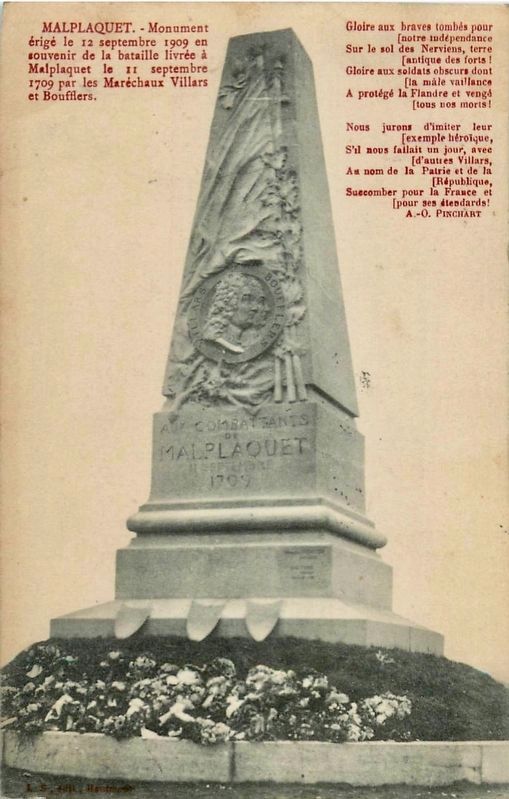
7. Battle of Malplaquet Monunent
Credits. This page was last revised on February 18, 2026. It was originally submitted on February 13, 2026, by Jonathan Woody of Warrenton, Virginia. This page has been viewed 41 times since then. Photos: 1, 2, 3, 4, 5, 6. submitted on February 13, 2026, by Jonathan Woody of Warrenton, Virginia. 7. submitted on February 18, 2026. • Andrew Ruppenstein was the editor who published this page.
