Intramuros in Manila in Metropolitan Manila First District, Metro Manila, Philippines — Southeast Asia
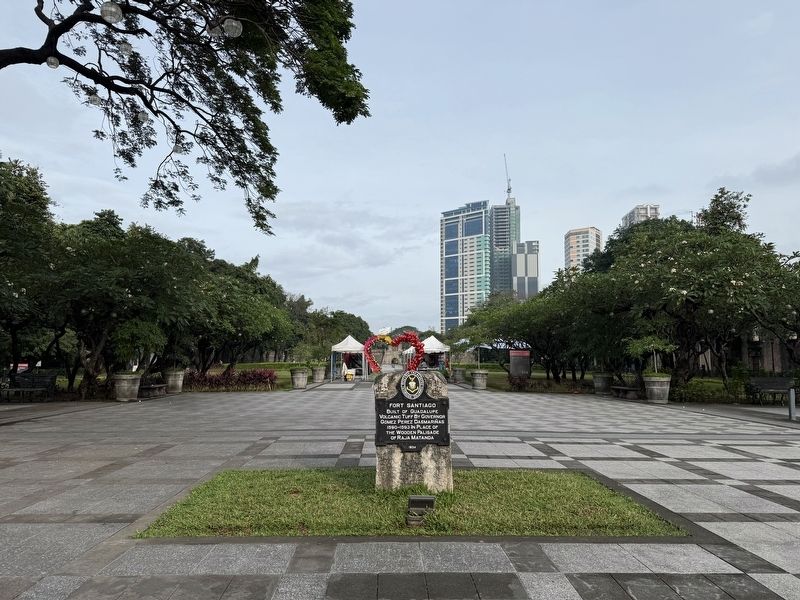
Fort Santiago

February 15, 2026
1. Fort Santiago Marker
Built of Guadalupe Volcanic Tuff By Governor Gomez Perez Dasmariñas 1590-1593 In Place of the Wooden Palisade of Raja Matanda
1934
Erected 1934 by Historical Research and Markers Committee.
Topics. This historical marker is listed in these topic lists: Architecture • Colonial Era • Forts and Castles. A significant historical year for this entry is 1590.
Location. 14° 35.566′ N, 120° 58.303′ E. Marker is in Manila, Metro Manila, in Metropolitan Manila First District. It is in Intramuros. It can be reached from Fort Santiago. Touch for map. Marker is at or near this postal address: Fort Santiago, Manila, Metro Manila 1002, Philippines. Touch for directions.

Regionally, it is in Asia, specifically in Southeast Asia, in the Malay Archipelago, in the Pacific Ocean, in North Pacific, on the Ring of Fire, in the Pacific Rim, and in the Anglosphere. Historically, it finds itself in what was once a Spanish colony.
Other nearby markers. At least 8 other markers are within walking distance of this marker: Plaza Moriones (a few steps from this marker); Madrigal Residence Fence (within shouting distance
this page online
Also see . . .
1. Fort Santiago (Wikipedia).
Fort Santiago (Spanish: Fuerte de Santiago; Filipino: Moóg ng Santiago), built in 1571, is a citadel or castle built by Spanish navigator and governor Miguel López de Legazpi for the newly established city of Manila in the Philippines. The defense fortress is located in Intramuros, the walled city of Manila.(Submitted on February 18, 2026.)
The fort is one of the most important historical sites in Manila. Several people died in its prisons during the Spanish Empire and World War II. José Rizal, the Philippine national hero, was imprisoned here before his execution in 1896. The Rizal Shrine museum displays memorabilia of the hero in their collection and the fortfeatures, embedded onto the ground in bronze, his footsteps representing his final walk from his cell to the location of the actual execution.February 15, 20262. Fort Santiago Marker
It is only a few meters away from the Manila Cathedral and the Palacio del Gobernador (lit. Governor's Palace, currently the office of the Commission on Elections).
The fort was named after Saint James (Santiago in Spanish), the patron saint of Spain, who is also known as Saint James the Muslim-slayer because of the legend that he miraculously appeared hundreds of years after his death to fight in the battle of Clavijo, whose relief adorns the façade of the front gate. It is located at the mouth of the Pasig River and served as the premier defense fortress of the Spanish Government during their rule of the country. It became a main fort for the spice trade to the Americas and Europe for 333 years. The Manila Galleon trade to Acapulco, Mexico began from the Fuerte de Santiago.
2. National Historical Commission of the Philippines (Wikipedia). This marker is one of the oldest in the Philippines. Excerpt:
The Philippine Historical Research and Markers(Submitted on February 18, 2026.)Committee was created by U.S. Governor General Frank Murphy, by virtue of Executive Order 451, to identify and mark "historic antiquities" first in Manila, then throughout the Philippines, as a first step towards their preservation. The Church of San Agustin, Fort Santiago, Plaza McKinley, the Roman Catholic Cathedral of Manila, San Sebastian Church, Concordia College, Manila Railroad Company, Dr. Lorenzo Negrao, and University of Santo Tomas (Intramuros site) were among the first structures to be granted historical markers.Photographed by Squires Bingham and Co., Manila, circa 19053. Fort Santiago

Credits. This page was last revised on February 18, 2026. It was originally submitted on February 15, 2026. This page has been viewed 70 times since then. Photos: 1, 2. submitted on February 15, 2026. 3. submitted on February 18, 2026. • Andrew Ruppenstein was the editor who published this page.
