Città Antica in Verona in Provincia di Verona, Venetia, Italy — Southern and Western Europe (Mediterranean)
Chiesa di Sant'Elena (secoli IX–XII) e Battistero di San Giovanni in Fonte (secolo XII)
Church of Saint Helena (9th–12th Centuries) and Baptistery of Saint John in Fonte (12th Century)
Photographed by James Hulse, June 11, 2025
1. Chiesa di Sant'Elena (secoli IX–XII) e Battistero di San Giovanni in Fonte (secolo XII) Marker

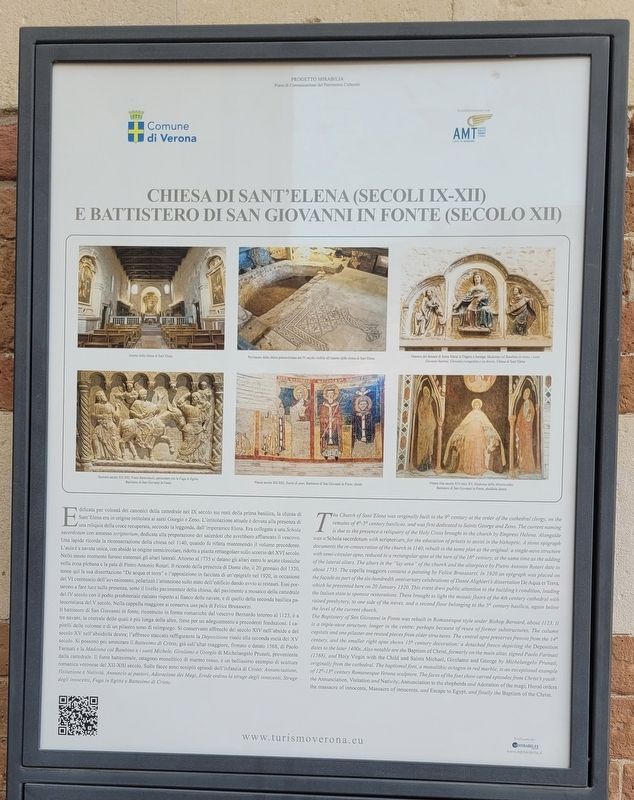
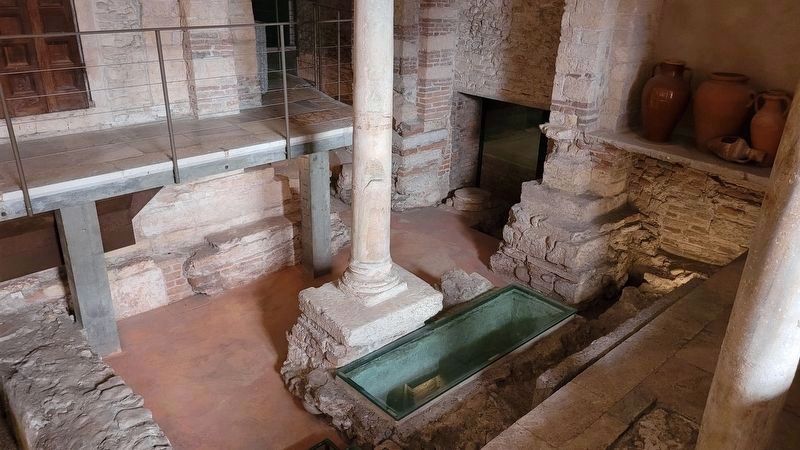
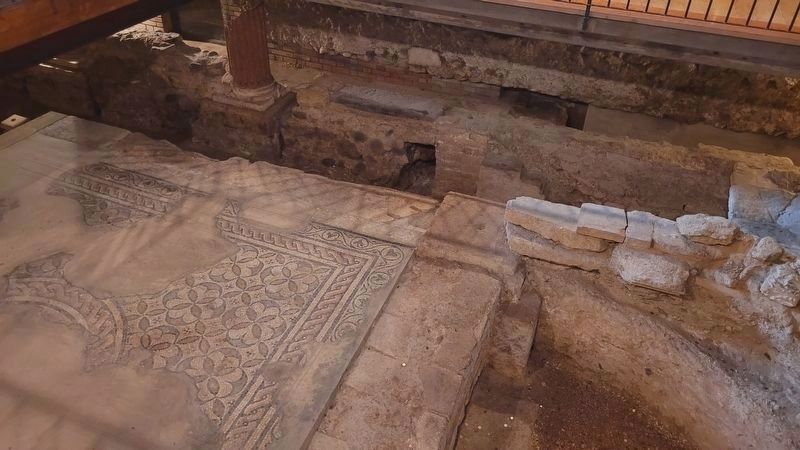
Edificata per volontà dei canonici della cattedrale nel IX secolo sui resti della prima basilica, la chiesa di Sant'Elena era in origine intitolata ai santi Giorgio e Zeno. L'intitolazione attuale è dovuta alla presenza di una reliquia della croce recuperata, secondo la leggenda, dall'imperatrice Elena. Era collegata a una Schola sacerdotum con annesso scriptorium, dedicata alla preparazione dei sacerdoti che avrebbero affiancato il vescovo. Una lapide ricorda la riconsacrazione della chiesa nel 1140, quando fu rifatta mantenendo il volume precedente. L'aula è a navata unica, con abside in origine semicircolare, ridotta a pianta rettangolare sullo scorcio del XVI secolo. Nello stesso momento furono sistemati gli altari laterali. Attorno al 1735 si datano gli altari entro le arcate classiche nella zona plebana e la pala di Pietro Antonio Rotari. Il ricordo della presenza di Dante che, il 20 gennaio del 1320, tenne qui la sua dissertazione "De aqua et terra" e l'apposizione in facciata di un'epigrafe nel 1920, in occasione del VI centenario dell'avvenimento, polarizzò l'attenzione sullo stato dell'edificio dando avvio ai restauri. Essi portarono a fare luce sulla presenza, sotto il livello pavimentale della chiesa, del pavimento a mosaico della cattedrale del IV secolo con il podio presbiteriale rialzato rispetto al fianco delle navate, e di quello della seconda basilica paleocristiana del V secolo. Nella cappella maggiore si conserva una pala di Felice Brusasorzi.
Il battistero di San Giovanni in Fonte, ricostruito in forme romaniche dal vescovo Bernardo intorno al 1123, è a tre navate, la centrale
this page online
Didascalie
(Foto #1) Interno della chiesa di Sant'Elena
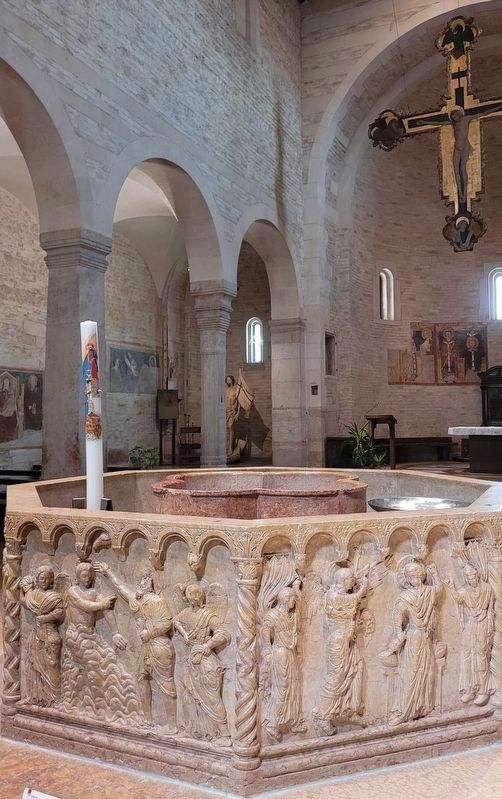
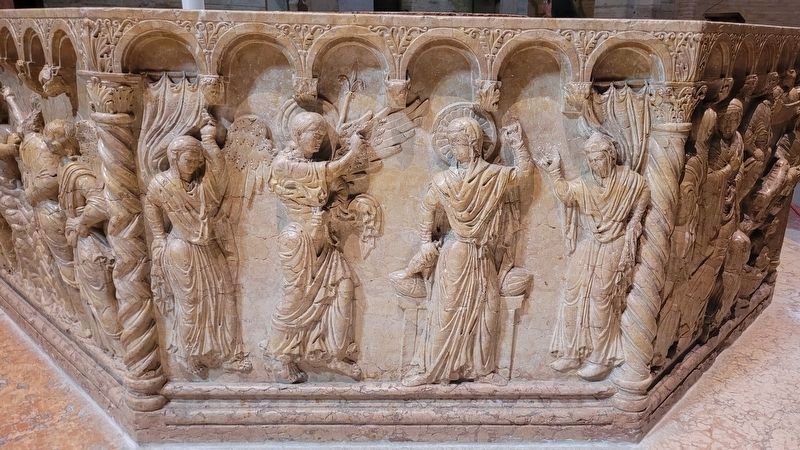
(Foto #2) Scultore secolo XII-XIII, Fonte Battesimale, particolare con la Fuga in Egitto, Battistero di San Giovanni in Fonte
(Foto #3) Pavimento della chiesa paleocristiana del IV secolo visibile all'interno della chiesa di Sant'Elena
(Foto #4) Pittore secolo XII-XIII, Teoria di santi. Battistero di San Giovanni in Fonte, abside
(Foto #5) Maestro col dossale di Santa Maria in Organo e bottega, Madonna col Bambino in trono, i santi Giovanni battista, Giovanni evangelista e un devoto. Chiesa di Sant'Elena
(Foto #6) Pittore fine secolo XIV-inizi XV, Madonna della Misericordia. Battistero di San Giovanni in Fonte, absidiola destra
The
Photographed by James Hulse, June 11, 2025
2. Church of Saint Helena (9th–12th Centuries)
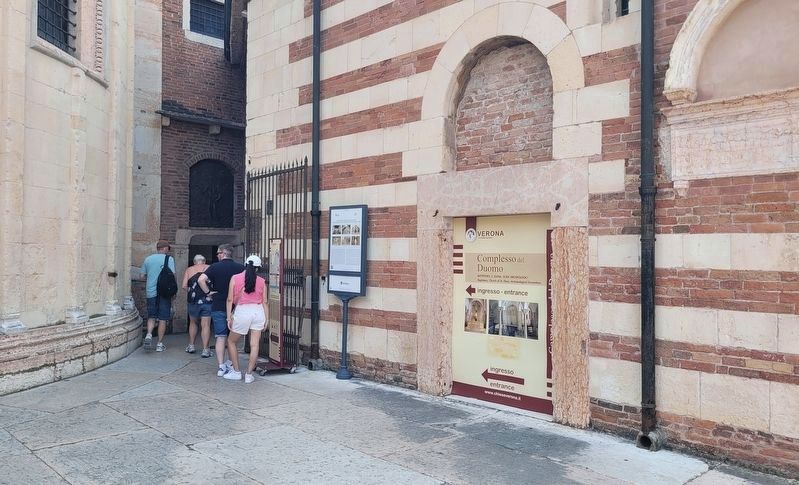
The marker is located at a side entrance to the church. The building on the right is the Church of Saint Helena while the Cathedral and Duomo are on the left.
The Baptistery of San Giovanni in Fonte was rebuilt in Romanesque style under Bishop Bernard, about 1123. It is a three-aisled structure, longer in the centre: perhaps because of reuse of former substructures. The column capitals and one pilaster are
Photographed by James Hulse, June 11, 2025
3. Cathedral of Santa Maria Matricolare (12th century)
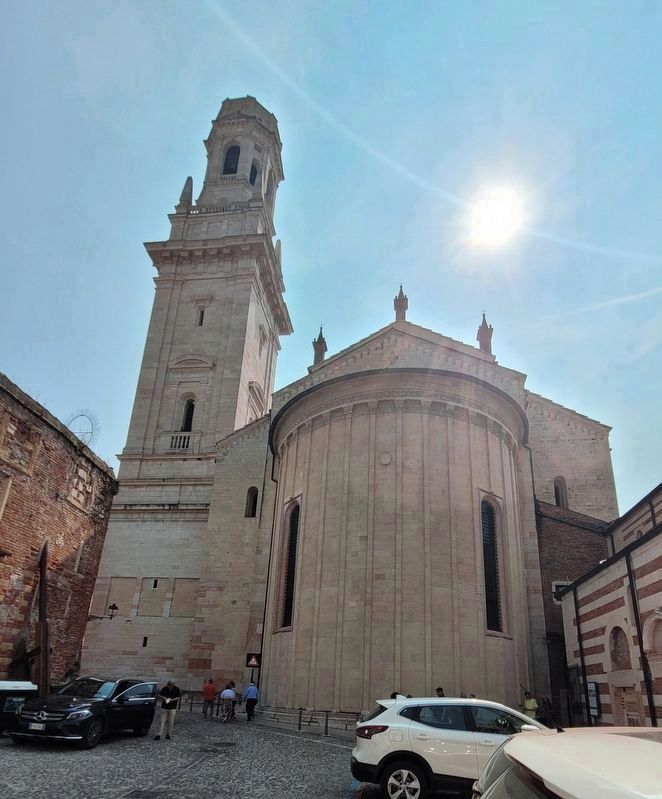
The marker is located at the far right in the photo.
Captions
(Photo #1) Interior of the Church of Sant’Elena.
(Photo #2) 12th–13th-century sculptor, Baptismal font, detail with the Flight into Egypt, Baptistery of San Giovanni in Fonte.
(Photo #3) Floor of the 4th-century early Christian church visible inside the Church of Sant’Elena.
(Photo #4) 12th–13th-century painter, Procession of Saints. Baptistery of San Giovanni in Fonte, apse.
(Photo #5) Master of the Santa Maria in Organo altarpiece and workshop, Madonna and Child enthroned, Saints John the Baptist, John the Evangelist, and a devout donor. Church of Sant’Elena.
(Photo #6) Painter of the late 14th–early 15th century, Madonna of Mercy. Baptistery of San Giovanni in Fonte, right apse chapel.
Erected by Comune di Verona, Progetto Mirabila Plano di Comunicazione
Photographed by James Hulse, June 11, 2025
4. Church of Saint Helena (9th–12th Centuries)
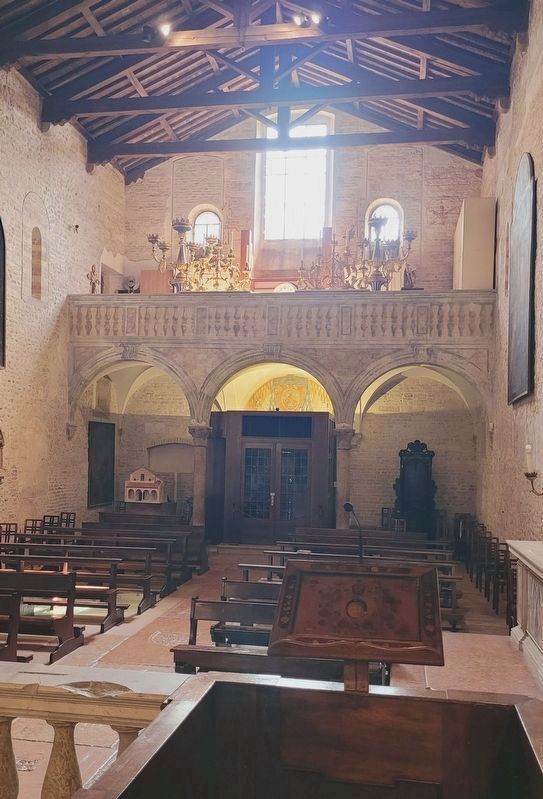
The interior view of the church.
Topics. This historical marker is listed in these topic lists: Anthropology & Archaeology • Religion & Religious Structures. A significant historical date for this entry is January 20, 1320.
Location. 45° 26.852′ N, 10° 59.844′ E. Marker is in Verona, Veneto (Venetia), in Provincia di Verona. It is in Città Antica. It is at the intersection of Piazza Vescovado and Vicolo Accoliti, on the right when traveling west on Piazza Vescovado. Touch for map. Marker is at or near this postal address: Piazza Vescovado 35, Verona, Veneto 37121, Italy. Touch for directions.

Regionally, it is in Europe, the European Union, the Schengen Area, a coastal Mediterranean country, and the Western World. Historically, it finds itself in what was once the Roman Empire and specifically also the Holy Roman Empire.
Other nearby markers. At least 8 other markers are within walking distance of this marker: Giuseppe Zamboni (within shouting distance of this marker); Duomo di Santa Maria Matricolare (secolo XII) / Cathedral of Santa Maria Matricolare (12th century) (within shouting distance of this marker); Libro Percorso - una città ritrova il suo fiume / Book Route - a city finds its river again (approx. 0.2 kilometers away); Guglielmo Guarienti (approx. 0.3 kilometers away); Romea Postumia / Pilgrimage Route to Rome (approx. 0.3 kilometers away); Basilica di Sant'Anastasia / Basilica of Saint Anastasia (approx. 0.3 kilometers away); Chiesa di San Giorgetto o San Pietro Martire / Church of San Giorgetto, or Saint Peter Martyr (approx. 0.3 kilometers away); Giuseppe Catterinetti Franco and Marianna Catterinetti Franco Fontana (approx. 0.4 kilometers away). Touch for a list and map of all markers in Verona.
Photographed by James Hulse, June 11, 2025
5. Church of Saint Helena (9th–12th Centuries)
The view of archaeological artifacts found along the church floor.
Photographed by James Hulse, June 11, 2025
6. Church of Saint Helena (9th–12th Centuries)
The view of the hidden mosaic floor found during restoration and archaeological work.
Photographed by James Hulse, June 11, 2025
7. Baptistery of Saint John in Fonte (12th Century)
The large, octagonal font is carved from a single block of red Verona marble and features detailed relief sculptures depicting scenes from the life of Christ.
Photographed by James Hulse, June 11, 2025
8. Closeup view of the San Giovanni in Fonte - baptismal
Credits. This page was last revised on February 17, 2026. It was originally submitted on February 16, 2026, by James Hulse of Medina, Texas. This page has been viewed 52 times since then. Photos: 1, 2, 3. submitted on February 16, 2026, by James Hulse of Medina, Texas. 4, 5, 6, 7, 8. submitted on February 17, 2026, by James Hulse of Medina, Texas.
