Culpeper in Culpeper County, Virginia — The American South (Mid-Atlantic)
The Civil War

Photographed by Evan Dwyer, October 25, 2025
1. The Civil War Marker
this page online
1862
July 20
Federal forces occupy Culpeper.
1862
August 17
Major General J.E.B. Stuart orders Fitzhugh Lee to cross Rapidan River.
U.S. General Pope learns of Lee's movements and leaves Culpeper.
1862
October 6-7
Rebel troops retreat through Culpeper after defeat at Barbee's Crossroads.
1862
October 7
Skirmishes at the burnt Rappahannock railroad bridge.
(Photo Captions)
Confederate General A.P. Hill, November 9, 1825 (Culpeper, Virginia) - April 2, 1865
Photograph from the main eastern theater of war, Meade in Virginia, 1863. Shows two African American men sitting in front of a tent, one with a cigar and the other with a soup ladle.
Culpeper Courthouse and railroad depot yard.
Camp of the 114th Pennsylvania Infantry, Brandy Station, Virginia, March 1864.
Brandy Station, Virginia, Capt. Samuel A. McClellan, Capt. J. Henry Sleeper, Capt. O'Neil W. Robinson, all of the Artillery Brigade, 3d Corps, and Alfred R. Waud, artist correspondent.
Encampment, Culpeper, Virginia, August 1862.
Confederate General J.E.B. Stuart, February 6, 1833 - May 11, 1864
Headquarters of Army of Potomac, Wallach's house, Culpeper, Virginia, September 1863.
General Andrew A. Humphreys standing in front of the door facing General George G. Meade, seated. Standing, to Meade's right is Major J.C. Biddle, A.D.C., on the steps of Wallach's House, the headquarters of the Army of the Potomac, Culpeper, Virginia, September 1863.
*Photos and descriptions courtesy of the Library of Congress
*Nattarive and timeline courtesy of Claude Guinn, Bud Hall, Rose Marie Martin, Giles Miller, Zann (Miner) Nelson
Topics.
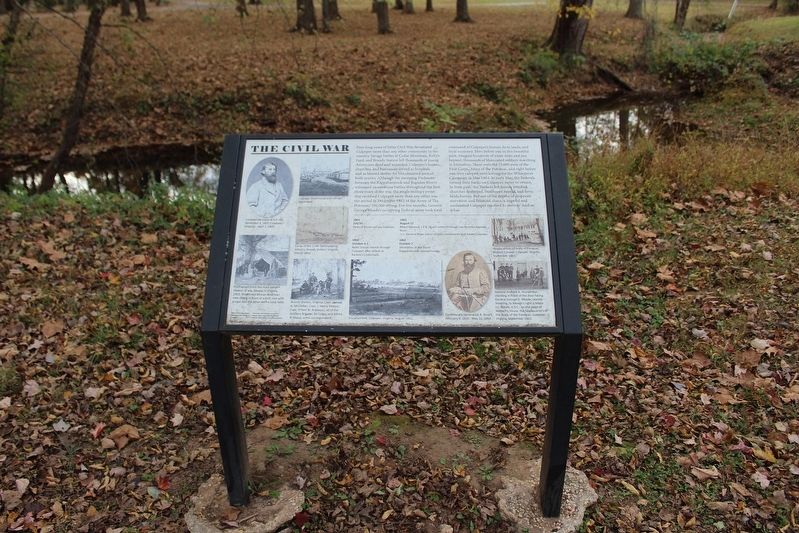
Photographed by Evan Dwyer, October 25, 2025
2. The Civil War Marker
Location. 38° 28.438′ N, 78° 0.15′ W. Marker is in Culpeper, Virginia, in Culpeper County. It can be reached from North Blue Ridge Avenue 0.1 miles south of Sperryville Pike (U.S. 522). Marker is in Yowell Meadow Park on the main trail. Touch for map. Marker is at or near this postal address: 226 N Blue Ridge Ave, Culpeper VA 22701, United States of America. Touch for directions.

Regionally, this marker is in the Washington Metropolitan Area and in Northern Virginia. It is also in the American South, specifically in the Upper South, and in the Mid-Atlantic. Globally, it is in North America, the Western Hemisphere, the Western World, and the Anglosphere. Historically, it finds itself in what was once the territory of the Mississippian Culture, one of the original Thirteen Colonies, one of the Confederate States of America, and the Antebellum South.
Other nearby markers. At least 8 other markers are within walking distance of this marker: A different marker also named The Revolutionary War (within shouting distance of this marker); Mountain Run Watershed (about 500 feet away, measured in a direct line); The Culpeper Minute Men (about 800 feet away); Who Were The Culpeper Minute-Men? (approx. 0.2 miles away); Culpeper Minute Battalion (approx. 0.2 miles away); What Did The Minute-Men Accomplish? (approx. 0.2 miles away); Major Gabriel Long (approx. 0.2 miles away); Yowell Meadow Park (approx. 0.2 miles away). Touch for a list and map of all markers in Culpeper.
Other markers no longer nearby. The Civil War (has been replaced with this marker); The Revolutionary War (was within shouting distance of this marker but has been replaced with another marker now near it).
Regarding The Civil War. There are a variety of communities that were utterly devastated by the Civil War. It is impossible for the marker's claim about Culpeper being the most devastated to be empirically validated.
Related marker. Click here for another marker that is related to this marker. Old Marker At This Location also titled "The Civil War".
Credits. This page was last revised on February 19, 2026. It was originally submitted on February 16, 2026, by Evan Dwyer of Richmond, Virginia. This page has been viewed 75 times since then. Photos: 1, 2. submitted on February 16, 2026, by Evan Dwyer of Richmond, Virginia. • Bernard Fisher was the editor who published this page.
