San Luis in Costilla County, Colorado — The American Mountains (Southwest)
Hispano Folkways
Photographed by Cosmos Mariner, July 12, 2025
1. Hispano Folkways Marker
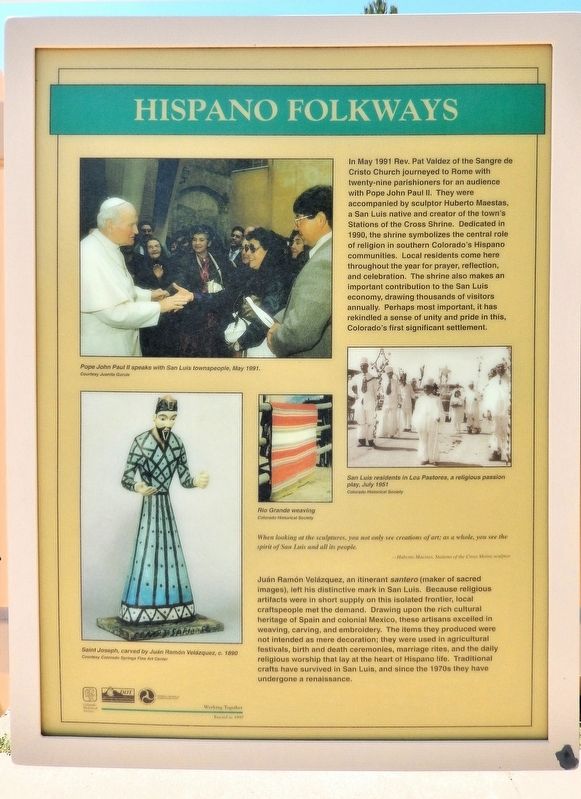
In May 1991 Rev. Pat Valdez of the Sangre de Cristo Church journeyed to Rome with twenty-nine parishioners for an audience with Pope John Paul II. They were accompanied by sculptor Huberto Maestas, a San Luis native and creator of the town's Stations of the Cross Shrine. Dedicated in 1990, the shrine symbolizes the central role of religion in southern Colorado's Hispano communities. Local residents come here throughout the year for prayer, reflection, and celebration. The shrine also makes an important contribution to the San Luis economy, drawing thousands of visitors annually. Perhaps most important, it has rekindled a sense of unity and pride in this, Colorado's first significant settlement.
When looking at the sculptures, you not only see creations of art; as a whole, you see the spirit of San Luis and all its people.
—Huberto Maestas, Stations of the Cross Shrine sculptor
Juán Ramón Velázquez, an itinerant santero (maker of sacred images), left his distinctive mark in San Luis. Because religious artifacts were in short supply on this isolated frontier, local craftspeople met the demand. Drawing upon the rich cultural
this page online
[photo captions]
• Rio Grande weaving
• San Luis residents in Los Pastores, a religious passion play, July 1951
Erected 1977 by Colorado Historical Society, Colorado Department of Transportation, and Federal Highway Administration.
Topics. This historical marker is listed in these topic lists: Arts, Letters, Music • Hispanic Americans • Religion & Religious Structures • Settlements & Settlers. A significant historical month for this entry is May 1991.
Location. 37° 12.043′ N, 105° 25.562′ W. Marker is in San Luis, Colorado, in Costilla County. It is on Main Street (State Highway 159) just north of State Highway 142, on the left when traveling north. The marker is on the sidewalk at the north end of
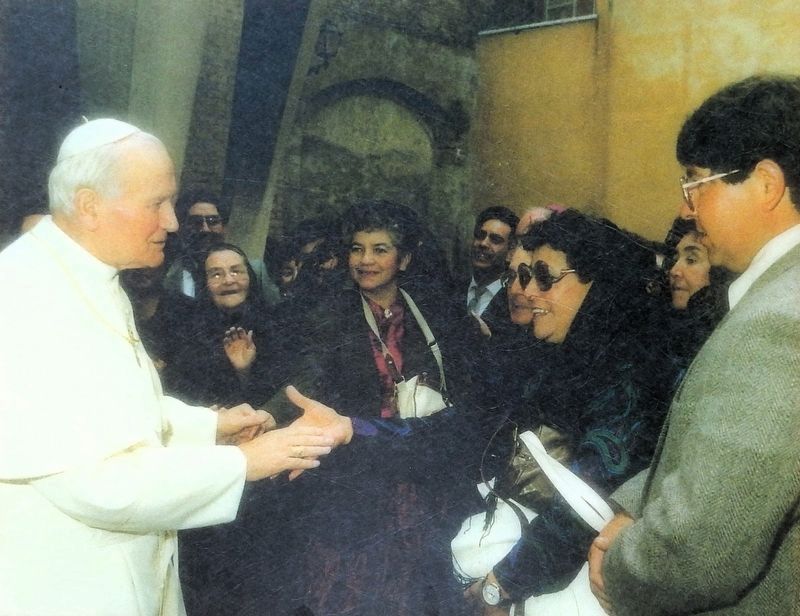
Courtesy Juanita Gurule
2. Marker detail: Pope John Paul II speaks with San Luis townspeople, May 1991

Regionally, this marker is in Colorado’s San Juan Mountains and in the San Luis Valley. It is also in the American Mountain West. Globally, it is in North America, the Rocky Mountains, the Western Hemisphere, the Western World, and the Anglosphere. Historically, it finds itself in what was once New Spain and also the Republic of Texas.
Other nearby markers. At least 8 other markers are within walking distance of this marker: Acequias (here, next to this marker); San Luis (here, next to this marker); San Luis Valley Country (here, next to this marker); Plaza de San Luis de la Culebra (about 500 feet away, measured in a direct line); San Luis and Costilla County Veterans Memorial (about 500 feet away); R & R Market (about 600 feet away); Welcome to El Valle de San Luis (about 600 feet away); Oldest Town in Colorado (about 600 feet away). Touch for a list and map of all markers in San Luis.
Also see . . . Shrine of the Stations of the Cross (Atlas Obscura).
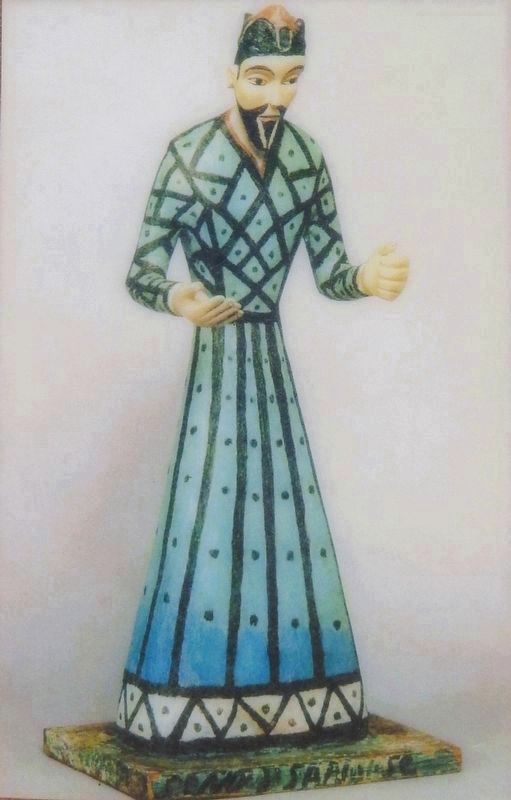
Courtesy Colorado Springs Fine Art Center
3. Marker detail: Saint Joseph, by Juán Ramón Velázquez, c. 1890
(by Jonathan Carey) Excerpt: A deep history of Hispanic heritage runs throughout the San Luis Valley in Colorado, and this is perhaps most evident at the Shrine of the Stations of the Cross in San Luis.(Submitted on February 18, 2026, by Cosmos Mariner of Cape Canaveral, Florida.)
Constructed in the 1980s and dedicated in 1990, the Spanish-Moorish style adobe church was created by parishioners of the Sangre de Cristo Parish in San Luis, Colorado, crafted as an act of love and good faith. The shrine also resides atop a mesa and was designed as a place where any faith was welcome to fellowship. The church itself is an architectural masterpiece, and it is complemented by a half-mile trail leading to the shrine that is decorated with several pieces of religious artwork. Along the path are 15 stations with bronze sculptures depicting moments in the story of Jesus Christ's crucifixion, designed by local sculptor Huberto Maestas.
The Shrine of the Stations of the Cross is an ode to the region's rich Hispanic heritage, along with its strong beliefs in community and religion.
Photographed by Cosmos Mariner, July 12, 2025
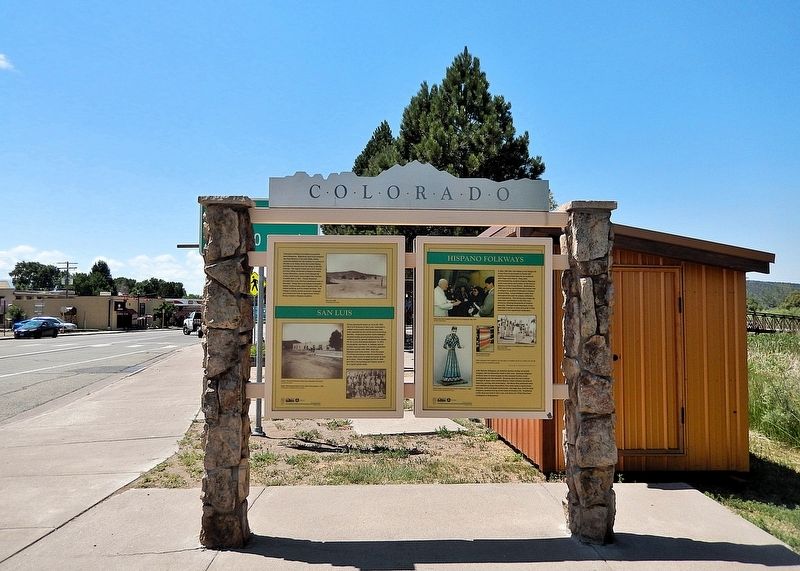
4. San Luis Interpretive Kiosk
Looking south; Main Street is on the left. This historical marker is the rightmost of two interpretive panels on the north side of the kiosk.
Credits. This page was last revised on February 18, 2026. It was originally submitted on February 17, 2026, by Cosmos Mariner of Cape Canaveral, Florida. This page has been viewed 63 times since then. Photos: 1, 2, 3, 4. submitted on February 18, 2026, by Cosmos Mariner of Cape Canaveral, Florida.
