Grinnell in Poweshiek County, Iowa — The American Midwest (Upper Plains)
Notable Grinnellians
Town and College
Photographed by Cosmos Mariner, September 19, 2025
1. Notable Grinnellians Marker
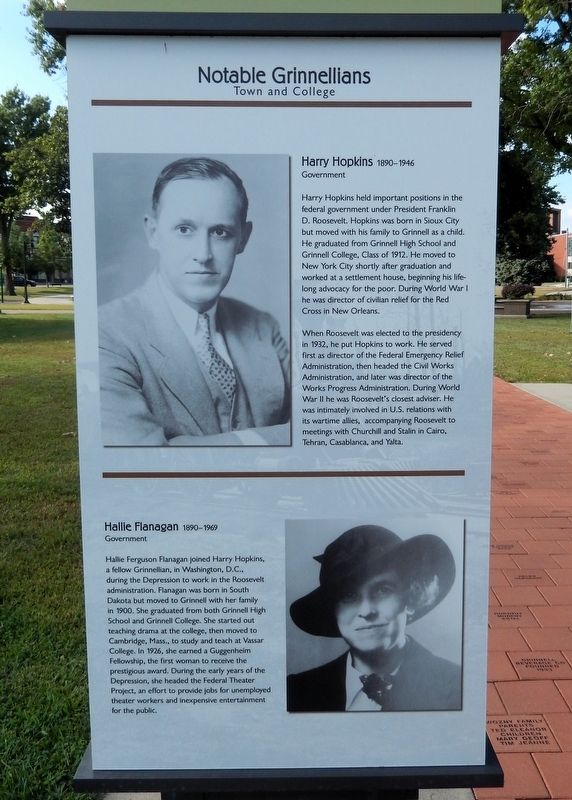
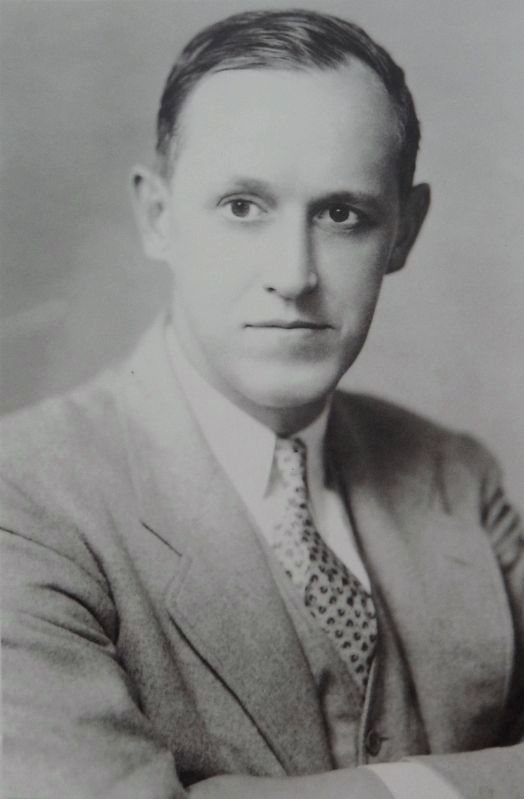
Harry Hopkins 1890-1946
Government
Harry Hopkins held important positions in the federal government under President Franklin D. Roosevelt. Hopkins was born in Sioux City but moved with his family to Grinnell as a child. He graduated from Grinnell High School and Grinnell College, Class of 1912. He moved to New York City shortly after graduation and worked at a settlement house, beginning his life-long advocacy for the poor. During World War I he was director of civilian relief for the Red Cross in New Orleans.
When Roosevelt was elected to the presidency in 1932, he put Hopkins to work. He served first as director of the Federal Emergency Relief Administration, then headed the Civil Works Administration, and later was director of the Works Progress Administration. During World War II he was Roosevelt's closest adviser. He was intimately involved in U.S. relations with its wartime allies, accompanying Roosevelt to meetings with Churchill and Stalin in Cairo, Tehran, Casablanca, and Yalta.
Hallie Flanagan 1890-1969
Government
Hallie Ferguson Flanagan joined Harry Hopkins, a fellow Grinnellian, in Washington. D.C., during the
this page online
Topics and series. This historical marker is listed in these topic lists: Arts, Letters, Music • Charity & Public Work • War, World II • Women. In addition, it is included in the Former U.S. Presidents: #32 Franklin D. Roosevelt, and the Works Progress Administration (WPA) projects series lists.
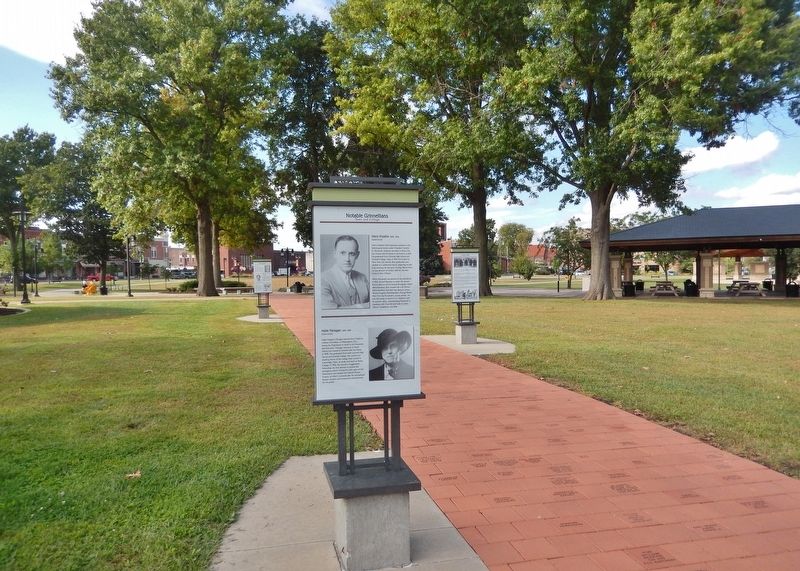
Location. 41° 44.525′ N, 92° 43.372′ W. Marker is in Grinnell, Iowa, in Poweshiek County. It is at the intersection of 3rd Avenue and Park Street, on the left when traveling east on 3rd Avenue.
2. Marker detail: Harry Hopkins

Regionally, this marker is in Eastern Iowa. It is also in the American Midwest and in the Corn Belt. Globally, it is in North America, the Western Hemisphere, the Western World, and the Anglosphere. Historically, it finds itself in what was once the territory of the Mississippian Culture and also the Louisiana Purchase.
Other nearby markers. At least 8 other markers are within walking distance of this marker: A different marker also named Notable Grinnellians (here, next to this marker); J. B. Grinnell (a few steps from this marker); Grinnell College (a few steps from this marker); Founding of Grinnell (a few steps from this marker); First Businesses (a few steps from this marker); a different marker also named Notable Grinnellians (a few steps from this marker); a different marker also named Notable Grinnellians (a few steps from this marker); a different marker also named Notable Grinnellians (a few steps from this marker). Touch for a list and map of all markers in Grinnell.
Also see . . .
1. Harold Lloyd Hopkins (Wikipedia).
Excerpt: American statesman, public administrator, and presidential advisor. A trusted deputy to President Franklin Delano Roosevelt, Hopkins directed New Deal relief programs before serving as the eighth United States secretary of commerce from 1938 to 1940 and as Roosevelt's chief foreign policy advisor and liaison to Allied leaders during World War II.(Submitted on February 20, 2026, by Cosmos Mariner of Cape Canaveral, Florida.)
During his career, Hopkins supervised the New York Temporary Emergency Relief Administration, the Federal Emergency Relief Administration, the Civil Works Administration, and the Works ProgressAdministration, which he built into the largest employer in the United States. He later oversaw the $50 billion Lend-Lease program of military aid to the Allies and, as Roosevelt's personal envoy, played a pivotal role in shaping the alliance between the United States and the United Kingdom.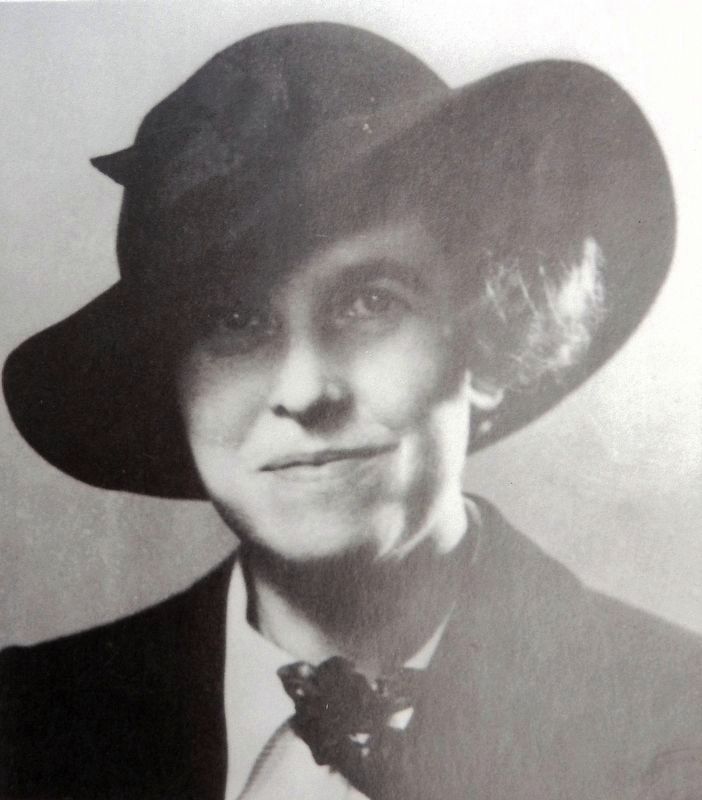 3. Marker detail: Hallie Flanagan
As Roosevelt's closest confidant, Hopkins assumed a leading foreign policy role after the outset of World War II. From 1940 until 1943, Hopkins lived in the White House and assisted the president in the management of American foreign policy, particularly toward the United Kingdom and the Soviet Union. He traveled frequently to the United Kingdom, whose prime minister, Winston Churchill, recalled Hopkins in his memoirs as a "natural leader of men" with "a flaming soul."
2. Hallie Flanagan Davis (Wikipedia).
Excerpt: American theatrical producer and director, playwright and author, best known for running the Federal Theatre Project, a part of the Works Progress Administration (WPA) during the New Deal.(Submitted on February 20, 2026, by Cosmos Mariner of Cape Canaveral, Florida.)
In 1925, Flanagan was hired as professor at VassarCollege. When she arrived, there was no theater on campus, and all drama courses were taught in the English department. Her official title at the school was "Director of English Speech". In 1926, she became the first woman awarded a Guggenheim Fellowship to study theatre.Photographed by Cosmos Mariner, September 19, 20254. Notable Grinnellians MarkerLooking northwest through Central Park.
With the onset of the Great Depression, and masses of people (including the theatrically inclined) out of work, Franklin D. Roosevelt established the Works Progress Administration (WPA) as a jobs program. Among the WPA's branches was the Federal Theatre Project (FTP), which aimed to employ theatrical workers across America. In 1934, WPA head Harry Hopkins, who knew Flanagan from Grinnell College, asked her to lead the FTP. Flanagan's vision was to bring high-quality, cutting-edge theatre to the masses of American people, many of whom had never witnessed live theater. The Project paid salaries to struggling artists and crafts workers, and staged affordable productions across the nation. By 1936, Flanagan had hired 12,500 people across 28 states. In New York City alone, the FTP's productions played to weekly audiences of 350,000. Since the plays were federally funded, the Project could afford to sell tickets at drastically reduced prices, making the productions accessible and inclusive to a wider audience. After operating for less than four years, the Federal Theatre Project was shut down, and Flanagan returned to Vassar.
Credits. This page was last revised on February 20, 2026. It was originally submitted on February 17, 2026, by Cosmos Mariner of Cape Canaveral, Florida. This page has been viewed 56 times since then. Photos: 1, 2, 3, 4. submitted on February 20, 2026, by Cosmos Mariner of Cape Canaveral, Florida.
