Madison in Dane County, Wisconsin — The American Midwest (Great Lakes)
Lewis Nine Springs E-Way
Photographed by McGhiever, July 24, 2025
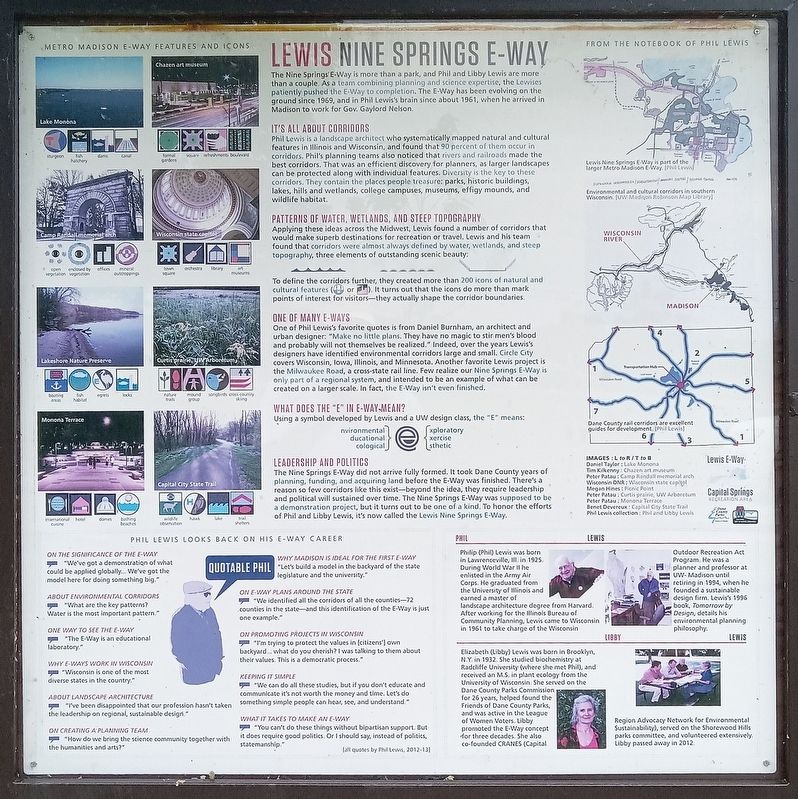
1. Lewis Nine Springs E-Way Marker
Metro Madison E-Way Features and Icons
· Lake Monona
· Chazen art museum
· Camp Randall memorial arch
· Wisconsin state capitol
· Lakeshore Nature Preserve
· Curtis prairie, UW Arboretum
· Monona Terrace
· Capital City State Trail
The Nine Springs E-Way is more than a park, and Phil and Libby Lewis are more than a couple. As a team combining planning and science expertise, the Lewises patiently pushed the E-Way to completion. The E-Way has been evolving on the ground since 1969, and in Phil Lewis's brain since about 1961, when he arrived in Madison to work for Gov. Gaylord Nelson.
It's All About Corridors
Phil Lewis is a landscape architect who systematically mapped natural and cultural features in Illinois and Wisconsin, and found that 90 percent of them occur in corridors. Phil's planning teams also noticed that rivers and railroads made the best corridors. That was an efficient discovery for planners, as larger landscapes can be protected along with individual features. Diversity is the key to these corridors. They contain the places people treasure: parks, historic buildings, lakes, hills and wetlands,
this page online
Patterns of Water, Wetlands, and Steep Topography
Applying these ideas across the Midwest, Lewis found a number of corridors that would make superb destinations for recreation or travel. Lewis and his team found that corridors were almost always defined by water, wetlands, and steep topography, three elements of outstanding scenic beauty.
To define the corridors further, they created more than 200 icons of natural and cultural features. It turns out that the icons do more than mark points of interest for visitors—they actually shape the corridor boundaries.
One of Many E-Ways
One of Phil Lewis's favorite quotes is from Daniel Burnham, an architect and urban designer: "Make no little plans. They have no magic to stir men's blood and probably will not themselves be realized." Indeed, over the years Lewis's designers have identified environmental corridors large and small. Circle City covers Wisconsin, Iowa, Illinois, and Minnesota. Another favorite Lewis project is the Milwaukee Road, a cross-state rail line. Few realize our Nine Springs E-Way is only part of a
Photographed by McGhiever, July 24, 2025
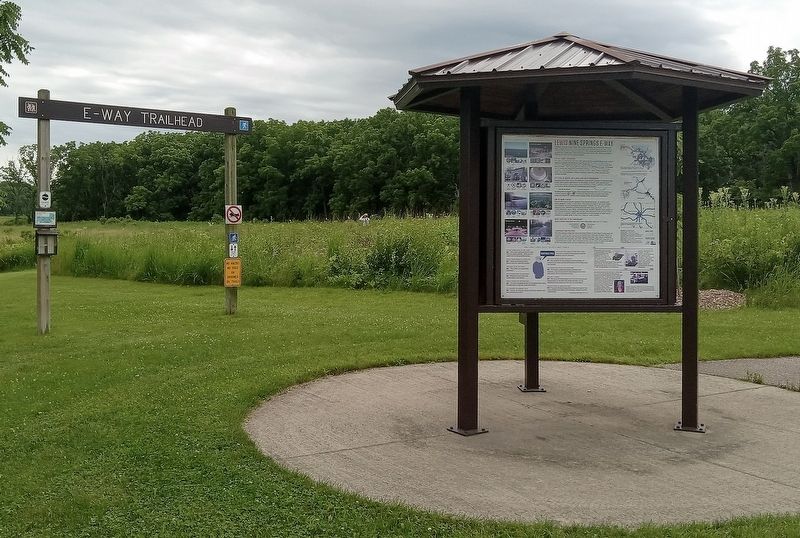
2. Lewis Nine Springs E-Way marker and trailhead
What Does the "E" in E-Way Mean?
Using a symbol developed by Lewis and a UW design class, the "E" means:
· nvironmental · ducational · cological · xploratory · xercise · sthetic
Leadership and Politics
The Nine Springs E-Way did not arrive fully formed. It took Dane County years of planning, funding, and acquiring land before the E-Way was finished. There's a reason so few corridors like this exist—beyond the idea, they require leadership and political will sustained over time. The Nine Springs E-Way was supposed to be a demonstration project, but it turns out to be one of a kind. To honor the efforts of Phil and Libby Lewis, it's now called the Lewis Nine Springs E-Way.
From the Notebook of Phil Lewis
Lewis Nine Springs E-Way is part of the larger Metro Madison E-Way.
Environmental and cultural corridors in southern Wisconsin
Dane County rail corridors are excellent guides for development.
Quoteable Phil
Phil Lewis Looks Back on his E-Way Career
On the Significance of the E-Way
"We've got a demonstration of what could be applied globally… We've got the model here for doing something big."
About Environmental Corridors
"What are the key patterns? Water is the most important pattern."
One Way to See the E-Way
"The E-Way is an educational laboratory."
Why E-Ways Work in Wisconsin
"Wisconsin is one of the most diverse states in the country."
About Landscape Architecture
"I've been disappointed that our profession hasn't taken the leadership on regional, sustainable design."
On Creating a Planning Team
"How do we bring the science community together with the humanities and arts?"
Why Madison is Ideal for the First E-Way
"Let's build a model in the backyard of the state legislature and the university."
On E-Way Plans around the State
"We identified all the corridors of all the counties—72 counties in the state—and this identification of the E-Way is just one example."
On Promoting Projects in Wisconsin
"I'm trying to protect the values in [citizens'] own backyard… what do you cherish? I was talking to them about their values. This is a democratic process."
Keeping it Simple
"We can do all these studies, but if you don't educate and communicate it's not worth the money and time. Let's do something simple people can hear, see, and understand."
What it Takes to Make an E-Way
"You can't do these things without bipartisan support. But it does require good politics. Or I should say, instead of politics, statesmanship."
(all quotes by Phil Lewis, 2012-13)
Phil Lewis
Philip (Phil) Lewis was born in Lawrenceville, Ill. in 1925. During World War II he enlisted in the Army Air Corps. He graduated from the University of Illinois and earned a master of landscape architecture degree from Harvard. After working for the Illinois Bureau of Community Planning, Lewis came to Wisconsin in 1961 to take charge of the Wisconsin Outdoor Recreation Act Program. He was a planner and professor at UW-Madison until retiring in 1994, when he founded a sustainable design firm. Lewis's 1996 book, Tomorrow by Design, details his environmental planning philosophy.
Libby Lewis
Elizabeth (Libby) Lewis was born in Brooklyn, N.Y. in 1932. She studied biochemistry at Radcliffe University (where she met Phil), and received an M.S. in plant ecology from the University of Wisconsin. She served on the Dane County Parks Commission for 26 years, helped found the Friends of Dane County Parks, and was active in the League of Women Voters. Libby promoted the E-Way concept for three decades. She also co-founded CRANES (Capital Region Advocacy Network for Environmental Sustainability), served on the Shorewood Hills parks committee, and volunteered extensively. Libby passed away in 2012.
Topics. This historical marker is listed in this topic list: Parks & Recreational Areas. A significant historical year for this entry is 1969.
Location. 43° 1.853′ N, 89° 20.942′ W. Marker is in Madison, Wisconsin, in Dane County. It can be reached from Moorland Road, on the right when traveling east. The marker is at the south end of the Lewis Nine Springs E-Way parking lot. Touch for map. Marker is in this post office area: Madison WI 53713, United States of America. Touch for directions.

Regionally, this marker is in Southeast Wisconsin. It is also in the American Midwest and in the Corn Belt. Globally, it is in North America, the Western Hemisphere, the Western World, and the Anglosphere. Historically, it finds itself in what was once the territory of the Mississippian Culture and also the Northwest Territory.
Other nearby markers. At least 8 other markers are within walking distance of this marker: MMSD Wildlife Observation Area (within shouting distance of this marker); The Madison Metropolitan Sewerage District Wildlife Observation Area / From Wastewater to Habitat (within shouting distance of this marker); The Lewis Nine Springs E-Way / Philip and Elizabeth Lewis (within shouting distance of this marker); In Memory of Bud Morton 1907-1992 (about 700 feet away, measured in a direct line); The Gilman Mounds (approx. 0.4 miles away); Mounds for the Future (approx. 0.4 miles away); Destroying and Saving a Sacred Landscape (approx. 0.4 miles away); Carlos J. Martin Memorial Native American Interpretive Site (approx. 0.9 miles away). Touch for a list and map of all markers in Madison.
Credits. This page was last revised on February 21, 2026. It was originally submitted on February 21, 2026, by McGhiever of Minneapolis, Minnesota. This page has been viewed 68 times since then. Photos: 1, 2. submitted on February 21, 2026, by McGhiever of Minneapolis, Minnesota.
