Laclede in Linn County, Missouri — The American Midwest (Upper Plains)
Meuse-Argonne American Cemetery and Memorial
| — | First World War Commemorative Garden | — |

Photographed by Cosmos Mariner, September 22, 2025
1. Meuse-Argonne American Cemetery Marker
The Meuse-Argonne battle was the largest single battle American forces ever fought. Over 1.2 million American soldiers fought alongside French and British soldiers for 47 days. The battle culminated in the war’s armistice on Nov. 11, 1918.
Over 26,000 American lives were lost, among them Ernest Alfred McNish from nearby Brookfield, Missouri. He joined the Army on Aug. 27, 1917, and served as Second Lieutenant with the 369th Harlem Hell Fighters (also known as the Harlem Rattlers). A German artillery shell killed 2nd Lt. McNish on Sept. 29, 1918, in the Meuse Argonne. He served a total of 10 months.
His family placed a headstone in the family plot at Rose Hills Cemetery in Brookfield.
[photo caption] 93rd Division Patch
Meuse-Argonne American Cemetery and Memorial
Dedicated: 1937
Location: France
Burials: 14,246
Missing in Action: 954
Acres: 130.5
Missourians:
Ernest McNish, Second Lieutenant, US Army
369th Infantry Regiment, 93rd Division
September 29, 1918
Plot F, Row 4, Grave #37
Missouri
Erected 2018 by Missouri State Parks.
Topics. This historical marker and memorial is listed in these topic lists: Cemeteries & Burial Sites
this page online
Location. 39° 47.374′ N, 93° 10.254′ W. Marker is in Laclede, Missouri, in Linn County. It is on Prairie Street just west of Olive Street, on the right when traveling west. The marker is in the First World War Commemorative Garden at the General John J. Pershing Boyhood Home State Historic Site. Touch for map. Marker is at or near this postal address: 905 Pershing Drive, Laclede MO 64651, United States of America. Touch for directions.

Regionally, this marker and memorial is in North Missouri. It is also in the American Midwest, in the Lewis & Clark Corridor, and in the Corn Belt. Globally, it is in North America, the Western Hemisphere, the Western World, and the Anglosphere. Historically, it finds itself in what was once the territory of the Mississippian Culture, the Louisiana Purchase, and the Antebellum South.
Other nearby markers. At least 8 other markers are within walking distance of this marker: Suresnes American Cemetery and Memorial (here, next to this marker); Flanders Field American Cemetery and Memorial (a few steps

Courtesy Lura McAllister
2. Marker detail: Second Lieutenant Ernest McNish
As a Second Lieutenant, Ernest McNish was the highest ranking soldier from Linn County killed in World War I. The American Legion named the Brookfield post the Earnest A. McNish, MO Post 182 in his honor.
Related markers. Click here for a list of markers that are related to this marker. First World War Commemorative Garden
Also see . . .
1. Harlem Hell Fighters (USmilitariaforum.com).
Excerpt: The rattlesnake shoulder patch of the 369th Infantry Regiment, whose nom de guerre was ‘Harlem Hell Fighters’. The regiment’s insignia consisted of a coiled rattlesnake ready to strike on a field of black.(Submitted on February 26, 2026, by Cosmos Mariner of Cape Canaveral, Florida.)
2. Meuse–Argonne Offensive (Wikipedia).
Excerpt: The Meuse–Argonne campaign was a major(Submitted on February 26, 2026, by Cosmos Mariner of Cape Canaveral, Florida.)part of the final Allied offensive of World War I that stretched along the entire Western Front. It was fought from September 26, 1918, until the Armistice of November 11, 1918, a total of 47 days. The Meuse–Argonne offensive was the largest in United States military history, involving 1.2 million American soldiers, sailors and marines, along with 800,000 French and 850 Siamese personnel. It is also the deadliest campaign in the history of the United States Army, resulting in over 350,000 casualties, including 28,000 German lives, 26,277 American lives and abound 35,000 French lives. American losses were worsened by the inexperience of many of the troops, the tactics used during the early phases of the operation, and the widespread onset of the global influenza outbreak called the “Spanish flu.”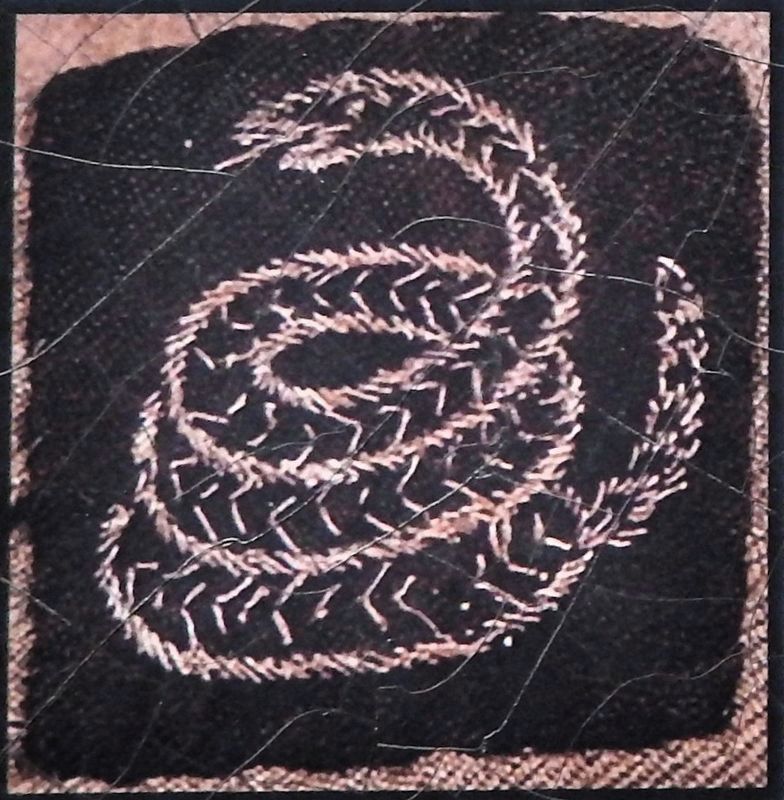 3. Marker detail: 369th Regiment Patch
(the Harlem Hell Fighters)The 369th Regiment of the 93rd Division had their own distinct patch of a coiled rattlesnake. Courtesy http://www.usmilitariaforum.com/forums/index.php?/topic/202900-world-2ar-i-war-service-chevrons/page-2
The offensive was the principal engagement of the American Expeditionary Forces (AEF) in World War I. It was one of a series of Allied attacks, known as the Hundred Days Offensive, which brought the war to an end. It was the largest and bloodiest operation of the entire war for the AEF even though, given the scale of other battles on the WesternFront, its size was limited and the operation itself secondary, being far from the main offensive axis. 4. Marker detail: Meuse-Argonne American Cemetery location
3. Meuse-Argonne American Cemetery and Memorial (Wikipedia).
Excerpt: The Meuse-Argonne American Cemetery is located east of the village of Romagne-sous-Montfaucon in Meuse. The cemetery contains the largest number of American military dead in Europe (14,246), most of whom lost their lives during the Meuse-Argonne Offensive and were buried there. The cemetery consists of eight sections behind a large central reflection pool. Beyond the grave sections is a chapel which is decorated with stained glass windows depicting American units' insignias. Along the walls of the chapel area are the tablets of the missing which include the names of those soldiers who fought in the region and in northern Russia but have no known grave. It also includes the Meuse-Argonne American Memorial.(Submitted on February 26, 2026, by Cosmos Mariner of Cape Canaveral, Florida.)
4. Second Lieutenant Ernest Alfred McNish (Find A Grave).
(Rose Hill(Submitted on February 26, 2026, by Cosmos Mariner of Cape Canaveral, Florida.)Cemetery, Brookfield, Linn County, Missouri, USA) Excerpt: Member of; the 77th Inf. Div. (Statue of Liberty) 153rd Inf. Brigade 305th Inf. Reg., the 30th Inf. Div. (Old Hickory) 59th Inf. Brig. 117th Inf. Reg. and the 93rd Inf. Div. (Blue Helmet's) 185th Inf. Reg. 369 Inf. Reg. (Harlem Hell Fighters/Harlem's Rattlers) First Battalion Company D, A.E.F., KIA near Sechault, France. Buried; Meuse-Argonne American Cemetery & Memorial, Lorraine, France.Photographed by Cosmos Mariner, September 22, 20255. Meuse-Argonne American Cemetery MarkerThe marker is near the northeast corner of the First World War Commemorative Garden.

Credits. This page was last revised on February 26, 2026. It was originally submitted on February 21, 2026, by Cosmos Mariner of Cape Canaveral, Florida. This page has been viewed 44 times since then. Photos: 1, 2, 3, 4, 5. submitted on February 26, 2026, by Cosmos Mariner of Cape Canaveral, Florida.
