
Anacostia in Southeast Washington in Washington, District of Columbia — The American Northeast (Mid-Atlantic)
Barry Farm
Empower DC
Est. 2003
Organizing Community Power

Uplifting a Living History, Ensuring a Just Future
"The very things that we champion in this country — hard work, personal responsibility — this was the Barry Farm community. A thriving Black community."
- Dr. Michael Fisher, DC Legacy Project Advisor
In 1867, the federal government sold 375 acres of land in the nation's capital to African Americans, many who came to DC during the Civil War. The families who moved to the site, known as Barry Farm, built homes and churches, formed civic organizations, and operated small businesses. It was a self-sufficient Black community.
Over time, the government seized much of the land for public projects, eventually demolishing 32 houses in the most desirable section of the village for a segregated public housing complex. The new tenants formed a tight-knit community.
In recent years, everyone who lived at Barry Farm was forced to move in preparation for redeveloping the site. Empower DC and former residents won historic landmark protection for five buildings. DC Legacy Project is an outgrowth of this work. We invite you to learn about this history and our shared vision
this page online
Anacostans
1600's
Today's Barry Farm area is home to the Anacostans, ancestors of the Piscataway, who still live in the DMV today.
Washington DC Established
1791
Civil War
1861-1865
"Grandma & Frederick Douglass were like sister and brother—great abolitionists. I sat on his knee in his office in the house that is now a museum in Anacostia, where we were born."
Granddaughter of Emily Edmonson
Barry Farm
1867
After the war, the Freedmen's Bureau, buys 375 acres from the descendants of enslaver James Barry and sells it lot-by-lot to Black settlers. This new community is called Barry Farm. The community successfully lobbies the city council to change the village's name to Hillsdale, but the new name never becomes official.
Emily Edmonson
Tewnety-five year old Emily (Edmonson) Johnson, a teacher, became a founding resident of the Barry Farm community in 1869, when she bought two large lots on the banks of the Anacostia River. Emily and her five siblings had survived the Pearl Incident, the largest attempted escape from slavery in American history when they sailed away from Southwest

"Nowhere in the country where there is a dual school system, are educational opportunities so well integrated that a Colored pupil may pass from kindergarten through university, without suffering special disadvantages."
Garnet Wilkinson, 1926
Garnet Wilkinson
For 30 years, Garnet Wilkinson was in charge of all DC schools for Black children. Wilkinson moved with his parents to Barry Farm around 1888. He attended Birney Elementary until his family moved to LeDroit Park. Unlike many of his peers, Wilkinson believed all-Black schools were essential for Black advancement during segregation. He took great pride in the excellent education that Black residents of the nation's capital received.
Displacement:
Barry Farm Dwellings
1941
The federal government takes 34 acres and 23 homes, using eminent domain, for the construction of segregated public housing, the Barry Farm Dwellings.
Displacement:
Suitland Parkway
1942
Eminent domain is used to displace 600 residents for the construction of Suitland Parkway. The new road is routed through two of the community's cemeteries.
"I just got tiredof being shuttled around. I'd see my children standing out on Nichols Avenue waiting for a bus when Sousa was within walking distance."
Luberta Jennings, 1954

School Desegregation
1954
Children from Barry Farm are plaintiffs in the Supreme Court case Bolling v. Sharpe, which rules that segregation is unconstitutional. White residents march in protest against integrating Anacostia High School and other all-white schools in the area.
"You sit up here on the Hill and talk about building subways and bridges and parking lots for the tourists and people from suburbia…It's time to talk about the people who live here."
Etta Mae Horn, 1969
Tenant Organizing
1965
Barry Farm residents demand repairs and upkeep of the complex. Etta Horn and others advocate on Capitol Hill against cuts to welfare and for their rights as recipients of public assistance. Between 2,600 and 3,000 people live at the site, 70 percent of them children.
Etta Horn
Etta Horn lived at 1123 Stevens Road in the 1960s. She and her neighbors organized to demand improvements at Barry Farm Dwellings. She helped found the National Welfare Rights Organization,

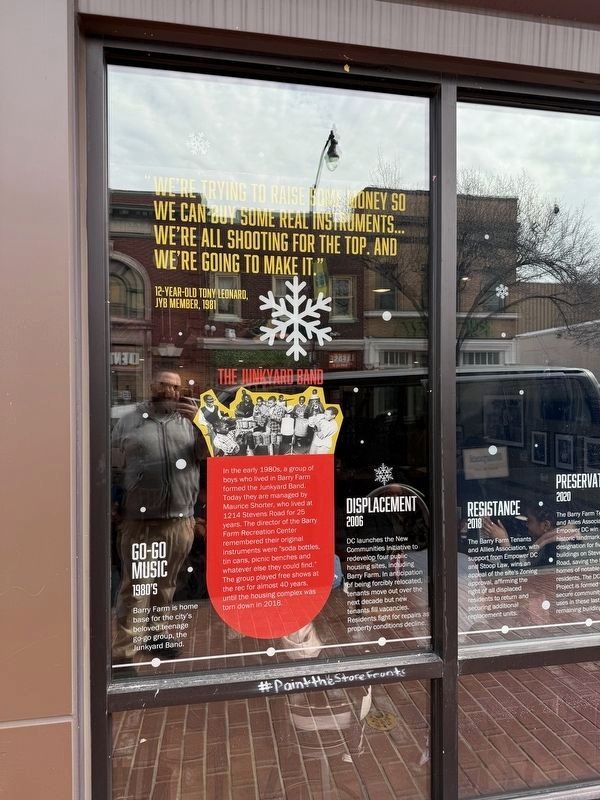
"We're trying to raise some money so that we can buy some real instruments… We're all shooting for the top. And we're going to make it."
12-year-old Tony Leonard, JYB Member, 1981
Go-Go Music
1980's
Barry Farm is home base for the city's beloved teenage go-go group, the Junkyard Band.
The Junkyard Band
In the early 1980s, a group of boys who lived in Barry Farm formed the Junkyard Band. Today they are managed by Maurice Shorter, who lived at 1214 Stevens Road for 25 years. The director of the Barry Farm Recreation Center remembered their original instruments were "soda bottles, tin cans, picnic benches, and whatever else they could find." The group played free shows at the rec for almost 40 years, until the housing complex was torn down in 2018.
Displacement
2006
DC launches

Resistance
2018
The Barry Farm Tenants and Allies Association, with support from Empower DC and Stoop Law, wins an appeal of the site's Zoning approval, affirming the right of all displaced residents to return and securing additional replacement units.
Preservation
2020
The Barry Farm Tenants and Allies Association and Empower DC win a historic landmark designation for five buildings on Stevens Road, saving the former homes of notable residents. The DC Legacy Project is formed to secure community serving uses in these last remaining buildings.
The Future
Led by developer Preservation of Affordable Housing (POAH), Barry Farm is being redeveloped into a mixed-use and mixed-income neighborhood with apartments, home ownership opportunities, recreational space, and a retail corridor. Efforts continue to ensure residents return home.
The Jennings Sisters
Adrienne

Erected by Empower DC.
Topics. This historical marker is listed in these topic lists: African Americans • Civil Rights • Education • Settlements & Settlers. A significant historical year for this entry is 1867.
Location. 38° 51.979′ N, 76° 59.341′ W. Marker is in Southeast Washington in Washington, District of Columbia. It is in Anacostia. It is on Martin Luther King Junior Avenue Southeast south of U Street Southeast, on the left when traveling south. Touch for map. Marker is at or near this postal address: 2006 Martin Luther King Jr Ave SE, Washington DC 20020, United States of America. Touch for directions.

Regionally, this marker is in the Washington Metropolitan Area. It is also in the American Northeast, in the Upper South, in the Mid-Atlantic, in the Tidewater, and in the Chesapeake
Other nearby markers. At least 8 other markers are within walking distance of this marker: A Neighborhood Oasis (a few steps from this marker); A Legacy of Resilience (within shouting distance of this marker); Welcome to the Go-Go Museum & Café. (within shouting distance of this marker); The Big Chair (about 300 feet away, measured in a direct line); a different marker also named The Big Chair (about 400 feet away); The World’s Largest Chair (about 400 feet away); ADACI (about 400 feet away); Rose's Row (about 500 feet away). Touch for a list and map of all markers in Southeast Washington.


Credits. This page was last revised on February 21, 2026. It was originally submitted on February 21, 2026, by Devry Becker Jones of Washington, District of Columbia. This page has been viewed 51 times since then. Photos: 1, 2, 3, 4, 5, 6, 7, 8, 9, 10. submitted on February 21, 2026, by Devry Becker Jones of Washington, District of Columbia.
