Pioneer Square in Seattle in King County, Washington — The American West (Northwest)
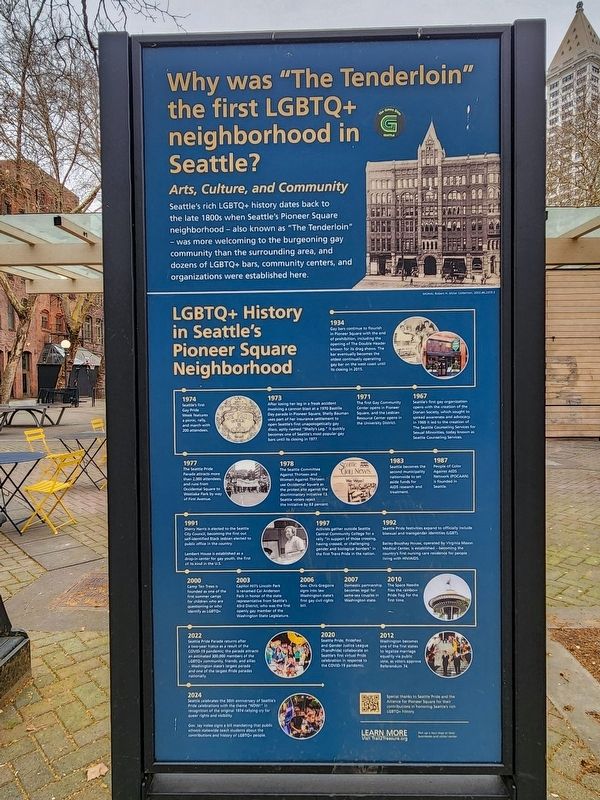
Why was “The Tenderloin” the first LGBTQ+ neighborhood in Seattle?
Photographed by Douglass Halvorsen, February 20, 2026
1. Why was "The Tenderloin" the first LGBTQ neighborhood in Seattle? Marker
Seattle’s rich LGBTQ+ history dates back to the late 1800s when Seattle’s Pioneer Square neighborhood — also known as “The Tenderloin” — was more welcoming to the burgeoning gay community than the surrounding area, and dozens of LGBTQ+ bars, community centers, and organizations were established here.
LGBTQ+ History in Seattle’s Pioneer Square Neighborhood
1934
Gay bars continue to flourish in Pioneer Square with the end of prohibition, including the opening of The Double Header known for its drag shows. The bar eventually becomes the oldest continually operating gay bar on the west coast until its closing in 2015.
1967
Seattle’s first gay organization opens with the creation of the Dorian Society, which sought to spread awareness and advocacy. In 1969 it led to the creation of The Seattle Counseling Services for Sexual Minorities, today known as Seattle Counseling Services.
1971
The first Gay Community Center opens in Pioneer Square, and the Lesbian Resource Center opens the University District.
1973
After losing her leg in a freak accident involving a cannon blast at a
this page online
1974
Seattle’s first Gay Pride Week features a picnic, rally, and march with 200 attendees.
1977
The Seattle Pride Parade attracts more than 2,000 attendees, and runs from Occidental Square to Westlake Park by way of First Avenue.
1978
The Seattle Committee Against Thirteen and Women Against Thirteen use Occidental Square as the protest site against the discriminatory initiave 13. Seattle voters reject the Initiative by 63 percent.
1983
Seattle becomes the second municipality nationwide to set aside funds for AIDS research and treatment.
1987
People of Color Against AIDS Network (POCAAN) is founded in Seattle.
1991
Sherry Harris is elected to the Seattle City Council, becoming the first out self-identified Black lesbian elected to public office in the country.
Lambert House is established as a drop-in center for gay youth, the first of its kind in

Photographed by Douglass Halvorsen, February 20, 2026
2. Why was “The Tenderloin” the first LGBTQ+ neighborhood in Seattle? Marker
1992
Seattle Pride festivities expand to officially include bisexual and transgender identities (LGBT).
Bailey-Boushay House, operated by Virginia Mason Medical Center, is established — becoming the country’s first nursing care residence for people living with HIV/AIDS.
1997
Activists gather outside Seattle Central Community College for a rally “in support of those crossing, having crossed, or challenging gender and biological borders” in the first Trans Pride in the nation.
2000
Camp Ten Trees is founded as one of the first summer camps for children who are questioning or who identify as LGBTQ+.
2003
Capitol Hill’s Lincoln Park is renamed Cal Anderson Park in honor of the state representative from Seattle’s 43rd District, who was the first openly gay member of the Washington State Legislature.
2006
Gov. Chris Gregoire signs into law Washington state’s first gay civil rights bill.
2007
Domestic partnership becomes legal for same-sex couples in Washington state.
2010
The Space Needle flies the rainbow Pride flag for the first time.
2012
Washington becomes one of the first states to legalize

Photographed by Douglass Halvorsen, February 20, 2026
3. Why was “The Tenderloin” the first LGBTQ+ neighborhood in Seattle? Marker
2020
Seattle Pride, PreideFest and Gender Justice League (TransPride) collaborate on Seattle’s first virtual Pride celebration in response to the COVID-19 pandemic.
2022
Seattle Pride Parade returns after a two-year hiatus as a result of the COVID-19 pandemic; the parade attracts an estimated 300,000 members of the LGBTQ+ community, friends, and allies — Washington state’s largest parade and one of the largest Pride parades nationally.
2024
Seattle celebrated the 50th anniversary of Seattle’s Pride celebration with the theme “NOW!” in recognition of the original 1974 rallying cry for queer rights and visibility.
Gov. Jay Inslee signs a bill mandating that public schools statewide teach students about contributions and history of LGBTQ+ people.
Erected by Trail2Treasure.org.
Topics. This historical marker is listed in these topic lists: Arts, Letters, Music • Civil Rights • Industry & Commerce.
Location. 47° 36.008′ N, 122° 19.998′ W. Marker is in Seattle, Washington, in King County.
Photographed by Douglass Halvorsen, February 20, 2026
4. Occidental Square
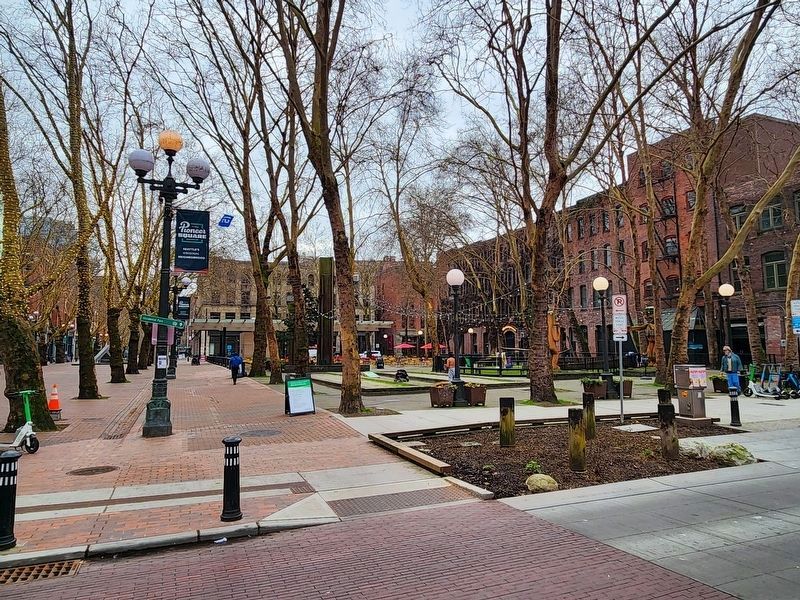
View of Occidental Square looking south from the north portion. The marker is located at the south portion of the square.

Regionally, this marker is in Washington’s Puget Sound Region. It is also on the American Pacific Coast, in the Pacific Northwest, and in the Lewis & Clark Corridor. Globally, it is in North America, in the Cascade Range, in the Inside Passage, on the Ring of Fire, in the Pacific Rim, in the Western Hemisphere, in the Western World, and in the Anglosphere.
Other nearby markers. At least 8 other markers are within walking distance of this marker: What makes a thriving village? (a few steps from this marker); Grand Central Hotel (within shouting distance of this marker); Earl Layman Street Clock (within shouting distance of this marker); Salvation Army Site (within shouting distance of this marker); UPS - Celebrating 100 years of Service (about 400 feet away, measured in a direct line); Birthplace of United Parcel Service (about 400 feet away); Smith and Squire Buildings (about 400 feet away); How Big Was Japantown? (about 500 feet away). Touch for a list and map of all markers in Seattle.
Other markers no longer nearby. Information Booth (was a few steps from this marker but has been permanently removed); Pioneer Square Historic District (was a few steps from this marker but has been permanently removed); Site of the Smaller Fort (was within shouting distance of this marker but has been confirmed missing).
Credits. This page was last revised on February 24, 2026. It was originally submitted on February 22, 2026, by Douglass Halvorsen of Klamath Falls, Oregon. This page has been viewed 54 times since then. Photos: 1, 2, 3, 4. submitted on February 22, 2026, by Douglass Halvorsen of Klamath Falls, Oregon. • Andrew Ruppenstein was the editor who published this page.
