Saint Stephens in Washington County, Alabama — The American South (East South Central)
The St. Stephens Historical Commission
Photographed by Mark Hilton, February 17, 2026
1. The St. Stephens Historical Commission Marker
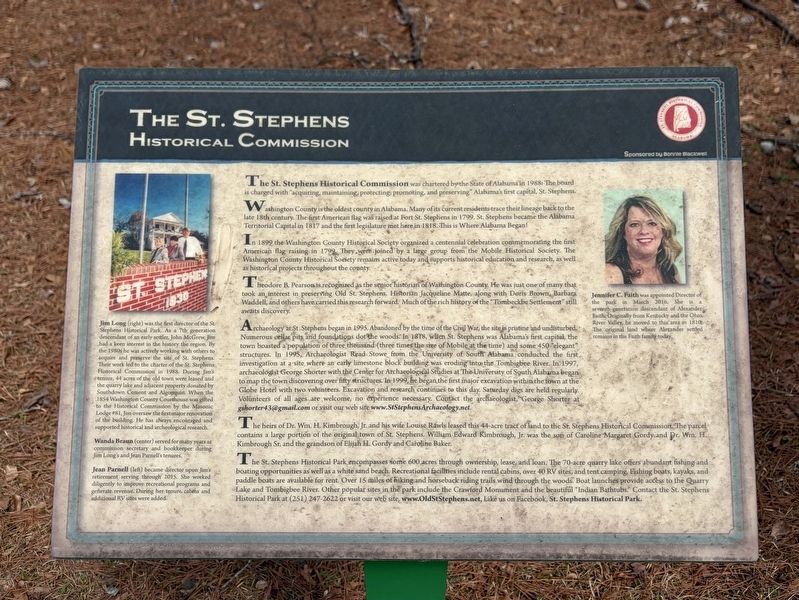
The St. Stephens Historical Commission was chartered by the State of Alabama in 1988: The board is charged with "acquiring, maintaining, protecting, promoting, and preserving" Alabama's first capital, St. Stephens.
Washington County is the oldest county in Alabama. Many of its current residents trace their lineage back to the late 18th century. The first American flag was raised at Fort St. Stephens in 1799. St. Stephens became the Alabama Territorial Capital in 1817 and the first legislature met here in 1818. This is Where Alabama Began!
In 1899 the Washington County Historical Society organized a centennial celebration commemorating the first American flag raising in 1799 They were joined by a large group from the Mobile Historical Society. The Washington County Historical Society remains active today and supports historical education and research, as well as historical projects throughout the county.
Theodore B. Pearson is recognized as the senior historian of Washington County. He was just one of many that took an interest in preserving Old St. Stephens. Historian Jacqueline Matte, along with Doris Brown,
this page online
Archaeology at St. Stephens began in 1995. Abandoned by the time of the Civil War, the site is pristine and undisturbed. Numerous cellar pits and foundations dot the woods. In 1818, when St. Stephens was Alabama's first capital, the town boasted a population of three thousand (three times the size of Mobile at the time) and some 450 "elegant" structures. In 1995, Archaeologist Read Stowe from the University of South Alabama conducted the first investigation at a site where an early limestone block building was eroding into the Tombigbee River. In 1997, archaeologist George Shorter with the Center for Archaeological Studies at The University of South Alabama began to map the town discovering over fifty structures. In 1999, he began the first major excavation within the town at the Globe Hotel with two volunteers. Excavation and research continues to this day. Saturday digs are held regularly. Volunteers of all ages are welcome, no experience necessary. Contact the archaeologist, George Shorter
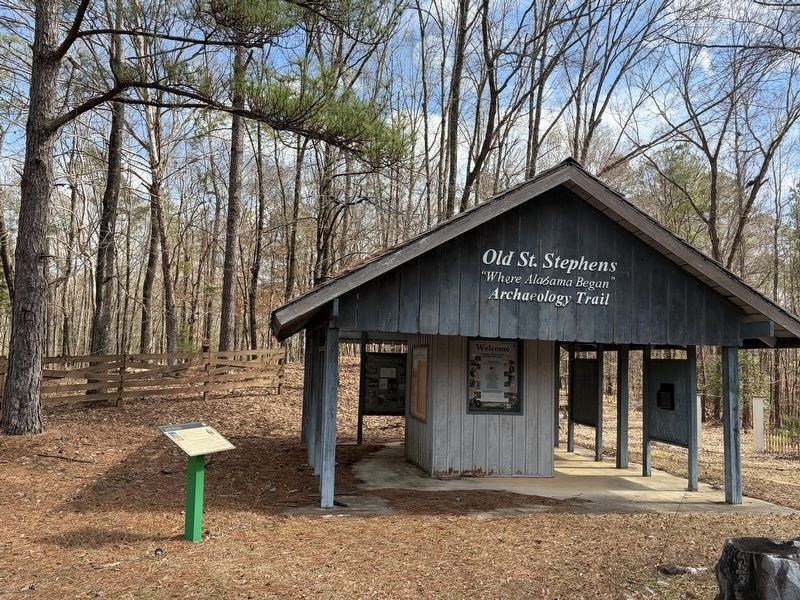
Photographed by Mark Hilton, February 17, 2026
2. The St. Stephens Historical Commission Marker
The heirs of Dr. Wm. H. Kimbrough, Jr. and his wife Louise Rawls leased this 44-acre tract of land to the St. Stephens Historical Commission. The parcel contains a large portion of the original town of St. Stephens. William Edward Kimbrough, Jr. was the son of Caroline Margaret Gordy and Dr. Wm. H. Kimbrough Sr. and the grandson of Elijah H. Gordy and Caroline Baker.
The St. Stephens Historical Park encompasses some 600 acres through ownership, lease, and loan. The 70-acre quarry lake offers abundant fishing and boating opportunities as well as a white sand beach. Recreational facilities include rental cabins, over 40 RV sites, and tent camping. Fishing boats, kayaks, and paddle boats are available for rent. Over 15 miles of hiking and horseback riding trails wind through the woods. Boat launches provide access to the Quarry Lake and Tombigbee River. Other popular sites in the park include the Crawford Monument and the beautiful "Indian Bathtubs." Contact the St. Stephens Historical Park at (251) 247-2622 or visit our web site, www.OldStStephens.net, Like us on Facebook, St. Stephens Historical Park.
[Left Photo Inset:]
Jim Long (right) was the first director of the St. Stephens Historical Park. As a 7th generation descendant of an early settler, John McGrew, Jim had a keen interest in the history the region. By the 1980s he was actively working with others to acquire and preserve the site of St. Stephens. Their work led to the charter of the St. Stephens Historical Commission in 1988. During Jim's tenure, 44 acres of the old town were leased and the quarry lake and adjacent property donated by Southdown Cement and Algonquin. When the 1854 Washington County Courthouse was gifted to the Historical Commission by the Masonic Lodge #81, Jim oversaw the first major renovation of the building. He has always encouraged and supported historical and archeological research.
Wanda Braun (center) served for many years as commission secretary and bookkeeper during Jim Long's and Jean Parnell's tenures.
Jean Parnell (left) became director upon Jim's retirement serving through 2015. She worked diligently to improve recreational programs and generate revenue. During her tenure, cabins and additional RV sites were added.
[Right Photo Inset:]
Jennifer C. Faith was appointed Director of the park in March 2016. She is a seventh-generation descendant of Alexander Faith. Originally from Kentucky and the Ohio River Valley, he moved to this area in 1810. The original land where Alexander settled remains in the Faith family today.
Erected by St. Stephens Historical Commission.
Topics. This historical marker is listed in these topic lists: Parks & Recreational Areas • Settlements & Settlers. A significant historical month for this entry is March 2016.
Location. 31° 33.321′ N, 88° 2.219′ W. Marker is in Saint Stephens, Alabama, in Washington County. It is on Old Saint Stephens Road 1.2 miles east of Cement Plant Road, on the right when traveling west. Touch for map. Marker is at or near this postal address: 1190 Old Saint Stephens Rd, Saint Stephens AL 36569, United States of America. Touch for directions.

Regionally, this marker is in the Mobile Bay area. It is also in the American South and specifically in the Deep South. Globally, it is in North America, a Gulf of Mexico state, the Western Hemisphere, the Western World, and the Anglosphere. Historically, it finds itself in what was once New Spain, the territory of the Mississippian Culture, one of the Confederate States of America, and the Antebellum South.
Other nearby markers. At least 8 other markers are within 7 miles of this marker, measured as the crow flies: St. Stephens (a few steps from this marker); Site of Old St. Stephens (about 300 feet away, measured in a direct line); The Tombigbee Settlements (approx. 0.3 miles away); St. Stephens Courthouse and Masonic Lodge (approx. 1½ miles away); Old St. Stephens Masonic Lodge No. 9 / St. Stephens Lodge (approx. 1½ miles away); Upper Salt Works (approx. 4.9 miles away); The Taylor House (approx. 5.8 miles away); Bassetts Creek (approx. 6.3 miles away). Touch for a list and map of all markers in Saint Stephens.
Also see . . . A state park designated to preserve the history of the Territorial Capital of Alabama. (Submitted on February 22, 2026, by Mark Hilton of Montgomery, Alabama.)
Credits. This page was last revised on February 22, 2026. It was originally submitted on February 22, 2026, by Mark Hilton of Montgomery, Alabama. This page has been viewed 92 times since then. Photos: 1, 2. submitted on February 22, 2026, by Mark Hilton of Montgomery, Alabama.
