Discovery District in Toronto, Ontario — Central Canada (North America)
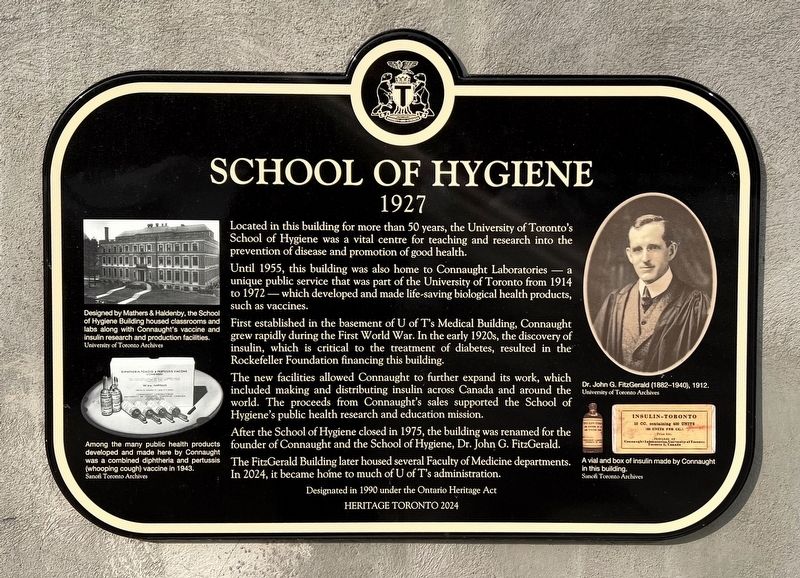
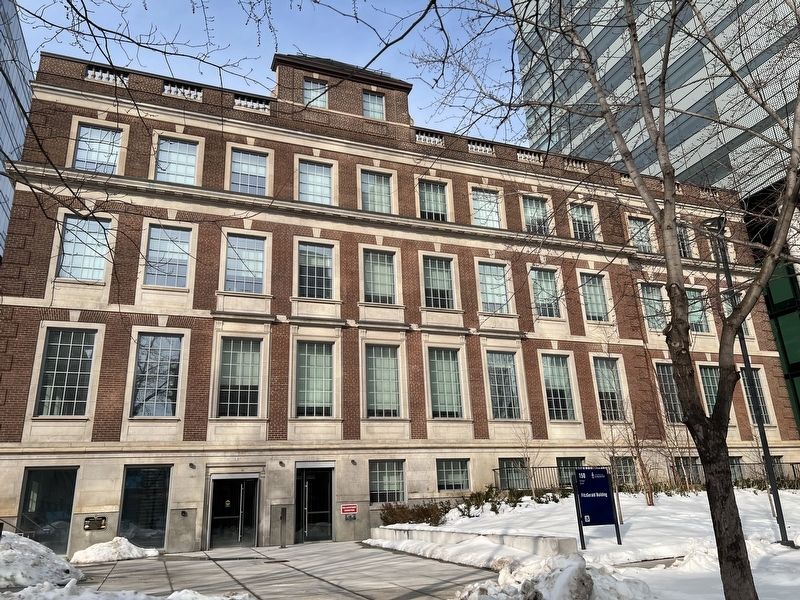
School of Hygiene
1927
Photographed by Tim Boyd, February 15, 2026
1. School of Hygiene Marker
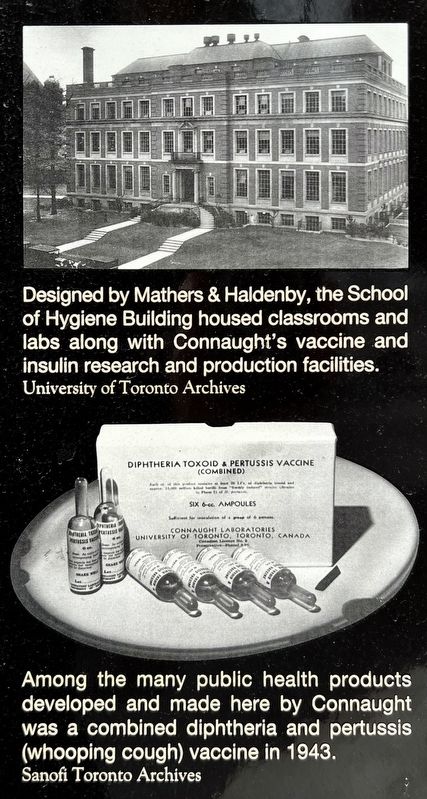
Until 1955, this building was also home to Connaught Laboratories - a unique public service that was part of the University of Toronto from 1914 to 1972 — which developed and made life-saving biological health products, such as vaccines.
First established in the basement of U of T's Medical Building, Connaught grew rapidly during the First World War. In the early 1920s, the discovery of insulin, which is critical to the treatment of diabetes, resulted in the Rockefeller Foundation financing this building.
The new facilities allowed Connaught to further expand its work, which included making and distributing insulin across Canada and around the world. The proceeds from Connaught's sales supported the School of Hygiene's public health research and education mission.
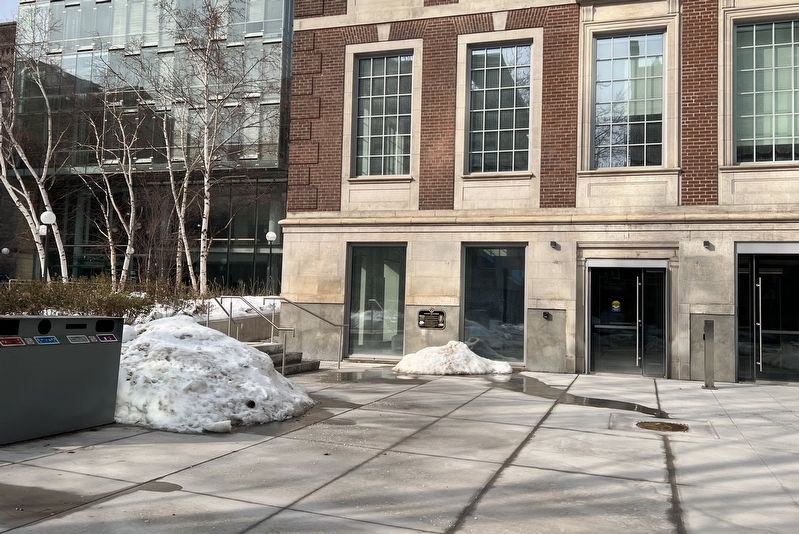
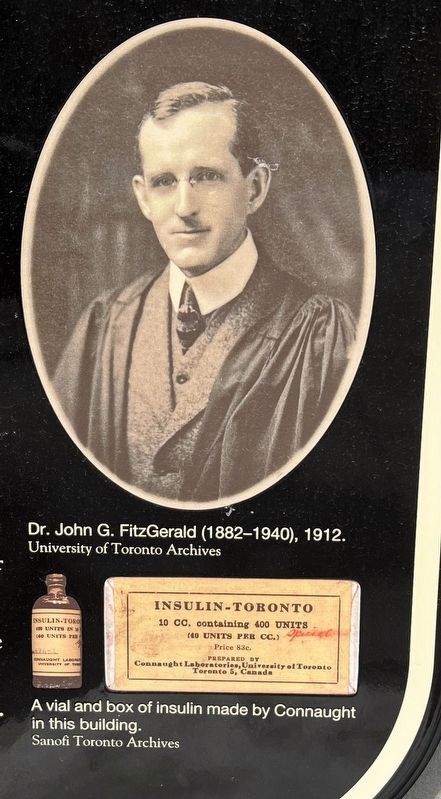
After the School of Hygiene closed in 1975, the building was renamed for the founder of Connaught and the School of Hygiene, Dr. John G. FitzGerald. The
this page online
Designated in 1990 under the Ontario Heritage Act
Erected 2024 by Heritage Toronto.
Topics and series. This historical marker is listed in this topic list: Science & Medicine. In addition, it is included in the Canada, Toronto Heritage series list. A significant historical year for this entry is 1927.
Location. 43° 39.583′ N, 79° 23.544′ W. Marker is in Toronto, Ontario. It is in the Discovery District. It is on College Street 0.1 kilometers west of University Avenue, on the right when traveling west. Touch for map. Marker is at or near this postal address: 150 College St, Toronto ON M5S 3M2, Canada. Touch for directions.

Regionally, this marker is in Greater Toronto and on the Golden Horseshoe. It is also in Central Canada. Globally, it is in North America, on the Great Lakes, in the Western Hemisphere, in the Western World, and in the Anglosphere. Historically, it finds itself in what was once a British colony, the Viceroyalty of New France, the Haudenosaunee (Iroquois) Confederacy,
Photographed by Tim Boyd, February 15, 2026
2. School of Hygiene Marker
Other nearby markers. At least 8 other markers are within walking distance of this marker: Dr. Peter Bryce (within shouting distance of this marker); Notre Place (about 120 meters away, measured in a direct line); Queen's Park, Toronto (about 150 meters away); King George V 25th Anniversary Tree (about 180 meters away); The Discovery of Insulin (about 210 meters away); a different marker also named Queen's Park (about 210 meters away); Charles William Jefferys (about 210 meters away); Sir Oliver Mowat (about 240 meters away). Touch for a list and map of all markers in Toronto.
Also see . . . History of Connaught (Laboratories).
The existence of Connaught as a unique public service and self-supporting part of the University of Toronto proved vital to the development and production of insulin. The Labs’ main facilities, in the Medical Building, were close to where Banting and Best worked, and fostered the important personal relationship that formed between Banting and FitzGerald. Connaught Laboratories originated within a uniquely Canadian public health context that evolved between the 1890s and the 1910s,(Submitted on February 22, 2026, by Tim Boyd of Hamilton, Ontario.)defined by increasingly proactive local and provincial public health efforts to control infectious diseases, especially diphtheria.Photographed by Tim Boyd, February 15, 20263. School of Hygiene marker photos and captions detail (left)
Photographed by Tim Boyd, February 15, 2026
4. School of Hygiene marker photos and captions detail (right)
Photographed by Tim Boyd, February 15, 2026
5. Former School of Hygiene building in 2026
marker is visible at the lower left of the building
Credits. This page was last revised on February 23, 2026. It was originally submitted on February 22, 2026, by Tim Boyd of Hamilton, Ontario. This page has been viewed 43 times since then. Photos: 1, 2, 3, 4, 5. submitted on February 22, 2026, by Tim Boyd of Hamilton, Ontario. • Andrew Ruppenstein was the editor who published this page.
