Yonge-Bay Corridor in Toronto, Ontario — Central Canada (North America)
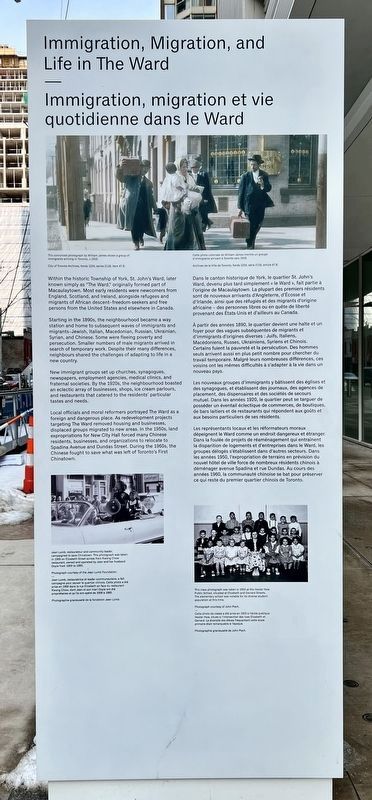
Immigration, Migration, and Life in The Ward
Immigration, migration et vie quotidienne dans le Ward
Photographed by Tim Boyd, February 15, 2026
1. Immigration, Migration, and Life in The Ward Marker

Within the historic Township of York, St. John's Ward, later known simply as "The Ward," originally formed part of Macaulaytown. Most early residents were newcomers from England, Scotland, and Ireland, alongside refugees and migrants of African descent-freedom-seekers and free persons from the United States and elsewhere in Canada.
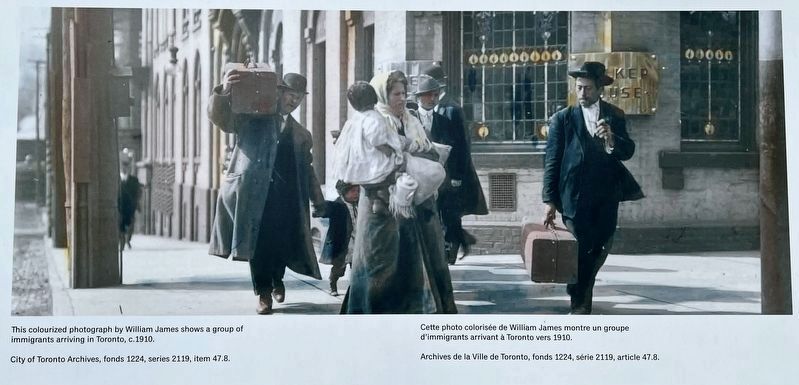
Starting in the 1890s, the neighbourhood became a way station and home to subsequent waves of immigrants and migrants-Jewish, Italian, Macedonian, Russian, Ukrainian, Syrian, and Chinese. Some were fleeing poverty and persecution. Smaller numbers of male migrants arrived in search of temporary work. Despite their many differences, neighbors shared the challenges of adapting to life in a new country.
New immigrant groups set up churches, synagogues, newspapers, employment agencies, medical clinics, and fraternal societies. By the 1920s, the neighbourhood boasted an eclectic array of businesses, shops, ice cream parlours, and restaurants that catered to the residents' particular tastes and needs.
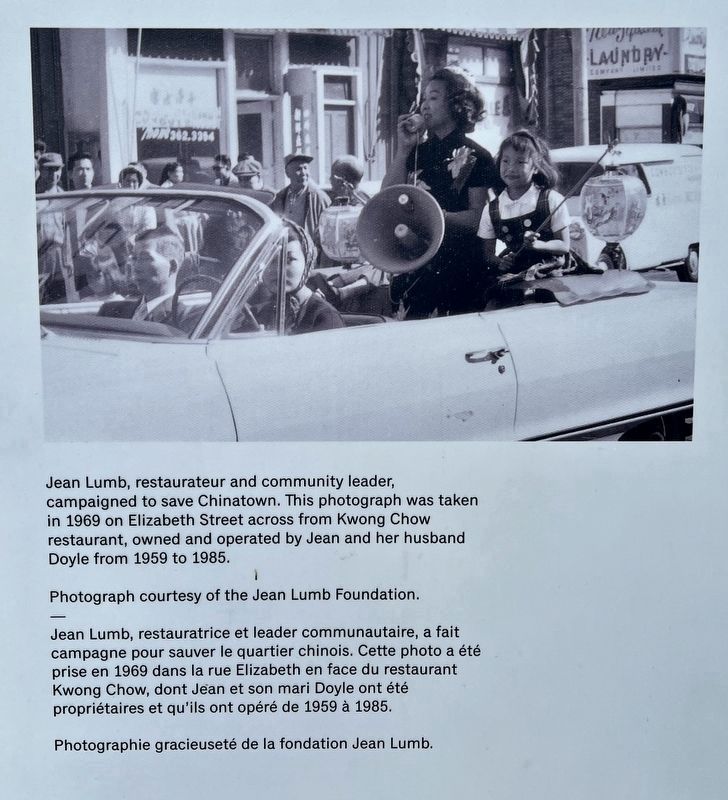
Local officials and moral reformers portrayed The Ward as a foreign and dangerous place. As redevelopment projects targeting The Ward removed housing and businesses, displaced groups migrated to new areas. In the 1950s, land expropriations for New City Hall forced many Chinese residents, businesses, and organizations to relocate to Spadina Avenue and Dundas Street. During the 1960s, the Chinese fought to save what was left of Toronto's First Chinatown.
Dans le canton historique de York, le quartier St. John's Ward, devenu plus tard simplement « le Ward », fait partie à l'origine de Macaulaytown. La plupart des premiers résidents sont de nouveaux arrivants d'Angleterre,
this page online
À partir des années 1890, le quartier devient une halte et un foyer pour des vagues subséquentes de migrants et d'immigrants d'origines diverses : Juifs, Italiens, Macédoniens, Russes, Ukrainiens, Syriens et Chinois. Certains fuient la pauvreté et la persécution. Des hommes seuls arrivent aussi en plus petit nombre pour chercher du travail temporaire. Malgré leurs nombreuses différences, ces voisins ont les mêmes difficultés à s'adapter à la vie dans un nouveau pays.
Les nouveaux groupes d'immigrants y bâtissent des églises et des synagogues, et établissent des journaux, des agences de placement, des dispensaires et des sociétés de secours mutuel. Dans les années 1920, le quartier peut se targuer de posséder un éventail éclectique de commerces, de boutiques, de bars laitiers et de restaurants qui répondent aux goûts et aux besoins particuliers de ses résidents.
Les représentants locaux et les réformateurs moraux dépeignent le Ward comme un endroit
Photographed by Tim Boyd, February 15, 2026
2. Immigration, Migration, and Life in The Ward
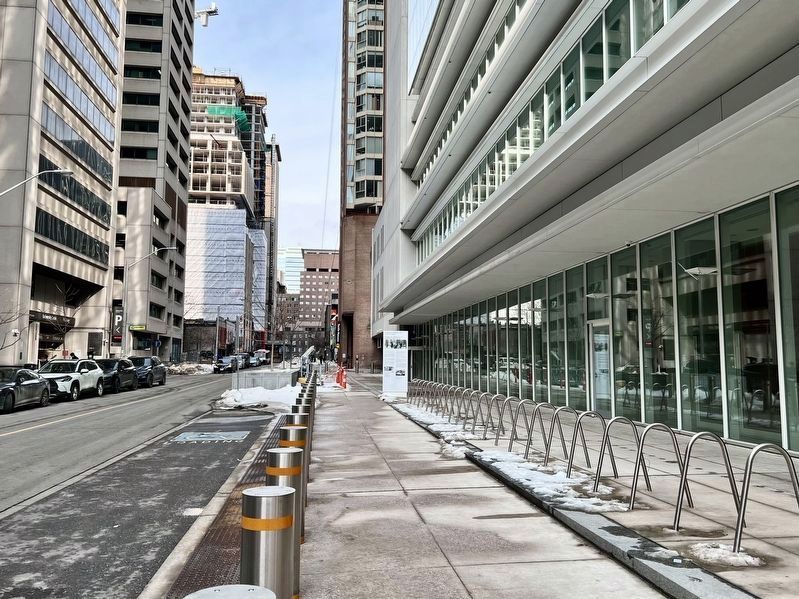
Looking north on Centre Street
Topics. This historical marker is listed in this topic list: Immigration. A significant historical year for this entry is 1890.
Location. 43° 39.244′ N, 79° 23.188′ W. Marker is in Toronto, Ontario. It is in Yonge-Bay Corridor. It is on Centre Avenue 0.1 kilometers Armoury Street, on the right when traveling north. Touch for map. Marker is at or near this postal address: 11 Centre Avenue, Toronto ON M5G M5G, Canada. Touch for directions.

Regionally, this marker is in Greater Toronto and on the Golden Horseshoe. It is also in Central Canada. Globally, it is in North America, on the Great Lakes, in the Western Hemisphere, in the Western World,
3. Immigration, Migration, and Life in The Ward marker photo and caption detail (top)
Other nearby markers. At least 8 other markers are within walking distance of this marker: Jewish Settlement and Religion / Communauté juive et judaisme (a few steps from this marker); Mapping a Block in The Ward / Cartographie d'un pâté de maisons dans le Ward (within shouting distance of this marker); An Evolving Block in The Ward / Un pâté de maisons en évolution dans le Ward (within shouting distance of this marker); Black Life in St. John's Ward / La vie des Noirs dans le St. John's Ward (within shouting distance of this marker); A Community Church / Une église communautaire (within shouting distance of this marker); Winston Churchill (about 120 meters away, measured in a direct line); a different marker also named Winston Churchill (about 120 meters away); Toronto’s First Chinatown (about 120 meters away). Touch for a list and map of all markers in Toronto.
4. Immigration, Migration, and Life in The Ward marker photo and caption detail (lower left)
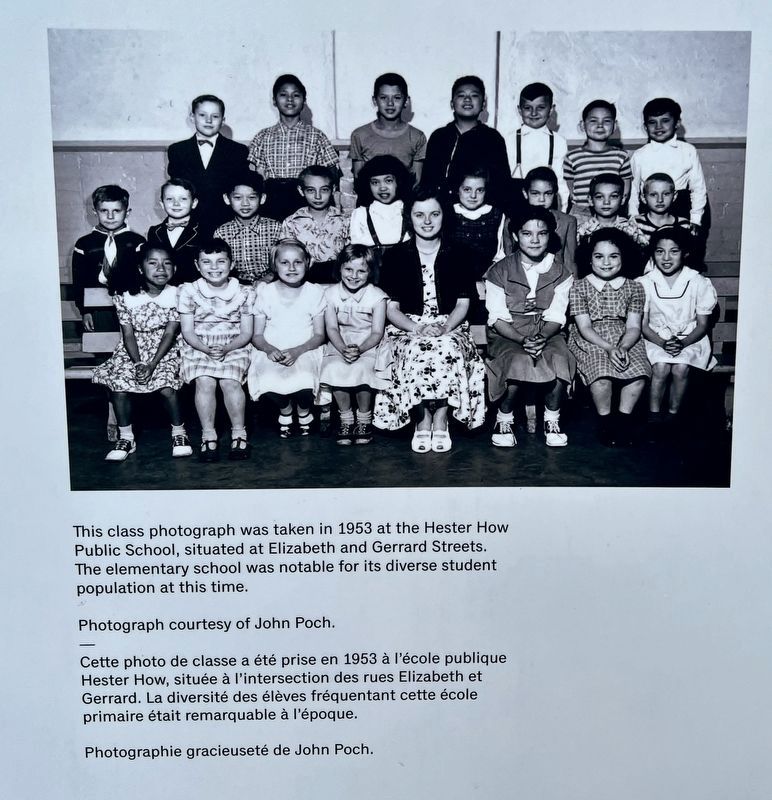
5. Immigration, Migration, and Life in The Ward marker photo and caption detail (lower right)
Credits. This page was last revised on February 25, 2026. It was originally submitted on February 23, 2026, by Tim Boyd of Hamilton, Ontario. This page has been viewed 47 times since then. Photos: 1, 2, 3, 4, 5. submitted on February 23, 2026, by Tim Boyd of Hamilton, Ontario. • Andrew Ruppenstein was the editor who published this page.
