Yonge-Bay Corridor in Toronto, Ontario — Central Canada (North America)
Jewish Settlement and Religion
⎯⎯⎯
Communauté juive et judaisme
Photographed by Tim Boyd, February 15, 2026
1. Jewish Settlement and Religion/Communauté juive et judaisme Marker

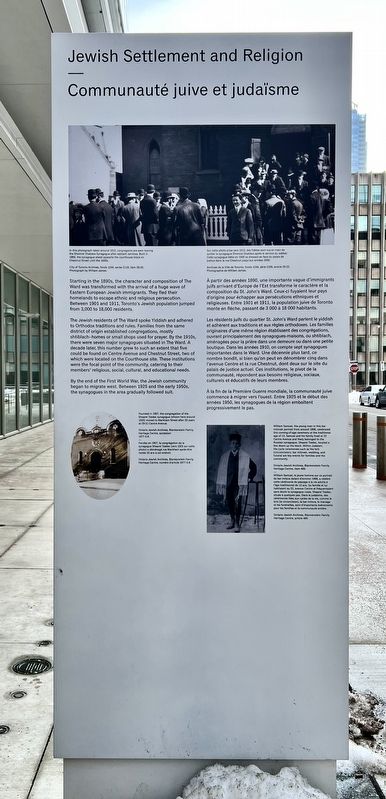
Starting in the 1890s, the character and composition of The Ward was transformed with the arrival of a huge wave of Eastern European Jewish immigrants. They fled their homelands to escape ethnic and religious persecution. Between 1901 and 1911, Toronto's Jewish population jumped from 3,000 to 18,000 residents.
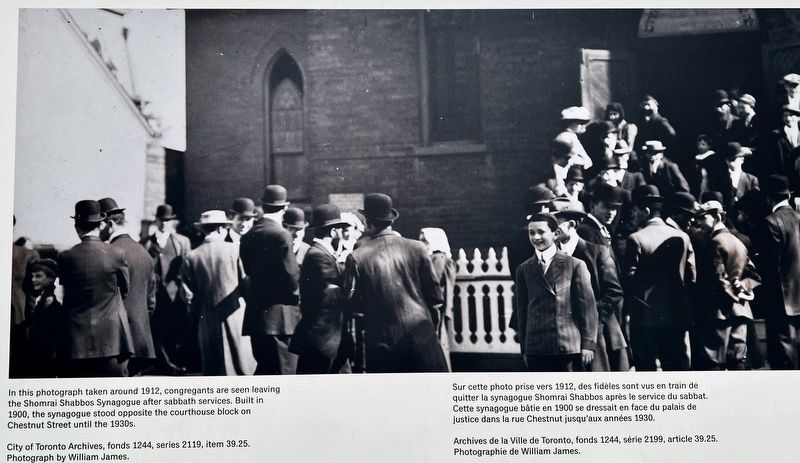
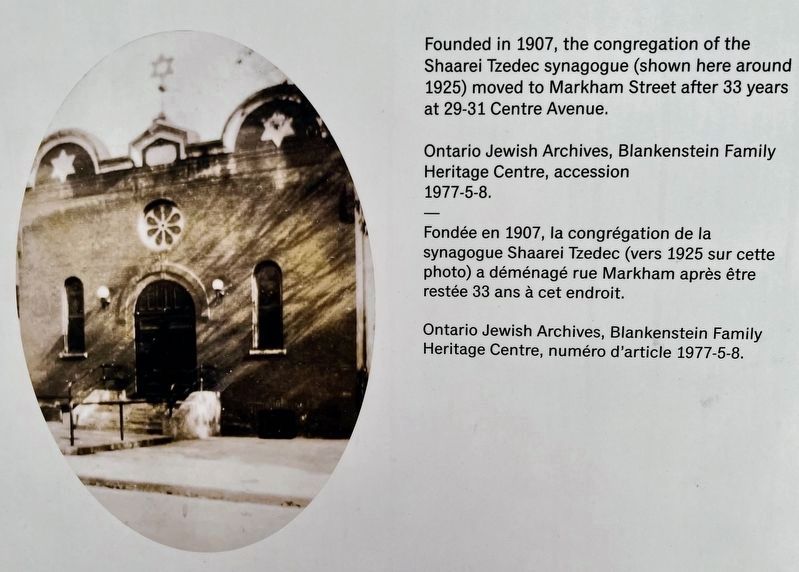
The Jewish residents of The Ward spoke Yiddish and adhered to Orthodox traditions and rules. Families from the same district of origin established congregations, mostly shtiblach-homes or small shops used for prayer. By the 1910s, there were seven major synacogues situated in the ward. A decade later, this number grew to such an extent that five could be found on Centre Avenue and Chestnut Street, two of which were located on the courthouse site. These institutions were the focal point of the community, catering to their members' religious, social, cultural, and educational needs.
By the end of the First World War, the Jewish community began to migrate west. Between 1925 and the early 1950s the synagogues in the area gradually followed suit.
À partir des années 1890, une importante vague d'immigrants juifs arrivant d'Europe de l'Est transforme le caractère et la composition du St. John's Ward. Ceux-ci fuyaient leur pays d'origine pour échapper aux persécutions ethniques et religieuses. Entre 1901 et 1911, la population juive de Toronto monte en flèche, passant de 3 000 à 18 000 habitants.
Les résidents juifs du quartier St. John's Ward parlent le yiddish et adhèrent aux traditions et aux règles orthodoxes. Les familles originaires d'une même région établissent des congrégations, ouvrant principalement des synagogues-maisons, ou shtiblach, aménagées pour la prière dans une demeure ou dans une petite boutique. Dans
this page online
À la fin de la Première Guerre mondiale, la communauté juive commence à migrer vers l'ouest. Entre 1925 et le début des années 1950, les synagogues de la région emboitent progressivement le pas.
Topics and series. This historical marker is listed in these topic lists: Immigration • Religion & Religious Structures. In addition, it is included in the Synagogues series list. A significant historical year for this entry is 1901.
Location. 43° 39.247′ N, 79° 23.193′ W. Marker is in Toronto, Ontario. It is in Yonge-Bay Corridor. It is on Centre Avenue 0.1 kilometers south of Dundas Street West, on the right when traveling south. Touch for map. Marker is at or near this postal address: 33 Centre Ave, Toronto ON M5G M5G, Canada. Touch for directions.

Regionally, this
Photographed by Tim Boyd, February 15, 2026
2. Jewish Settlement and Religion/Communauté juive et judaisme Marker
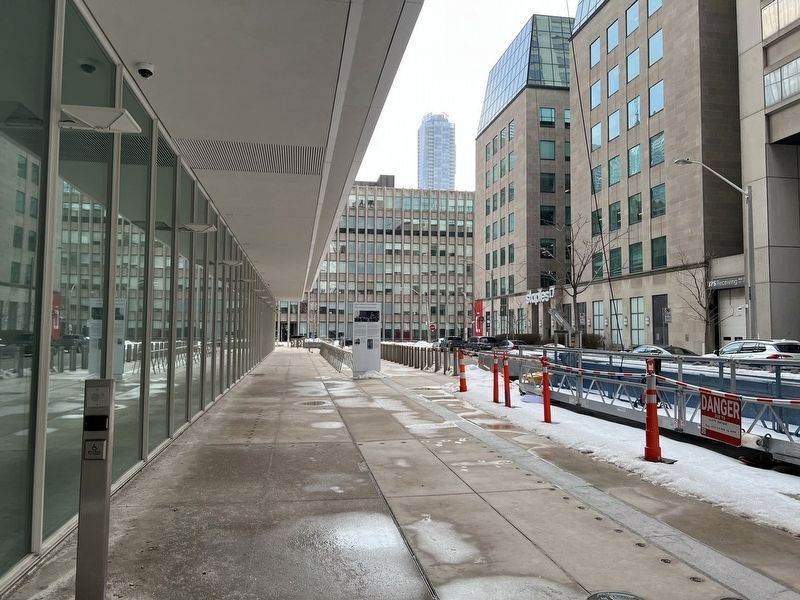
Facing south on Centre Street
Other nearby markers. At least 8 other markers are within walking distance of this marker: Immigration, Migration, and Life in The Ward (a few steps from this marker); Mapping a Block in The Ward / Cartographie d'un pâté de maisons dans le Ward (within shouting distance of this marker); An Evolving Block in The Ward / Un pâté de maisons en évolution dans le Ward (within shouting distance of this marker); Black Life in St. John's Ward / La vie des Noirs dans le St. John's Ward (within shouting distance of this marker); A Community Church / Une église communautaire (within shouting distance of this marker); Winston Churchill (about 120 meters away, measured in a direct line); Toronto’s First Chinatown (about 120 meters away); a different marker also named
3. Jewish Settlement and Religion marker photo and caption detail (top)
4. Jewish Settlement and Religion marker photo and caption detail (lower left)
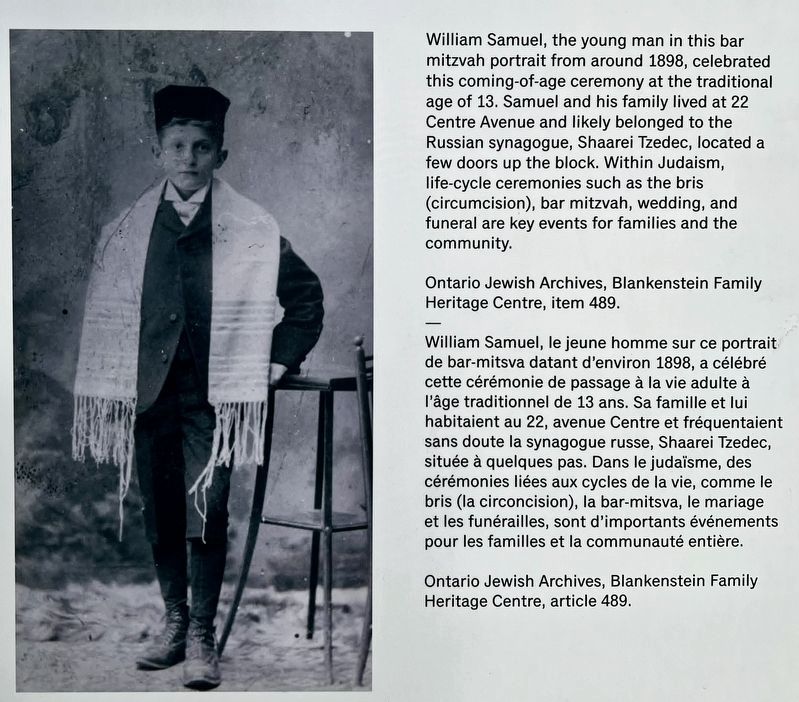
5. Jewish Settlement and Religion marker photo and caption detail (lower right)
Credits. This page was last revised on February 27, 2026. It was originally submitted on February 23, 2026, by Tim Boyd of Hamilton, Ontario. This page has been viewed 70 times since then. Last updated on February 26, 2026, by Tim Boyd of Hamilton, Ontario. Photos: 1, 2, 3, 4, 5. submitted on February 23, 2026, by Tim Boyd of Hamilton, Ontario. • Devry Becker Jones was the editor who published this page.
