Altstadt in Heidelberg, Baden-Württemberg, Germany — Central Europe
Historische Stätten der Chemie
⎯⎯⎯
Historic Landmarks of Chemistry
Photographed by James Hulse, February 19, 2026
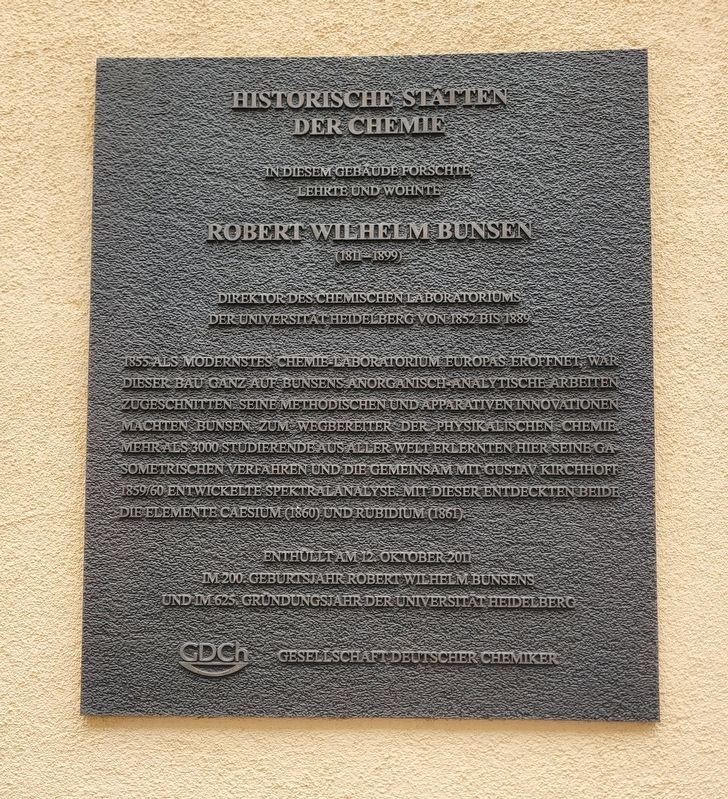
1. Historische Stätten der Chemie / Historic Landmarks of Chemistry Marker

lehrte und wohnte
Robert Wilhelm Bunsen
(1811–1899)
Direktor des Chemischen Laboratoriums
der Universität Heidelberg von 1852 bis 1889
1855 als modernstes Chemie-Laboratorium Europas eröffnet, war dieser Bau ganz auf Bunsens anorganisch-analytische Arbeiten zugeschnitten. Seine methodischen und apparativen Innovationen machten Bunsen zum Wegbereiter der physikalischen Chemie. Mehr als 3000 Studierende aus aller Welt erlernten hier seine gasometrischen Verfahren und die gemeinsam mit Gustav Kirchhoff 1859/60 entwickelte Spektralanalyse: Mit dieser entdeckten beide die Elemente Caesium (1860) und Rubidium (1861).
Enthüllt am 12. Oktober 2011. Im 200. Geburtsjahr Robert Wilhelm Bunsens und im 625. Gründungsjahr der Universität Heidelberg.
In this building researched, taught, and lived, Robert Wilhelm Bunsen, (1811–1899). Director of the Chemical Laboratory of Heidelberg University from 1852 to 1889. Opened in 1855 as the most modern chemical laboratory in Europe, this building was entirely designed to suit Bunsen’s inorganic-analytical research.
this page online
Unveiled on 12 October 2011. On the 200th anniversary of Robert Wilhelm Bunsen’s birth and the 625th anniversary of the founding of Heidelberg University.
Erected 2011 by GDCh German Chemical Society.
Topics. This historical marker is listed in this topic list: Science & Medicine. A significant historical date for this entry is October 12, 2011.
Location. 49° 24.575′ N, 8° 41.882′ E. Marker is in Heidelberg, Baden-Württemberg. It is in Altstadt. It is on Akademiestraße just north of Plöck, on the right when traveling north. Touch for map. Marker is at or near this postal address: Akademiestraße 4, Heidelberg BW 69117, Germany. Touch for directions.

Regionally, this marker is on the German Upper Rhine. Globally, it is in Europe, the European Union, Atlantic Europe, Central Europe, the Schengen
Photographed by James Hulse, February 19, 2026
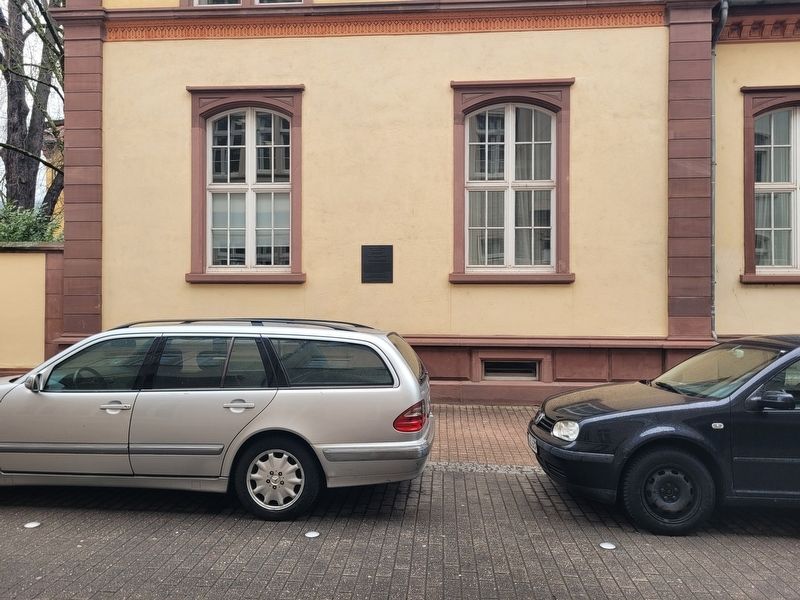
2. Historische Stätten der Chemie / Historic Landmarks of Chemistry Marker
The view of the marker along the side of the building.
Other nearby markers. At least 8 other markers are within walking distance of this marker: Laboratorium Chemicum / Chemical Laboratory (a few steps from this marker); R. W. Bunsen (within shouting distance of this marker); Die alten Institute der Naturwissenschaft / The Old Institutes of the Natural Sciences (within shouting distance of this marker); Hier wohnten die Chemiker / Here lived the chemists (within shouting distance of this marker); Friedrich Ebert (within shouting distance of this marker); Evangelical Reformed Hospital (within shouting distance of this marker); Spektralanalyse / Spectroscopic Analysis (about 90 meters away, measured in a direct line); David Friedrich Strauss (about 90 meters away). Touch for a list and map of all markers in Heidelberg.
Also see . . . Robert Bunsen. Wikipedia
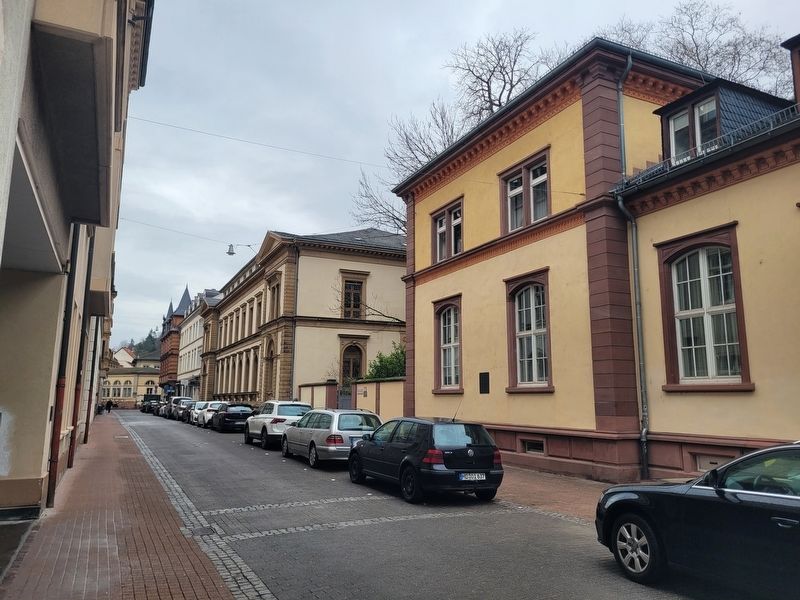
Robert Wilhelm Eberhard Bunsen (30 March 1811 – 16 August 1899) was a German chemist. He investigated emission spectra of heated elements, and discovered(Submitted on February 27, 2026, by James Hulse of Medina, Texas.)caesium in 1860 and rubidium in 1861 with the physicist Gustav Kirchhoff. The Bunsen–Kirchhoff Award for spectroscopy is named after Bunsen and Kirchhoff.Photographed by James Hulse, February 19, 20263. Historische Stätten der Chemie / Historic Landmarks of Chemistry MarkerThe view of the marker along the building.
Bunsen also developed several gas-analytical methods, was a pioneer in photochemistry, and did early work in the field of organic arsenic chemistry. With his laboratory assistant Peter Desaga, he developed the Bunsen burner, an improvement on the laboratory burners then in use.
Credits. This page was last revised on February 27, 2026. It was originally submitted on February 26, 2026, by James Hulse of Medina, Texas. This page has been viewed 32 times since then. Photos: 1, 2, 3. submitted on February 27, 2026, by James Hulse of Medina, Texas.
