Altstadt in Heidelberg, Baden-Württemberg, Germany — Central Europe
Robert Wilhelm Bunsen
(1811-1899)

Photographed by James Hulse, February 19, 2026
1. Robert Wilhelm Bunsen Marker

Professor in Marburg (1839), Breslau (1851), Heidelberg (1852). Direktor des Chemischen Laboratoriums, Begründer der chemischen Analyse, entwickelte die Chromsäure-Batterie und die Schmelzflusselektrolyse zure Herstellung von Magnesium; schuf zusammen mit Gustav Robert Kirchhoff die Spektralanalyse und entdeckte Cäsium und Rubidium (1860).
Professor in Marburg (1839), Breslau (1851), and Heidelberg (1852). Director of the Chemical Laboratory, pioneer of chemical analysis, he developed the chromic acid battery and molten-salt electrolysis for the production of magnesium; together with Gustav Robert Kirchhoff, he created spectroscopic analysis and discovered the elements cesium and rubidium (1860).
Topics. This historical marker is listed in this topic list: Science & Medicine.
Location. 49° 24.642′ N, 8° 41.883′ E. Marker is in Heidelberg, Baden-Württemberg. It is in Altstadt. It is at the intersection of Hauptstraße and Brunnengasse, on the left when traveling east on Hauptstraße. Touch for map. Marker is at or near this postal
this page online

Regionally, this marker is on the German Upper Rhine. Globally, it is in Europe, the European Union, Atlantic Europe, Central Europe, the Schengen Area, Western Europe, and the Western World. Historically, it finds itself in what was once the Roman Empire, the Holy Roman Empire, and the former West Germany.
Other nearby markers. At least 8 other markers are within walking distance of this marker: Friedrichsbau / Friedrich Building (a few steps from this marker); Wilhelm Salomon-Calvi (within shouting distance of this marker); Spektralanalyse / Spectroscopic Analysis (within shouting distance of this marker); Historische Stätten der Chemie / Historic Landmarks of Chemistry (about 120 meters away, measured in a direct line); Robert von Mohl (about 120 meters away); Laboratorium Chemicum / Chemical Laboratory (about 150 meters away); Max Wolf (about 150 meters away); R. W. Bunsen (about 150 meters away). Touch for a list and map of all markers in Heidelberg.
Also see . . . Robert Bunsen. Wikipedia
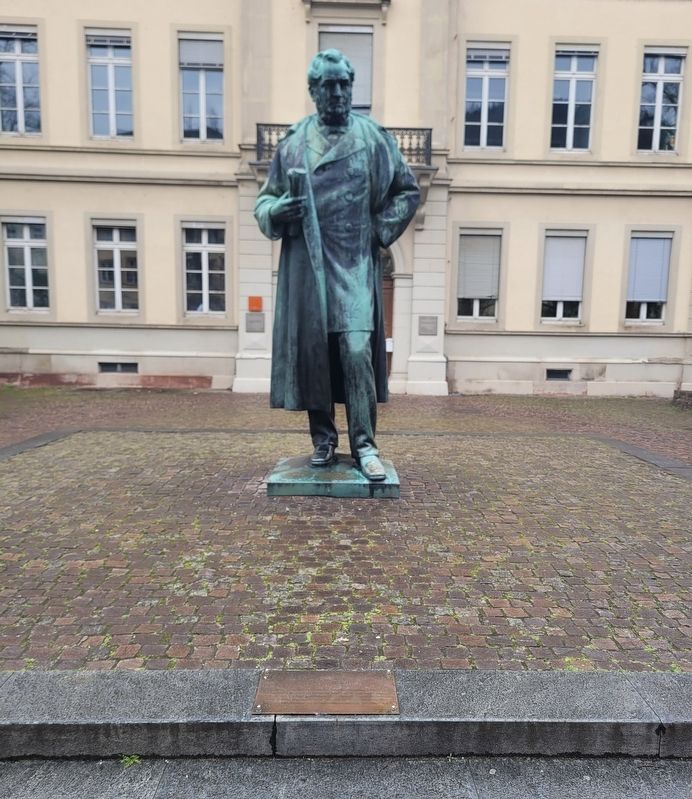
Robert Wilhelm Eberhard Bunsen (30 March(Submitted on February 28, 2026, by James Hulse of Medina, Texas.)1811 – 16 August 1899) was a German chemist. He investigated emission spectra of heated elements, and discovered caesium in 1860 and rubidium in 1861 with the physicist Gustav Kirchhoff. The Bunsen–Kirchhoff Award for spectroscopy is named after Bunsen and Kirchhoff.Photographed by James Hulse, February 19, 20262. Robert Wilhelm Bunsen MarkerThe marker is located on the ground in front of the statue.
Bunsen also developed several gas-analytical methods, was a pioneer in photochemistry, and did early work in the field of organic arsenic chemistry. With his laboratory assistant Peter Desaga, he developed the Bunsen burner, an improvement on the laboratory burners then in use.

Photographed by James Hulse, February 19, 2026
3. Robert Wilhelm Bunsen Marker
The marker and statue are located in front of the university building.

Photographed by James Hulse, February 19, 2026
4. Closeup of Robert Wilhelm Bunsen statue
Credits. This page was last revised on February 28, 2026. It was originally submitted on February 26, 2026, by James Hulse of Medina, Texas. This page has been viewed 32 times since then. Photos: 1, 2, 3, 4. submitted on February 28, 2026, by James Hulse of Medina, Texas.
