East Garfield Park in Chicago in Cook County, Illinois — The American Midwest (Great Lakes)
What's in the Garden?

Photographed by Sean P. Flynn, February 28, 2026
1. What's in the Garden? Marker
They require less water than other gardens
They require no fertilizers or pesticides and enrich the soil, rather than depleting it.
They produce beautiful flowers and greenery in a variety of shapes, sizes, and colors.
Topics. This historical marker is listed in these topic lists: Environment • Horticulture & Forestry.
Location. 41° 53.17′ N, 87° 42.929′ W. Marker is in Chicago, Illinois, in Cook County. It is in East Garfield Park. It is on West Fulton Boulevard east of Central Park Avenue. The marker is in front of the north entrance into Al Raby School for Community and Environment. Touch for map. Marker is at or near this postal address: 3545 West Fulton Boulevard, Chicago IL 60624, United States of America. Touch for directions.

Regionally, this marker is on Chicago’s West Side. It is also in the American Midwest. Globally, it is in North America, on the Great Lakes, in the Western
this page online
Other nearby markers. At least 8 other markers are within walking distance of this marker: Who is Wangari Maathi? (within shouting distance of this marker); Garfield Park (about 400 feet away, measured in a direct line); a different marker also named Garfield Park (about 500 feet away); The Boulevard System (about 500 feet away); Okra: A Plant with a Powerful Story / Okra: una planta con una historia poderosa (about 800 feet away); Corn: The Heart of Many Cultures / El maíz: el corazón de muchas culturas (approx. 0.2 miles away); Garfield Park Natural Area (approx. 0.2 miles away); City Garden (approx. 0.2 miles away). Touch for a list and map of all markers in Chicago.
Also see . . . The Wangari Maathai Natural Garden at the Al Raby School For Community & Environment.
Excerpt: " The installation of a native woodland garden, named after the 2004 Nobel laureate Wangari Maathai, will help to beautify the main(Submitted on February 28, 2026, by Sean P. Flynn of Oak Park, Illinois.)entrance of the school, and help connect the students to a living ecology by providing a hands-on experience in landscape design, creation, and maintenance. In order to maximize the transformative affect of the garden, approximately 2,000 square feet of concrete sidewalk and underlying aggregate will be removed and recycled."Photographed by Sean P. Flynn, February 28, 20262. What's in the Garden? Marker
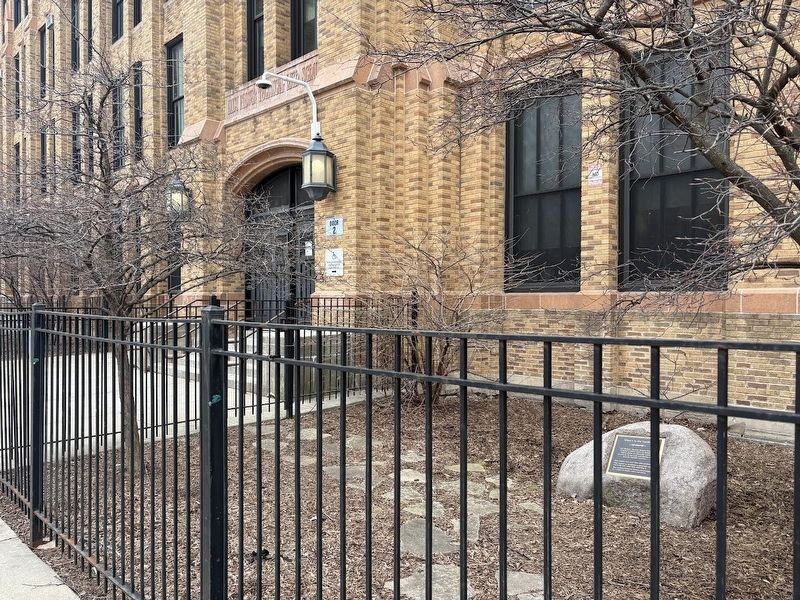

Photographed by Sean P. Flynn, February 28, 2026
3. Former home of Lucy Flower Technical High School
The building was erected in 1927 to house the Lucy Flower Technical High School for Girls, which had originally opened in 1911 and was named after a children's rights advocate. The school became coed in 1978 and closed in 2004. Today it is the home of a high school called Al Raby School for Community & Environment.
Credits. This page was last revised on February 28, 2026. It was originally submitted on February 28, 2026, by Sean P. Flynn of Oak Park, Illinois. This page has been viewed 42 times since then. Photos: 1, 2, 3. submitted on February 28, 2026, by Sean P. Flynn of Oak Park, Illinois.
