Clarendon in Arlington in Arlington County, Virginia — The American South (Mid-Atlantic)
Little Saigon
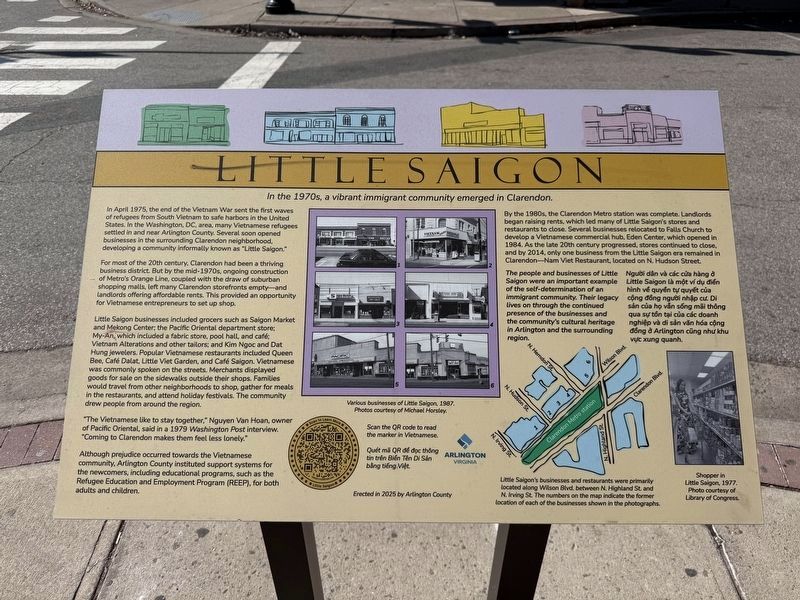

In April 1975, the end of the Vietnam War sent the first waves of refugees from South Vietnam to safe harbors in the United States. In the Washington, DC, area, many Vietnamese refugees settled in and near Arlington County. Several soon opened businesses in the surrounding Clarendon neighborhood, developing a community informally known as "Little Saigon."
For most of the 20th century, Clarendon had been a thriving business district. But by the mid-1970s, ongoing construction of Metro's Orange Line, coupled with the draw of suburban shopping malls, left many Clarendon storefronts empty—and landlords offering affordable rents. This provided an opportunity for Vietnamese entrepreneurs to set up shop.
Little Saigon businesses included grocers such as Saigon Market and Mekong Center; the Pacific Oriental department store; My-An, which included a fabric store, pool hall, and café; Vietnam Alterations and other tailors; and Kim Ngoc and Dat Hung jewelers. Popular Vietnamese restaurants included Queen Bee, Café Dalat, Little Viet Garden, and Café
this page online
"The Vietnamese like to stay together," Nguyen Van Hoan, owner of Pacific Oriental, said in a 1979 Washington Post interview. "Coming to Clarendon makes them feel less lonely."
Although prejudice occurred towards the Vietnamese community, Arlington county instituted support systems for the newcomers, including educational programs, such as the Refugee Education and Employment Program (REEP0, for both adults and children.
By the 1980s, the Clarendon Metro station was complete. Landlords began raising rents, which led many of Little Saigon's stores and restaurants to close. Several businesses relocated to Falls Church to develop a Vietnamese commercial hub, Eden Center, which opened in 1984. As the late 20th century progressed, stores continued to close, and by 2014, only one business from the Little Saigon era remained in Clarendon—Nam
The people and businesses of Little Saigon were an important example of the self-determination of an immigrant community. Their legacy lives on through the continued presence of the businesses and the community's cultural heritage in Arlington and the surrounding region.
Various businesses of Little Saigon, 1987. Photos courtesy of Michael Horsley.
Little Saigon's businesses and restaurants were primarily located along Wilson Blvd. between N. Highland St. and N. Irving St. The nubmers on the map indicate the former location of each of the businesses shown in the photographs.
Shopper in Little Saigon, 1977. Photo courtesy of Library of Congress.
Erected 2025 by Arlington County, Virginia.
Topics. This historical marker is listed in these topic lists: Asian Americans • Immigration • Industry & Commerce • Railroads & Streetcars. A significant historical month for this entry is April 1975.
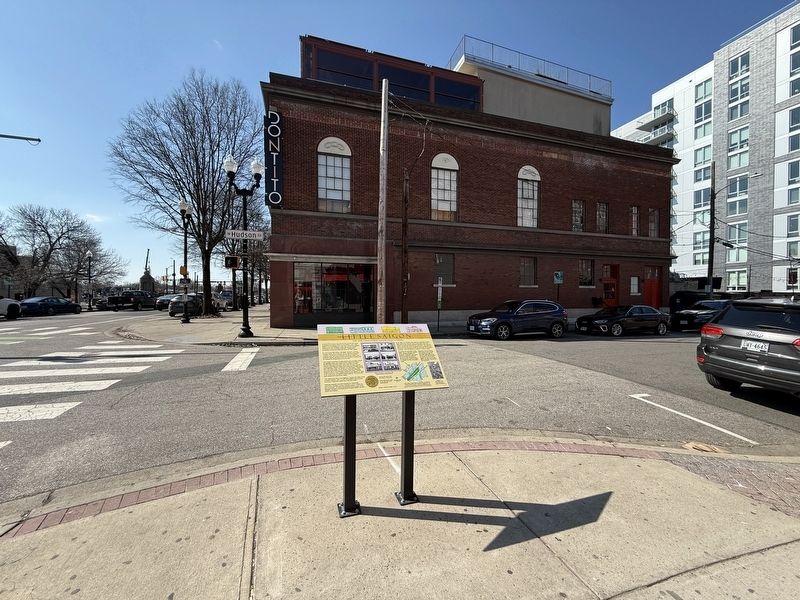
Location. 38° 53.206′ N, 77° 5.77′ W. Marker is in Arlington, Virginia, in Arlington County. It is in Clarendon. It is at the intersection of North Hudson Street and Wilson Boulevard, on the right when traveling north on North Hudson Street. Touch for map. Marker is at or near this postal address: 3141 Wilson Boulevard, Arlington VA 22201, United States of America. Touch for directions.

Regionally, this marker is in the Washington Metropolitan Area and in Northern Virginia. It is also in the American South, specifically in the Upper South, in the Mid-Atlantic, and on the Eastern Seaboard. Globally, it is in the North Atlantic Region, North America, the Western Hemisphere, the Western World, and the Anglosphere. Historically, it finds itself in what was once the territory of the Mississippian Culture, one of the original Thirteen Colonies, one of the Confederate States of America, and the Antebellum South.
Other nearby markers. At least 8 other markers are within walking distance of this marker: World War I (within shouting distance of this marker); Global War on Terror (within shouting distance of this marker); Vietnam War (within shouting distance of this marker); World War II (within shouting distance of this marker); Korean War (within shouting distance of this marker); American Legion Memorial of Arlington (within shouting distance of this marker); Arlington County War Memorial (within shouting distance of this marker); Arlington Post Office (about 400 feet away, measured in a direct line). Touch for a list and map of all markers in Arlington.
Credits. This page was last revised on March 1, 2026. It was originally submitted on March 1, 2026, by Devry Becker Jones of Washington, District of Columbia. This page has been viewed 62 times since then. Photos: 1, 2. submitted on March 1, 2026, by Devry Becker Jones of Washington, District of Columbia.
