Logan Circle in Northwest Washington in Washington, District of Columbia — The American Northeast (Mid-Atlantic)
Major General George H. Thomas
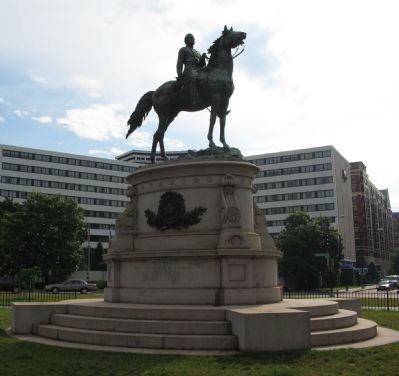
Photographed by Craig Swain, June 4, 2008
1. Major General George H. Thomas Memorial
(Right):
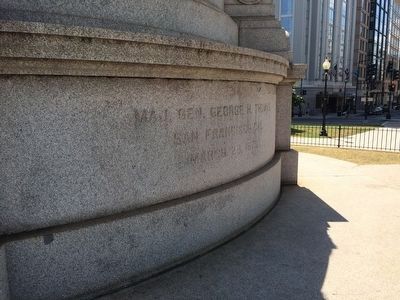
San Francisco, Cal.
March 28, 1870
(Left):
of the Society of
The Army of the Cumberland
Erected 1878 by Society of the Army of the Cumberland.
Topics. This historical marker is listed in this topic list: War, US Civil. A significant historical month for this entry is March 1882.
Location. 38° 54.339′ N, 77° 1.917′ W. Marker is in Northwest Washington in Washington, District of Columbia. It is in Logan Circle. It is at the intersection of 14th Street Northwest and Massachusetts Avenue Northwest, on the right when traveling north on 14th Street Northwest. Located in Thomas Circle Park. Touch for map. Marker is at or near this postal address: 1400 Massachusetts Avenue Northwest, Washington DC 20005, United States of America. Touch for directions.

Regionally, this marker is in the Washington Metropolitan Area. It is also in the American Northeast, in the Upper South, in the Mid-Atlantic, in the Tidewater, and in the Chesapeake Bay Region. Globally, it is in North America, the Western Hemisphere, the Western World, and the Anglosphere.
Other nearby markers. At least
this page online
Another marker is no longer nearby. Linotype Model 31 (was approx. 0.2 miles away but has been permanently removed).
Related marker. Click here for another marker that is related to this marker. To better understand the relationship, study each marker in the order shown.
Also see . . .
1. Major General George H. Thomas Memorial. SIRIS entry for the memorial. As with the nearby McPherson Memorial, the Thomas Memorial is said to be cast from the metal of captured Confederate cannon. The statue was criticized for
Photographed by J. Makali Bruton, September 7, 2015
2. Major General George H. Thomas Marker
Close-up of the monument's text.
2. Army of the Cumberland. Wikipedia entry (Submitted on January 6, 2026, by Larry Gertner of New York, New York.)
Additional commentary.
1. George Thomas: Virginian for the Union .
"George Thomas was one of the Civil War's most prominent Southern Unionists, known for his heroic leadership at Mill Springs, Chickamauga, and Nashville. A slave owner before the war, he commanded African American soldiers at the Battle of Nashville and the experience transformed him into a stalwart defender of Civil Rights. During Reconstruction, he led the fight against the Ku Klux Klan as the commander of U.S. army troops in Kentucky and Tennessee."
[Abstract re: George Thomas, Virginian for the Union by Christopher J. Einolf. Norman: University of Oklahoma Press, 2007.]
— Submitted August 15, 2009, by Richard E. Miller of Oxon Hill, Maryland.
Additional keywords. George Henry Thomas; "Rock of Chickamauga"; "The Sledge of Nashville"; John Quincy Adams Ward, sculptor; Reconstruction.
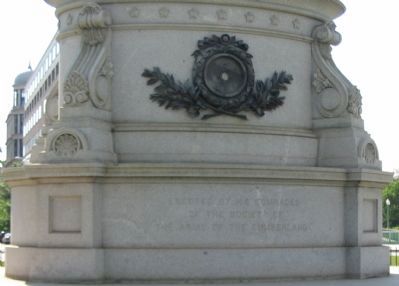
Photographed by Craig Swain, May 22, 2008
3. Left Side Inscription
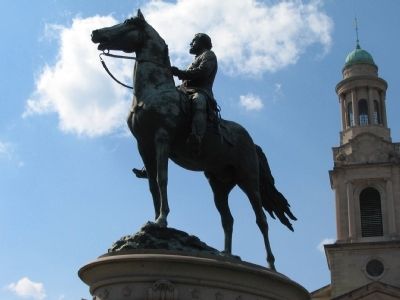
Photographed by Craig Swain, May 22, 2008
4. Equestrian Statue of General Thomas
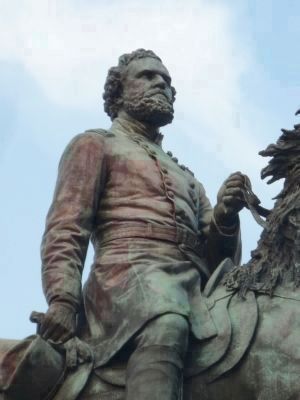
Photographed by Richard E. Miller, August 17, 2009
5. Maj. Gen. George H. Thomas (1816 - 1870)
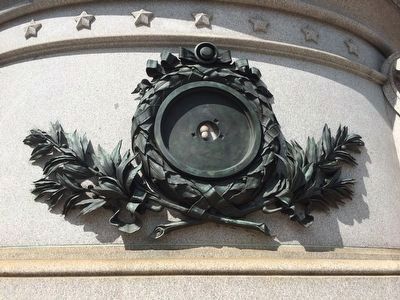
Photographed by J. Makali Bruton, September 7, 2015
6. Major General George H. Thomas Marker
This view shows how the center part of the metal decoration has been removed from the monument. Comparing it to the decoration on the opposite side, it probably was of an acorn (symbol of the Army of the Cumberland) over a five-pointed star. Interestingly, a stone acorn can also be seen on the monument underneath the metal decoration.
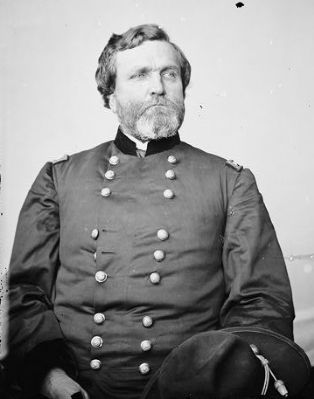
7. Major General George H. Thomas
Thomas was a loyal Southerner who fought for the Union during the Civil War. While occasionally surrounded by controversy, he was a stable and deliberate commander. He is well known for his stand on the closing stages of the Battle of Chickamauga. Later he soundly defeated a Confederate force in the battle of Nashville.
(Photo Source: Civil War photographs, 1861-1865 / compiled by Hirst D. Milhollen and Donald H. Mugridge, Washington, D.C. : Library of Congress, 1977. No. 0995)
Click for more information.
(Photo Source: Civil War photographs, 1861-1865 / compiled by Hirst D. Milhollen and Donald H. Mugridge, Washington, D.C. : Library of Congress, 1977. No. 0995)
Click for more information.
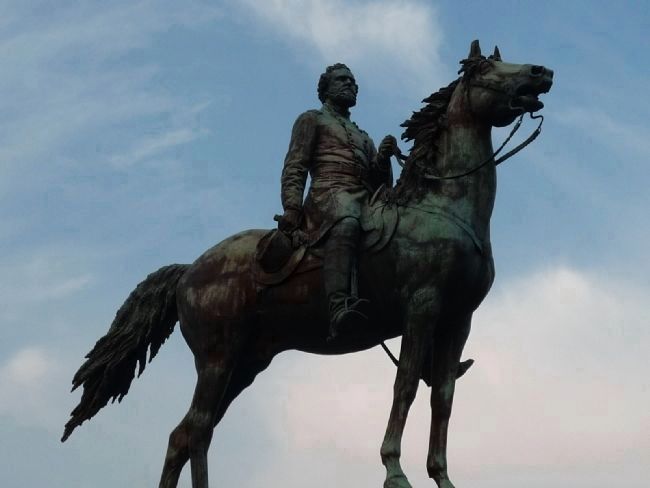
Photographed by Richard E. Miller, August 17, 2009
8. Maj. Gen. George H. Thomas
"J. Q. A. Ward./Sculp. 1879." (Base front)
Credits. This page was last revised on January 6, 2026. It was originally submitted on April 1, 2009, by Craig Swain of Leesburg, Virginia. This page has been viewed 2,893 times since then and 83 times this year. Last updated on April 3, 2010, by Richard E. Miller of Oxon Hill, Maryland. Photos: 1. submitted on April 1, 2009, by Craig Swain of Leesburg, Virginia. 2. submitted on September 21, 2015, by J. Makali Bruton of Washington, District of Columbia. 3, 4. submitted on April 1, 2009, by Craig Swain of Leesburg, Virginia. 5. submitted on April 4, 2010, by Richard E. Miller of Oxon Hill, Maryland. 6. submitted on September 21, 2015, by J. Makali Bruton of Washington, District of Columbia. 7. submitted on April 1, 2009, by Craig Swain of Leesburg, Virginia. 8. submitted on April 4, 2010, by Richard E. Miller of Oxon Hill, Maryland.
