Central Business District in Mobile in Mobile County, Alabama — The American South (East South Central)
Bienville Square
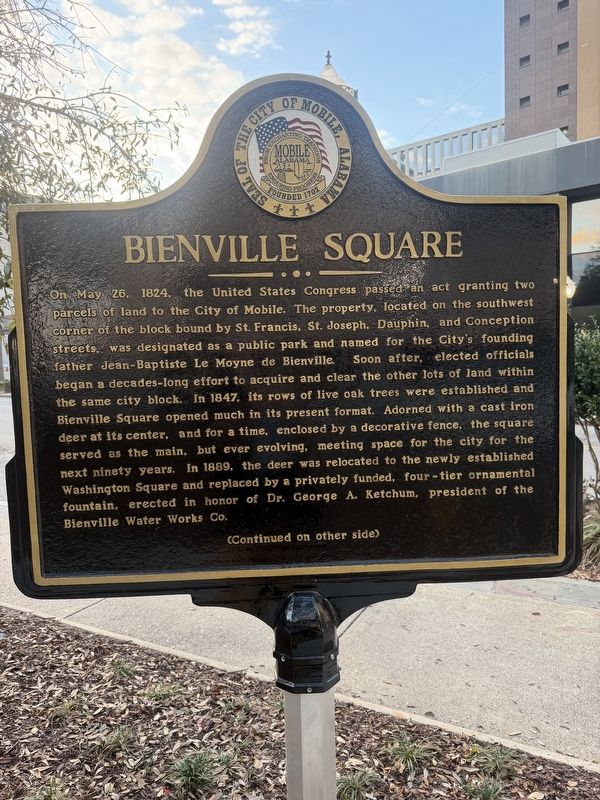
Photographed by Billy Clemmons, March 3, 2026
1. Bienville Square Marker
On May 26, 1824, the United States Congress passed an act granting two parcels of land to the City of Mobile. The property, located on the southwest corner of the block bound by St. Francis, St. Joseph, Dauphin, and Conception streets, was designated as a public park and named for the City's founding father Jean-Baptiste Le Moyne de Bienville. Soon after, elected officials began a decades-long effort to acquire and clear the other lots of land within the same city block. In 1847, its rows of live oak trees were established and Bienville Square opened much in its present format. Adorned with a cast iron deer at its center, and for a time, enclosed by a decorative fence, the square served as the main, but ever evolving, meeting space for the city for the next ninety years. In 1889, the deer was relocated to the newly established Washington Square and replaced by a privately funded, four-tier ornamental fountain, erected in honor of Dr. George A. Ketchum, president of the Bienville Water Works Co.
Reverse Side
During the 20th century, Bienville Square served as a backdrop to many of the city's major events, including
this page online
Erected by City of Mobile.
Topics. This historical marker is listed in this topic list: Parks & Recreational Areas. A significant historical date for this entry is May 26, 1824.
Location. 30° 41.564′ N, 88° 2.538′ W. Marker is in Mobile, Alabama, in Mobile

Photographed by Billy Clemmons, March 3, 2026
2. Bienville Square Marker - Reverse Side

Regionally, this marker is on Alabama’s Gulf Coast and in the Mobile Bay area. It is also in the American South, specifically in the Deep South, and on the Gulf Coast. Globally, it is in North America, a Gulf of Mexico state, the Western Hemisphere, the Western World, and the Anglosphere. Historically, it finds itself in what was once New Spain, the Viceroyalty of New France, the territory of the Mississippian Culture, one of the Confederate States of America, and the Antebellum South.
Other nearby markers. At least 8 other markers are within walking distance of this marker: Merchants National Bank Building (within shouting distance of this marker); John Forbes & Co. (within shouting distance of this marker); Pierre Le Moyne d'Iberville (about 300 feet away, measured in a direct line); In Memory of the Battle of Mobile Bay (about 300 feet away); The Salvation Army in Mobile (about 300 feet away); To Jean Baptiste LeMoyne (about 400 feet away); a different marker also named Joe Cain (about 400 feet away); Site of Sixth Mobile Theatre (about 500 feet away). Touch for a list and map of all markers in Mobile.
Another marker is no longer nearby. Joe Cain (was about 400 feet away but has been permanently removed).
Credits. This page was last revised on March 5, 2026. It was originally submitted on March 4, 2026, by Billy Clemmons of Florence, Alabama. This page has been viewed 61 times since then. Photos: 1, 2. submitted on March 4, 2026, by Billy Clemmons of Florence, Alabama. • James Hulse was the editor who published this page.
Editor’s want-list for this marker. A wide view photo of the marker and the surrounding area together in context. • Can you help?
