Deco District in Tulsa in Tulsa County, Oklahoma — The American South (West South Central)
Tulsa
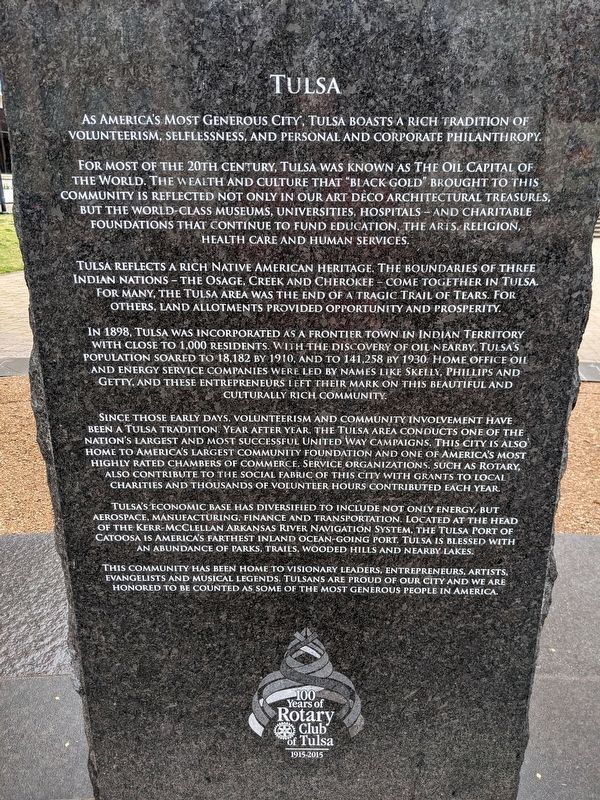
Photographed by Sean C Bath, March 30, 2023
1. Tulsa Marker
As America's Most Generous City, Tulsa boasts a rich tradition of volunteerism, selflessness, and personal and corporate philanthropy.
For most of the 20th century, Tulsa was known as The Oil Capital of the World. The wealth and culture that "black gold" brought to this community is reflected not only in our art deco architectural treasures, but the world-class museums, universities, hospitals - and charitable foundations that continue to fund education, the arts, religion, health care and human services.
Tulsa reflects a rich Native American heritage. The boundaries of three Indian Nations - The Osage, Creek, and Cherokee - come together in Tulsa. For many, the Tulsa area was the end of a tragic Trail of Tears. For others, land allotments provided opportunity and prosperity.
In 1898, Tulsa was incorporated as a frontier town in Indian Territory with close to 1,000 residents. With the discovery of oil nearby, Tulsa's population soared to 18,182 by 1910, and to 141,258 by 1930. Home office oil and energy service companies were led by names like Skelly, Phillips and Getty, and these entrepreneurs left their mark
this page online
Since those early days, volunteerism and community involvement have been a Tulsa tradition. Year after year, the Tulsa area conducts one of the nation's largest and most successful United Way campaigns. This city is also home to America's largest community foundation and one of America's most highly rated chambers of commerce. Service organizations, such as Rotary, also contribute to the social fabric of this city with grants to local charities and thousands of volunteer hours contributed each year.
Tulsa's economic base has diversified to include not only energy, but aerospace, manufacturing, finance and transportation. Located at the head of the Kerr-McClellan Arkansas River Navigation System, the Tulsa Port of Catoosa is America's farthest inland ocean-going port. Tulsa is blessed with an abundance of parks, trails, wooded hills and nearby lakes.
This community has been home to visionary leaders, entrepreneurs, artists, evangelists and musical legends. Tulsans are proud of our city and we are honored to be counted as some of the most generous people in America.
Erected by Rotary Club of Tulsa.
Topics and series. This historical marker is listed in these topic lists: Charity & Public Work • Indigenous Peoples and Communities • Industry & Commerce • Settlements & Settlers. In addition, it is included in the Rotary International series list. A significant historical year for this entry is 1898.
Location. 36° 9.237′ N, 95° 59.424′ W. Marker is in Tulsa, Oklahoma, in Tulsa County. It is in the Deco District. It is on East 3rd Street west of South Boston Street, on the right when traveling west. Touch for map. Marker is at or near this postal address: 61 East 3rd Street, Tulsa OK 74103, United States of America. Touch for directions.

Regionally, this marker is in the Muscogee Nation, specifically in the Cherokee Nation, and in Northeast Oklahoma—Green Country. It is also in the American South, specifically on the prairies, and on the Southern Plains. Globally, it is in North America, the Western Hemisphere, the Western World, and the Anglosphere. Historically, it finds itself in what was once the territory of the Mississippian Culture and also the Louisiana Purchase.
Other nearby markers. At least 8 other markers are within walking distance of this marker: The Mid-Continent Building (about 600 feet away, measured in a direct line); Tulsa Municipal Building (about 600 feet away); In Memoriam (about 700 feet away); Tulsey Town Overpass (about 800 feet away); Warner Brothers Marker (about 800 feet away); The J.M. & H.C. Hall Mercantile Company (about 800 feet away); The Mayo Building (approx. 0.2 miles away); Philtower Building (approx. 0.2 miles away). Touch for a list and map of all markers in Tulsa.
Credits. This page was last revised on March 6, 2026. It was originally submitted on August 1, 2023, by Sean C Bath of Silver Spring, Maryland. This page has been viewed 516 times since then and 286 times this year. Last updated on March 5, 2026, by Tatiana Zavala of Orange County, California. Photo 1. submitted on August 1, 2023, by Sean C Bath of Silver Spring, Maryland. • Devry Becker Jones was the editor who published this page.
Editor’s want-list for this marker. A wide shot of the marker in context. • • Can you help?
