Near Iroquois in Iroquois County, Illinois — The American Midwest (Great Lakes)
Prairie Dell Meeting House

Photographed by Daniel Barriball, March 25, 2025
1. Prairie Dell Meetinghouse Marker
2005
Illinois
Landmarks
Preservation
Site
Erected 2005.
Topics. This historical marker is listed in these topic lists: Architecture • Cemeteries & Burial Sites • Religion & Religious Structures. A significant historical year for this entry is 1870.
Location. 40° 49.562′ N, 87° 38.666′ W. Marker is near Iroquois, Illinois, in Iroquois County. It is on 2150 North Road (Local Road 31) west of North 2550 East Road, on the right when traveling west. There is neither street parking nor a parking lot. The only place to park is on the gravel roads that go through the cemetery. Touch for map. Marker is at or near this postal address: 2548 2150 North Rd, Watseka IL 60970, United States of America. Touch for directions.

Regionally, this marker is in Central Illinois. It is also in the American Midwest and in the Corn Belt. Globally, it is in North America, the Western Hemisphere, the Western World, and the Anglosphere. Historically, it finds itself in what was once the territory of the Mississippian Culture and also the Northwest Territory.
Other nearby markers. At
this page online
Another marker is no longer nearby. State Line Survey (was approx. 7.3 miles away in Indiana but has been confirmed missing).
Regarding Prairie Dell Meeting House. From the National Register of Historic Places form's Statement of Significance:
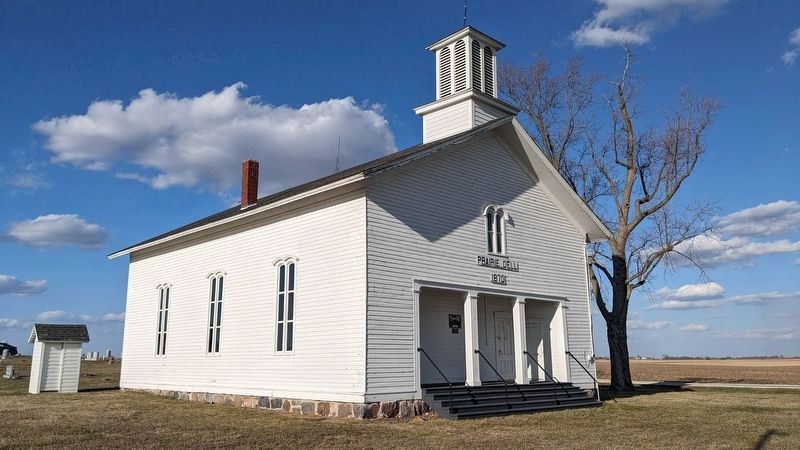
Prairie Dell Meetinghouse is a good vernacular example of a rural religious building built in the 1870s, having qualities of varying styles of architecture, including Greek Revival and Italianate characteristics...The church was constructed in 1870. Local farmers set up a sawmill

Photographed by Daniel Barriball, March 25, 2025
2. Prairie Dell Meeting House Marker in context
The marker is in the middle between the columns and doors.
Also see . . . National Register of Historic Places Nomination Form. Illinois Historic and Architectural Resources Geographic Information System (HARGIS) The form contains copious information on the architecture of Prairie Dell Meeting House and its class of structures, as well as a history of the church, its various congregations, and the surrounding cemetery.
Two of the founders of the Prairie Dell Meetinghouse were Quakers who had moved into the neighborhood in 1856, and their influence has remained. They(Submitted on March 5, 2026, by Daniel Barriball of Chesterton, Indiana.)considered it a community church, non-denominational, and essentially in its years of use the concept was carried out...A certain freedom of discussion remained a hallmark of all events there...The really remarkable predominance of independent thinkers who came to worship was exemplified in the early 1900s by a very charismatic woman preacher...She was the second woman to be ordained in Illinois and was considered a very powerful preacher. Even with a one-week old baby, she drove her buggy to Prairie Dell.Photographed by Daniel Barriball, March 25, 20253. Prairie Dell Meeting HouseThe small building to the left is one of the privies built at the same time as the meeting house.
Photographed by Daniel Barriball, March 25, 2025
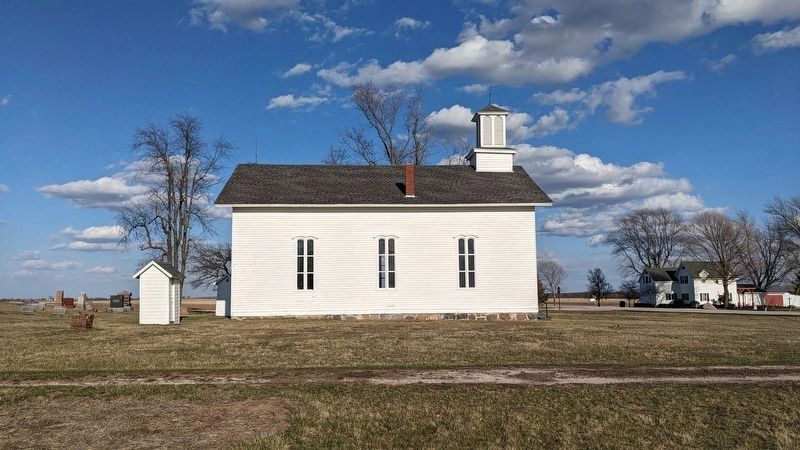
4. Prairie Dell Meeting House west side
Both privies are visible in this photo to the left of the meeting house. The one farther back is partly obscured.
Credits. This page was last revised on March 6, 2026. It was originally submitted on March 5, 2026, by Daniel Barriball of Chesterton, Indiana. This page has been viewed 71 times since then. Photos: 1, 2, 3, 4. submitted on March 5, 2026, by Daniel Barriball of Chesterton, Indiana. • Devry Becker Jones was the editor who published this page.
