
Fort Lewis College
Charles Dale Rea
| — | President 1949 to 1962 | — |

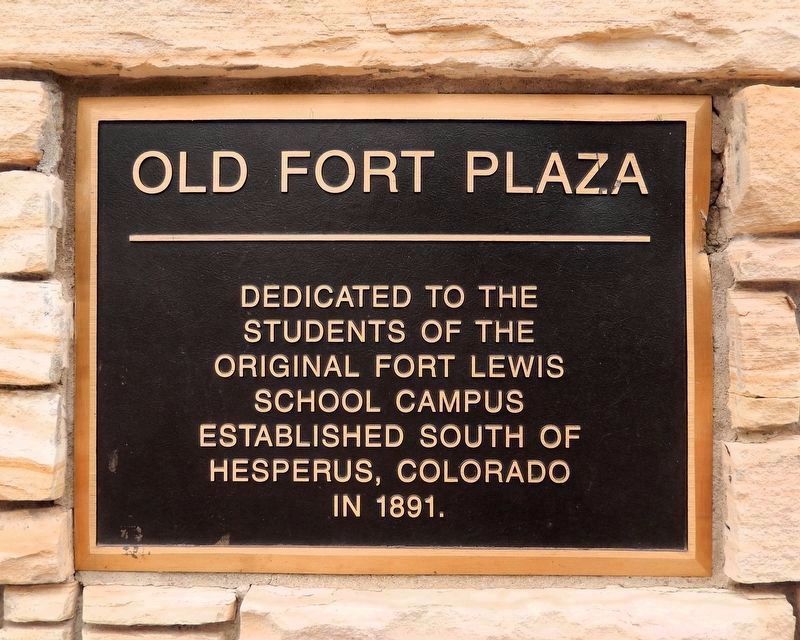
Originated on the site of a U. S. Cavalry post established in 1880 at Hesperus. From 1891 until 1956 the old fort was operated as an Indian School, a vocational high school and a junior college.
The first president of the college was Charles Dale Rea. It was chiefly through his aggressive leadership that the college was reconstructed here in 1956.
In 1962 it became a Liberal Arts college operating on a trimester program and offering work leading to the Bachelor of Arts and Bachelor of Science degrees.
Erected 2001.
Topics. This historical marker is listed in these topic lists: Education • Forts and Castles • Indigenous Peoples and Communities. A significant historical year for this entry is 1891.
Location. 37° 16.559′ N, 107° 52.117′ W. Marker is in Durango, Colorado, in La Plata County. It can be reached from the intersection of Rim Drive and East 8th Avenue. The marker is beside the clock tower near the center of Fort Lewis College campus. Touch for map. Marker is at or near this postal address: 1000 Rim Drive, Durango CO 81301, United States of America. Touch for directions.

Regionally, this marker is in
this page online
Other nearby markers. At least 8 other markers are within walking distance of this marker: Southern Durango with views of Smelter Mountain (approx. ¼ mile away); The Iron Horse (approx. half a mile away); Fassbinder's Legacy (approx. half a mile away); Main Avenue Bridge, circa 1908 (approx. 0.6 miles away); Old Durango Courthouse circa 1892 (approx. 0.6 miles away); A Pleasant Summer Afternoon, circa 1885 (approx. 0.6 miles away); Old Main Post Office Professional Building (approx. 0.6 miles away); Early Durango circa 1889 (approx. 0.6 miles away). Touch for a list and map of all markers in Durango.
Also see . . .
1. Fort Lewis College (Wikipedia).
Excerpt: The first Fort Lewis army post was constructed in Pagosa Springs, Colorado, in 1878, and was relocated in 1880 to Hesperus, Colorado, on the southern slopes of the La Plata Mountains. In 1891, Fort Lewis was decommissioned and converted into a federal, off-reservation Indian boarding(Submitted on March 9, 2026, by Cosmos Mariner of Cape Canaveral, Florida.)school.Photographed by Cosmos Mariner, July 16, 20252. Fort Lewis College MarkerThe marker is mounted on the north wall of the Charles Dale Rea Memorial Clock Tower plaza.In 1911, the fort's property and buildings in Hesperus were transferred to the state of Colorado to establish an "agricultural and mechanic arts high school." That deed came with two conditions: that the land would be used for an educational institution, and "to be maintained as an institution of learning to which Indian students will be admitted free of tuition and on an equality with white students" in perpetuity. Both conditions have been the missions and guides for the Fort Lewis school's various incarnations over the past century.
The Fort Lewis high school expanded into a two-year college in the 1930s, and in 1948 it became Fort Lewis A&M College, under the State Board of Agriculture's control. The "Aggies" studying at the Fort Lewis Branch of the Colorado State College of Agriculture and Mechanics could take courses in agriculture, forestry, engineering, veterinary science, and home economics.
Fort Lewis College began another period of growth and changes in 1956, when the college moved from its longtime home in Hesperus to its present location, 18 miles east, atop what was then known as Reservoir Hill, overlooking Durango.
Here, FLC became a four-year institution, awarding its first baccalaureate degrees in 1964.Photographed by Cosmos Mariner, July 16, 20253. Charles Dale Rea Memorial PlaqueIt is mounted on the clock tower.


2. A small Durango college is trying to reckon with its dark legacy... (The Colorado Sun).
(by Tracy Ross, 5/5/2024) Excerpt: Fort Lewis College, which awards the most degrees to Native American students of any four-year college in the nation, was once a boarding school that used severe methods to “civilize” Indigenous children.(Submitted on March 9, 2026, by Cosmos Mariner of Cape Canaveral, Florida.)At Fort Lewis College in Durango, around 30% of students are Native American or Alaska Native. They come from more than 110 tribes and villages and receive free tuition based on a mandate created when the federal boarding school was transferred to the state with the agreement that it would become an educational institute that wouldn’t charge tuition for Native American students. Today, the school website says, “the college awards more degrees to Native American students than any other four-year, baccalaureate-granting institution in the nation — about 26% of all degrees awarded.”

Credits. This page was last revised on March 9, 2026. It was originally submitted on March 6, 2026, by Cosmos Mariner of Cape Canaveral, Florida. This page has been viewed 16 times since then. Photos: 1, 2, 3, 4, 5. submitted on March 9, 2026, by Cosmos Mariner of Cape Canaveral, Florida.
