Lansing in Leavenworth County, Kansas — The American Midwest (Upper Plains)
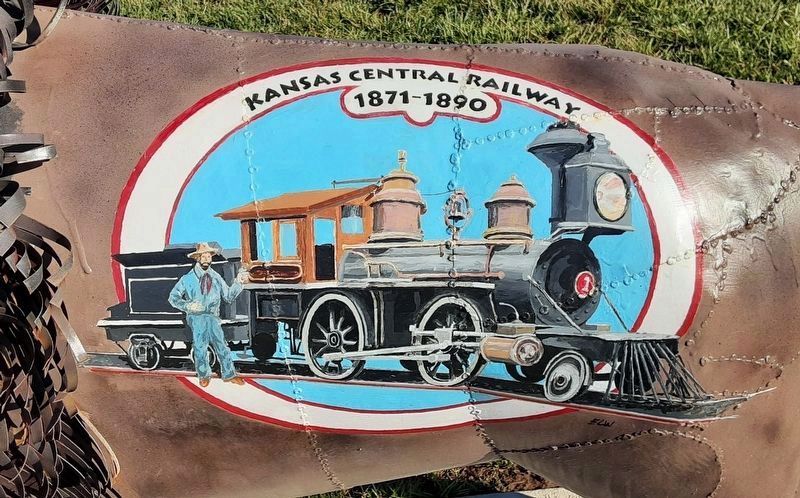
"Kansas Central Railway 1871-1890/Fallen Flags"
Spirit of the Buffalo Community Art & History Project
| — | Artist: Everett Ward, Leavenworth | — |
Photographed by William Fischer, Jr., March 8, 2026
1. "Kansas Central Railway 1871-1890" Marker Mural
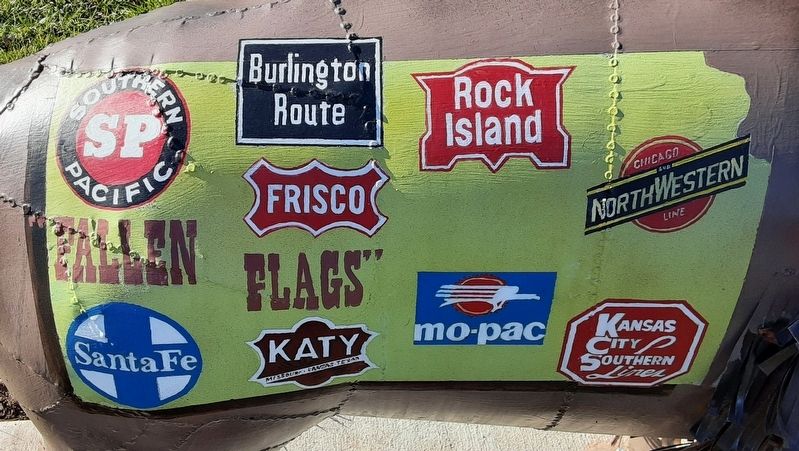
[Besides the KCR, other] "Fallen Flags"
Southern Pacific • Burlington Route • Rock Island
Chicago and NorthWestern Line • Frisco • Santa Fe
Katy • Mo-Pac • Kansas City Southern Lines
Erected by Leavenworth County Historical Society.
Topics. This historical marker is listed in these topic lists: Immigration • Industry & Commerce • Railroads & Streetcars • Settlements & Settlers. A significant historical month for this entry is June 1871.
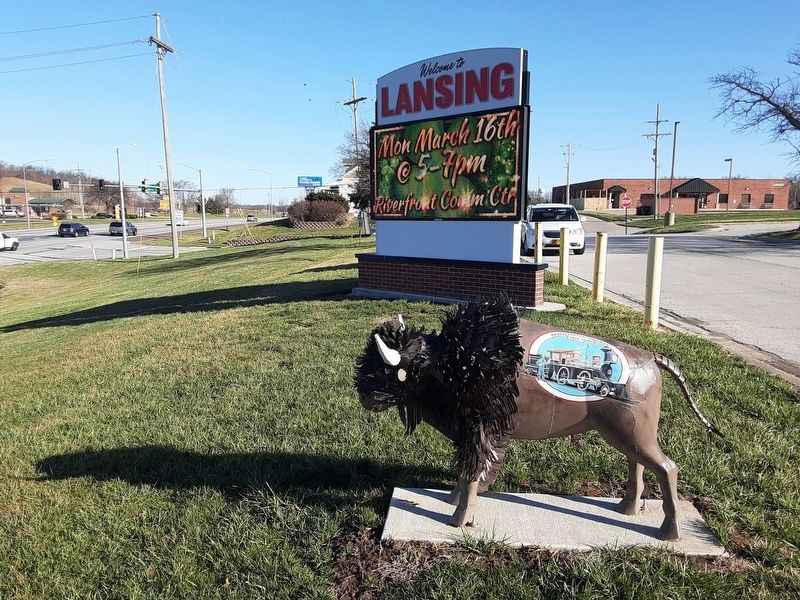
Location. 39° 14.245′ N, 94° 53.979′ W. Marker is in Lansing, Kansas, in Leavenworth County. It is at the intersection of Main Street (U.S. 73) and Lansing Lane, on the right when traveling north on Main Street. Bison is on the City Hall grounds. Touch for map. Marker is at or near this postal address: 800 1st Terrace, Lansing KS 66043, United States of America. Touch for directions.

Regionally, this marker is in Eastern Kansas and specifically in Greater Kansas City. It is also in the American Midwest, in the Lewis & Clark Corridor, in the Corn Belt, on the prairies, and on the Southern Plains. Globally, it is in North America, the Western Hemisphere, the Western
this page online
Other nearby markers. At least 8 other markers are within 3 miles of this marker, measured as the crow flies: Ft. Leavenworth - Ft. Scott Military Road (approx. 0.4 miles away); "Kansas Flag" (approx. 2.3 miles away); Daniel Read Anthony (approx. 2.4 miles away); Grand Army of the Republic/Woman's Relief Corps Memorial (approx. 2.4 miles away); Veterans Memorial (approx. 2.4 miles away); Fourth Marine Division (approx. 2.6 miles away); Thomas Brennan (approx. 2.7 miles away); Western Branch - National Home for Disabled Volunteer Soldiers (approx. 2.7 miles away). Touch for a list and map of all markers in Lansing.
Regarding "Kansas Central Railway 1871-1890/Fallen Flags". Excerpt from the LCHS Spirit of the Buffalo Project website:
The Leavenworth County Historical Society is proud to present the “Spirit of the Buffalo” Community Art and History Project in Leavenworth County. The outdoor exhibit focuses on connecting residents and visitors to the region's early history, with an emphasis on Kansas Plains Natives and their co-habitation
Photographed by William Fischer, Jr., March 8, 2026
2. "Fallen Flags" Marker
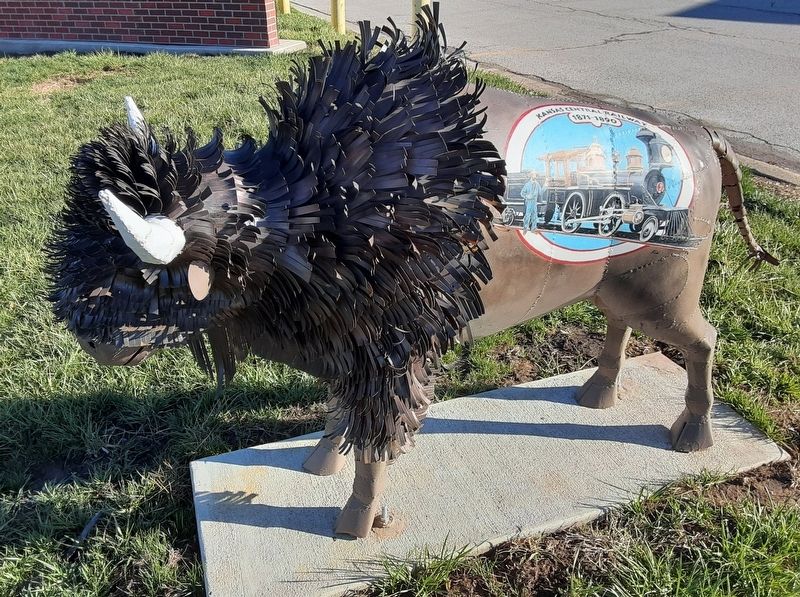
Kansas railroad history served as the inspiration for local artist Everett Ward's design of this hand-crafted metal buffalo sculpture.
When the Kansas Territory was organized in 1854, transportation for immigrants relied on water routes from St. Louis, followed by wagons, horses, or foot travel across roadless terrain. In 1855, the Kansas Territorial Legislature granted charters to five railroad companies. The Kansas Central Railroad, incorporated in June 1871, aimed to build a line from Leavenworth to Denver.
One side of the buffalo in the design features the first locomotive of the Kansas Central narrow-gauge line, named “The Leavenworth.” This locomotive could pull twenty passenger cars, carrying 400 people at 40 miles per hour. However, only 169 miles of track were laid. In 1890, the railroad converted to standard gauge and was sold under foreclosure to the Leavenworth, Kansas & Western Railroad, a subsidiary of the Atchison, Topeka and Santa Fe Railway (AT&SF). In May 1908, the Union Pacific Railroad Company acquired it.
The Kansas Central Railroad played a key role in Kansas’ economic development by supporting
Photographed by William Fischer, Jr., March 8, 2026
3. "Kansas Central Railway 1871-1890/Fallen Flags" Marker
On the other side of the buffalo, “Fallen Flags” commemorates railroads whose corporate identities have dissolved through mergers, bankruptcy, or liquidation. The Kansas Central Railroad, a “fallen flag,” is remembered for its historic role in shaping railroading in Kansas and the Midwest. Names and logos of other “fallen flags” remain iconic among rail enthusiasts and historians.
While the construction of railroads dramatically reshaped the American West by facilitating westward expansion and economic growth, deforestation and loss of habitat also occurred, along with the near extinction of the buffalo, which were vital to Native American communities.
Photographed by William Fischer, Jr., March 8, 2026
4. "Kansas Central Railway 1871-1890/Fallen Flags" Marker
Credits. This page was last revised on March 8, 2026. It was originally submitted on March 8, 2026, by William Fischer, Jr. of Reynoldsburg, Ohio. This page has been viewed 13 times since then. Photos: 1, 2, 3, 4. submitted on March 8, 2026, by William Fischer, Jr. of Reynoldsburg, Ohio.
