Columbia Heights in Arlington in Arlington County, Virginia — The American South (Mid-Atlantic)
The Artillery
Photographed by Evan Dwyer, January 17, 2026
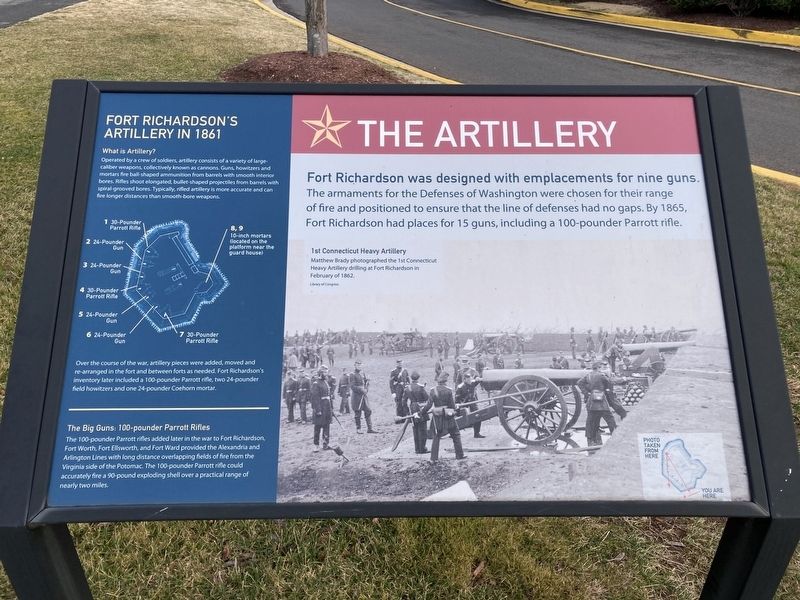
1. The Artillery Marker
Fort Richardson was designed with emplacements for nine guns. The armaments of the Defenses of Washington were chosen for their range of fire and positioned to ensure that the line of defenses had no gaps. By 1865, Fort Richardson had placed for 15 guns, including a 100-pounder Parrott Rifle.
Fort Richardson's Artillery in 1861
What is Artillery?
Operated by a crew of soldiers, artillery consists of a variety of large-caliber weapons, collectively known as cannons. Guns, howitzers and mortars fire ball-shaped ammunition from barrels with smooth interior bores. Rifles shoot elongated, bullet-shaped projectiles from barrels with spiral-grooved bores. Typically, rifled artillery is more accurate and can fire longer distances than smooth-bore weapons.
1 30-Pounder Parrott Rifle
2 24-Pounder Gun
3 24-Pounder Gun
4 30-Pounder Parrott Rifle
5 24-Pounder Gun
6 24-Pounder Gun
7 30-Pounder Parrott Rifle
8, 9 10-inch mortars (located on the platform near the guard house)
Over the course of the war, artillery pieces were added, moved and re-arranged in the fort and between forts as needed. Fort Richardson's inventory
this page online
The Big Guns: 100-Pounder Parrott Rifles
The 100-pounder Parrott rifles added later in the war to Fort Richardson, Fort Worth, Fort Ellsworth, and Fort Ward provided the Alexandria and Arlington Lines with long distance overlapping fields of fire from the Virginia side of the Potomac. The 100-pounder Parrott rifle could accurately fire a 90-pound exploding shell over a practical range of nearly two miles.
(caption) 1st Connecticut Heavy Artillery
Matthew Brady photographed the 1st Connecticut Heavy Artillery drilling at Fort Richardson in February of 1862. Library of Congress
Erected 2019 by Army Navy Country Club Foundation.
Topics. This historical marker is listed in these topic lists: Forts and Castles • War, US Civil. A significant historical year for this entry is 1865.
Location. 38° 51.453′ N, 77° 4.709′ W. Marker is in Arlington, Virginia, in Arlington County. It is in Columbia Heights. It is on Army Navy Country Club Access Road 0.4 miles east of South Edgewood Street, on the left. The marker is located

Photographed by Evan Dwyer, January 17, 2026
2. The Artillery Marker
Marker is one of four. It is shown at right.

Regionally, this marker is in the Washington Metropolitan Area and in Northern Virginia. It is also in the American South, specifically in the Upper South, in the Mid-Atlantic, and on the Eastern Seaboard. Globally, it is in the North Atlantic Region, North America, the Western Hemisphere, the Western World, and the Anglosphere. Historically, it finds itself in what was once the territory of the Mississippian Culture, one of the original Thirteen Colonies, one of the Confederate States of America, and the Antebellum South.
Other nearby markers. At least 8 other markers are within walking distance of this marker: The Soldiers (here, next to this marker); The Fort (here, next to this marker); Fort Richardson (here, next to this marker); a different marker also named Fort Richardson (within shouting distance of this marker); Our Lady Queen of Peace (approx. 0.3 miles away); Arlington Village (approx. 0.4 miles away); Selina Gray (approx.

Photographed by Evan Dwyer, January 17, 2026
3. Fort Richardson Relief
This relief model of the fort was installed in 2019 with the markers and shows eight guns mounted. It omits mortars on the eastern bastion.
More about this marker. Country Club access to the marker is limited to members, their guests, and registered attendees of club events.
Related markers. Click here for a list of markers that are related to this marker. These accompany this marker and combine to tell the reader the context of the fort.

Photographed by Evan Dwyer, January 17, 2026
4. Eastern Bastion
Where the walls of Fort Richardson are nearest to the access road is the most distinct of the two remaining gun positions on the southern fort fragment. This is the bastion that mounted the mortars.
Credits. This page was last revised on March 10, 2026. It was originally submitted on March 10, 2026, by Evan Dwyer of Richmond, Virginia. This page has been viewed 21 times since then. Photos: 1, 2, 3, 4. submitted on March 10, 2026, by Evan Dwyer of Richmond, Virginia. • Bernard Fisher was the editor who published this page.
